








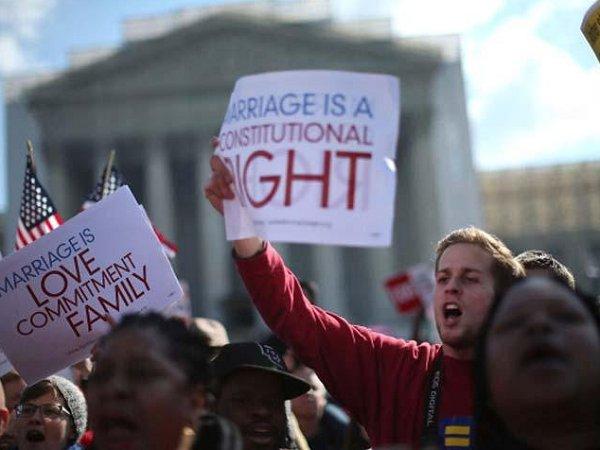
Because marriage rights are being considered at the Supreme Court on successive days, it’s tempting to think of this week as a sort of package deal, but there are two distinct cases being heard. Yesterday, of course, was a challenge to California’s Proposition 8, which in theory could lead to a ruling with sweeping consequences for marriage rights nationwide.
Today, it’s the Defense of Marriage Act, or DOMA, before the justices. More specifically, the high court will consider “whether married same-sex couples are entitled to federal benefits.”
The 1996 law defines marriage as the union of a man and a woman for purposes of more than 1,000 federal laws and programs, and it thus excludes married same-sex couples from benefits to which their opposite-sex counterparts are entitled. (Another part of the law, not before the court, says that states need not recognize same-sex marriages from other states.)
Nine states and the District of Columbia allow same-sex marriage, and about 18,000 same-sex couples married in California before voters there overturned a State Supreme Court decision that had established a right to such marriages.
If the United States Supreme Court strikes down the challenged part of the 1996 law, married same-sex couples in those places would start to receive federal benefits. But such a decision would not require any state that does not allow same-sex marriage to permit it.
Obviously, this matters a great deal to the families affected by DOMA, but this case, United States v. Windsor lacks the capacity to fundamentally alter the legal landscape on marriage the way the Prop 8 case does.
That’s not to say it’s unimportant. Indeed, this case involves Edith Windsor, who married her wife Thea Clara Spyer in Canada in 2007, but was widowed two years later when Spyer died in 2009. Windsor, naturally, inherited her spouse’s property.
But because of DOMA, the Internal Revenue Service hit Windsor with an enormous tax bill. Opposite-sex married couples wouldn’t have to worry about this penalty after one spouse dies, but under the Defense of Marriage Act, the IRS has no choice.
Two federal appeals courts have said DOMA is unconstitutional.
The justices have a few options on how to deal with the case, and Sahil Kapur sketched out the possible outcomes. First, the Court could uphold DOMA by determining that the federal government has a legitimate interest in treating straight and gay couples differently. This would continue the status quo unless and until Congress repeals the law. Second, the Court could strike down DOMA upon deciding that married same-sex couples are entitled to the same treatment as married opposite-sex couples. That would provide tax and retirement benefits to gay and lesbian couples and let Americans sponsor a gay partner from another country for legal permanent residency. Third, the Court could conclude that the case lacks standing and send it back to the lower courts for a do-over. The case is unique in that the White House has refused to defend a federal law, leaving the task to House Republicans. If a majority of justices decide that the House majority is not a proper party to defend this, the Court could punt the decision. When arguments begin in a couple of hours, attention will once again focus on Justice Anthony Kennedy, who will likely be the swing vote. A decision isn’t expected until June.
The place for in-depth analysis, commentary and informed perspectives. Recommended


