








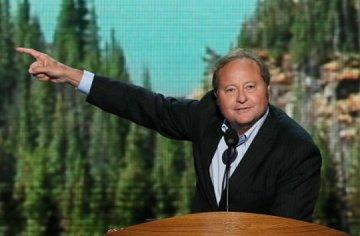
After Sen. Max Baucus (D-Mont.) announced his retirement, former Gov. Brian Schweitzer (D) made one thing clear: he was interested in the race. Indeed, the scuttlebutt suggested Schweitzer was even considering a primary campaign against Baucus if he didn’t retire. After statewide polls showed him running strong, the announcement from the former governor seemed to be a matter of when, not if.
It made the news over the weekend that much more surprising.
Brian Schweitzer, the former governor of Montana, announced Saturday that he would not run for the state’s open Senate seat in 2014, a decision that further impedes Democratic efforts to retain their majority in the midterm elections. […]
In an interview with The Associated Press, Mr. Schweitzer, 57, said that while he had considered a race, “people need to know I am not running for the United States Senate.” He said that he did not want to leave Montana for Washington.
There are a few angles to the story. The first is what caused Schweitzer to change direction unexpectedly. A “source familiar with his decision” said the former governor “was beginning to recognize what senior Democrats in Washington had feared” — that Republicans had a thick opposition-research file on him and Schweitzer wasn’t necessarily pleased with what they’d found.
National Journal added that “the amount of opposition research on the former governor painted a grim picture. A report in the Great Falls Tribune tomorrow will outline Schweitzer’s ties with a dark money organization, which may have been deeper than Schweitzer had let on.”
The second is what this is likely to mean for the Senate after the 2014 midterms.
Nate Cohn had a good piece on this, calling Schweitzer’s announce “a huge break” for Republicans, adding it’s “perhaps the biggest Senate news of 2013.”
With the GOP’s odds suddenly looking much better in Big Sky Country, their road to 51 seats in the Senate is looking much clearer. Republicans will need to pick-up six seats to make Mitch McConnell the Senate Majority Leader, as Democrats will hold 55 Senate seats after Cory Booker wins in October and Vice President Biden would cast a tie-breaking vote in a divided chamber. Republicans start with easy pick-up opportunities in South Dakota and West Virginia, two open seats on GOP friendly turf where Republicans have strong candidates and Democrats do not. From there, things get more difficult. Until today, Democrats seemed better positioned in three open races in Michigan, Iowa, or Montana. So Republicans were looking at the possibility of needing to sweep four Democratic incumbents in red states: Mary Landrieu in Louisiana, Mark Pryor in Arkansas, Mark Begich of Alaska, and Kay Hagan of North Carolina. With Montana looking more like a GOP pickup, Republicans would need three of those four instead of a sweep. That’s not an easy needle to thread, exactly, but Republicans seemed more optimistic after Schweitzer’s news than before it. Of course, it’s probably worth mentioning that at this point in 2011, it was widely assumed that Senate Republicans would make significant gains in the 2012 cycle, and they even had a credible shot at reclaiming the majority. And yet, when voters actually went to the polls, the opposite happened — Democrats gained seats and expanded their majority. In other words, the speculation is interesting at this point, but neither side of the aisle should get too excited. (How this may play into the possibility of the “nuclear option” is anybody’s guess.) And finally, let’s also keep in mind that Schweitzer was seen as the strongest Democratic candidate in Montana, but the bench is not empty. Monica Lindeen, the state Insurance Commissioner, is reportedly interested, and Denise Juneau, the state Schools Superintendent, has also demonstrated statewide appeal.
The place for in-depth analysis, commentary and informed perspectives. Recommended


