








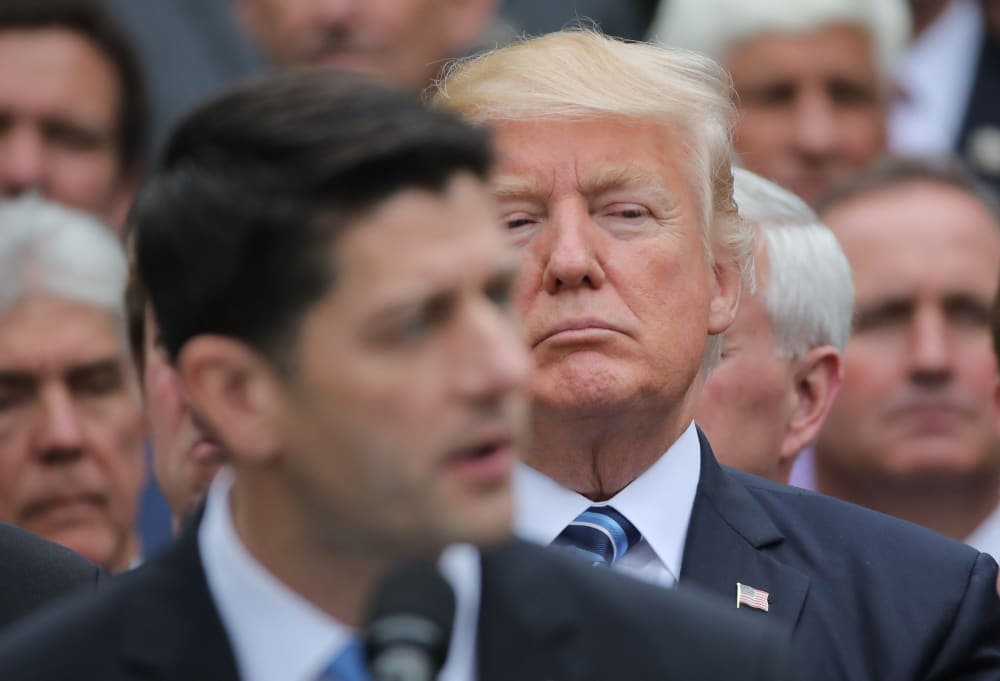
Last week, House Speaker Paul Ryan (R-Wis.) made clear he disagrees with Donald Trump’s trade tariffs, but the Republican lawmaker said the GOP-led Congress wouldn’t even try to approve a different policy.
The Atlantic‘s Ron Brownstein noted that the House Speaker’s posture made clear that there’s nothing House Republican lawmakers intend to do to constrain the White House. “Ryan is sending an unmistakable message to voters who want any check on Trump: ‘Don’t look to us.’” Brownstein wrote.

As much of the political world comes to terms with Trump’s support for Russian President Vladimir Putin, we’re confronted with a nearly identical dynamic this week. Paul Ryan made clear yesterday he disagrees with the American president on Russia, but the congressman again suggested those looking for accountability should look elsewhere.
After endorsing the findings of U.S. intelligence agencies, and saying “there should be no doubt” about Russia’s interference in American elections, Ryan had this exchange with a Capitol Hill reporter:
Q: What could you do? I mean, you guys are a co-equal branch of government. What could you do to make sure that [Trump] doesn’t do something…
RYAN: Here’s what we have already done and here’s what we could continue to do, which is to put sanctions on Russia. You just saw the indictments from the special counsel. Those GRU officers — I’ve already seen the intelligence — they were the people that — that conducted this cyber attack on our elections. We’d already put in place sanctions. If the Foreign Affairs Committee or the Financial Services Committee and the Senate Banking Committee think that there are other sanctions that we have not yet placed upon Russia, I’m more than happy to consider those.
And if the question were about steps Paul Ryan is prepared to take to constrain Russia, that might’ve been a more satisfactory answer. But the Speaker was asked about Trump.
And that was a question the Republican lawmaker seemed eager to dodge.
As Vox’s Zack Beauchamp added yesterday, “[This] isn’t a problem that can be solved by new sanctions. It would require passing legislation that puts limits on the president’s power to change US policy on a whole host of foreign policy issues (like Ukraine or Syria), or block Trump from firing special counsel Robert Mueller and ending the Russia collusion probe.”
Rachel noted on the show last night that when the United States faces a security crisis, Americans tend to look to the executive, but when the security crisis is the president, or at least about the president, Americans will look elsewhere for leadership, and they may very well turn to Congress. It’s hard not to get the impression that, as far as Paul Ryan is concerned, that would be a mistake. Indeed, the House Speaker warned at an event a couple of months ago that if Democrats gain any power in this year’s midterm elections, they’d conduct aggressive oversight of the Trump administration, as if that were an outcome voters should avoid. As we discussed yesterday, Quinnipiac released a poll two weeks ago that asked respondents, “Would you like to see Congress be a check on President Trump?” It found that 71% of Americans — including a narrow majority of Republican voters — said yes, Congress should be a check on the White House. It’s a message most GOP lawmakers apparently aren’t hearing.
Steve Benen is a producer for "The Rachel Maddow Show," the editor of MaddowBlog and an MS NOW political contributor. He's also the bestselling author of "Ministry of Truth: Democracy, Reality, and the Republicans' War on the Recent Past." Recommended


