








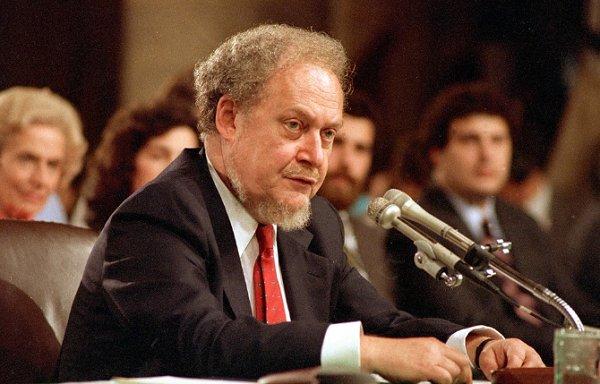
Robert Bork, a former solicitor general and failed U.S. Supreme Court nominee, died today at age 85. He leaves behind an important political legacy, which helped make him a legal icon for many on the far-right.
In 1987, Ronald Reagan nominated Bork to the high court, which in turn led to one of the fiercest nominating fights in American history. Indeed, less than an hour after Bork was introduced as Reagan’s choice, Sen. Ted Kennedy (D-Mass.) delivered a famous condemnation on the Senate floor: “Robert Bork’s America is a land in which women would be forced into back alley abortions, blacks would sit at segregated lunch counters, school children could not be taught about evolution, writers and artist could be censured at the whim of government.”
The indictment wasn’t especially hyperbolic. Bork had, after all, endorsed Jim Crow-era poll taxes, condemned portions of the Civil Rights Act banning discrimination in public accommodations, and argued against extending the equal protection of the 14th Amendment to women, among other things.
The nominating process that followed marked an important shift in American politics — senators decided it wasn’t enough to merely consider a Supreme Court nominee’s qualifications; they also had to consider whether he or she was ideologically and temperamentally suited for the bench. In Bork’s case, it was a test he failed, and 58 senators, including six Republicans, voted to reject his nomination.
For the left, the outcome is still remembered a victory for civil rights and modernity. For the right, it was the first modern example of mean liberals blocking a qualified jurist from reaching the high court. (In some conservative circles, “Bork” is occasionally used as a verb.) Let’s also not forget his role in Watergate. In 1973, when President Richard Nixon’s ordered the Justice Department to fire Archibald Cox, the special prosecutor investigating the scandal, Attorney General Elliot Richardson and Deputy Attorney General William Ruckelshaus refused and resigned. Bork was #3 at Justice, and he carried out the order, in what became known as the “Saturday Night Massacre.” More recently, Bork was a top advisor to the Romney/Ryan campaign.
The place for in-depth analysis, commentary and informed perspectives. Recommended


