









Congressional Democrats, congressional Republicans, and the Trump administration all agree that the Paycheck Protection Program — a key part of the $2.2 trillion CARES Act package — is worthwhile. They all want it to continue to help small businesses. They’re collectively prepared to infuse the initiative with considerably more money, so it can help more small businesses. They even agree on the amount of money to invest in the effort.
In theory, the next step should be easy. As the Washington Post reported, it’s just not working out that way.
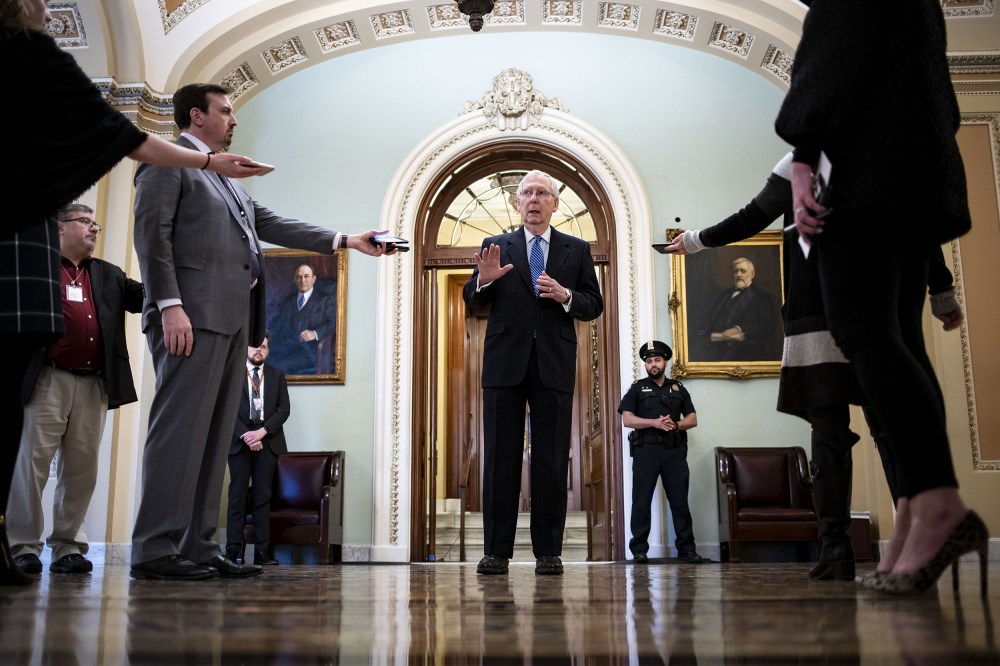
Top GOP leaders in Congress said Saturday they would not negotiate with Democrats and instead insisted that lawmakers approve more money for a small-business lending program for firms impacted by the coronavirus pandemic. Senate Majority Leader Mitch McConnell (R-Ky.) and House Minority Leader Kevin McCarthy (R-Calif.) released a joint statement Saturday morning saying they would not agree to any compromise with Democrats that changed their proposal to add $250 billion to the Paycheck Protection Program, which is being run by the Small Business Administration.
In case anyone needs a refresher, Congress originally allocated $349 billion for the Paycheck Protection Program, which is intended to encourage small businesses to keep workers on their payrolls. The pool of money has proven inadequate, especially given the overwhelming demand, and all the relevant players are eager to pump an additional $250 billion into the effort.
But as we discussed last week, Democratic leaders have also endorsed a plan they’re calling “Small Business Plus.” House Speaker Nancy Pelosi (D-Calif.) and Senate Majority Leader Chuck Schumer (D-N.Y.) unveiled a blueprint that would add the $250 billion to the Paycheck Protection Program, but they want the same bill to include an additional $100 billion for hospitals, community health centers, and health systems; an additional $150 billion for aid to cash-strapped states and local governments; and a 15% increase in SNAP food-stamp benefits.
And that’s caused Republicans to balk. GOP leaders over the weekend described these additional priorities as “unrelated programs” that Congress could address later.
Last Thursday, McConnell refused to sit down with Democrats to work out a compromise, and instead tried to pass his $250 billion bill during a pro-forma session. Dems balked and the bill failed to advance. Schumer suggested at the time that the setback could be addressed relatively quickly: officials could work something out over the weekend and have a bill ready for this week, perhaps as early as today’s pro-forma session.
But as the work week begins anew, there’s no bill — not because the parties’ negotiations fell apart, but because GOP leaders decided there’d be no negotiations.
Given the circumstances — each of the relevant players are already in agreement on the $250 billion for the PPP — why wouldn’t McConnell and McCarthy want to simply work out a deal? The answer isn’t altogether clear. I reached out to some Capitol Hill staffers over the weekend, and the consensus seemed to be that Republican leaders are worried that if they start making concessions on this bill, they’ll be in a weaker position when negotiations soon get underway on the sequel to the CARES Act.
Those same sources added that GOP leaders seem to believe that if Democrats continue to balk at the more narrow bill, it’s Schumer and Pelosi who’ll be blamed, even if it’s McConnell and McCarthy who refuse to engage in talks. For their part, the Democratic leaders issued another joint statement this morning, emphasizing that aid to states, hospitals, and hungry families can’t wait, adding, “[I]t’s time for the Republicans to quit the political posturing by proposing bills they know will not pass either chamber and get serious and work with us towards a solution.” No one seems to know when, whether, or how this will be resolved. In theory, there’s a world-class deal-maker in the Oval Office, but to date, Donald Trump hasn’t made an effort to get involved. Postscript: It’s a relevant detail that while everyone seems to like the Paycheck Protection Program, the Trump administration’s implementation of the initiative is off to a very rough start. The president claimed last week that the program has run into “minor glitches,” but he added that they’ve “already been taken care of.” I wish it were that simple. There’s been quite a bit of reporting in recent days suggesting the PPP’s implementation has been going quite poorly, at least so far. As Sen. Ben Cardin (D-Md.), among others, has argued, the result is an awkward policy dynamic in which the White House simultaneously struggles to implement the program while demanding an immediate financial infusion for the program.
Steve Benen is a producer for "The Rachel Maddow Show," the editor of MaddowBlog and an MS NOW political contributor. He's also the bestselling author of "Ministry of Truth: Democracy, Reality, and the Republicans' War on the Recent Past."
Latest Post
Recommended


