








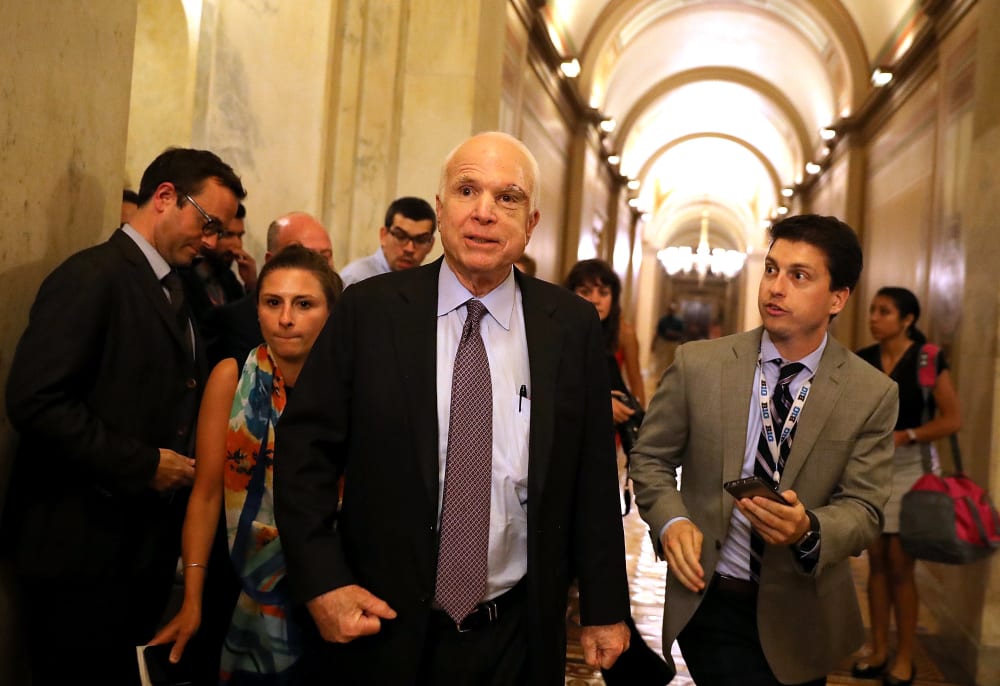
In late July, in the wake of a scary cancer diagnosis, Sen. John McCain (R-Ariz.) delivered stirring remarks on the Senate floor, making the case that his party was pursuing an overhaul of the nation’s health care system the wrong way. Republican leaders blew off his concerns and assumed the Arizonan would toe the party line.
He didn’t. McCain joined a bipartisan group of senators and derailed the GOP repeal crusade.
In the days and weeks that followed, when McCain wasn’t receiving cancer treatment, he was laying out his legislative principles with passion and depth. The veteran lawmaker hasn’t just casually expressed procedural preferences; McCain made a commitment to the kind of policymaking he wants to see in the United States.
The senator has done so repeatedly, in op-eds, in interviews, and in speeches. Just 12 days ago, McCain said in a statement that any legislative endeavor such as health care reform “must” — not “should,” not “it’d be nice,” but “must” — follow regular order.
And now we’re going to find out if he meant it. The New York Times’ David Leonhardt explained this morning:
The latest Trumpcare, known as Graham-Cassidy, risks the Senate’s credibility again. There has been none of the regular process that McCain demanded, not even a Congressional Budget Office analysis. No major medical group — not doctors, nurses, hospitals or advocates for the treatment of cancer, diabetes or birth defects — supports the bill.
Passing it would violate every standard that McCain laid down…. There is reason to believe McCain will stand firm, starting with his sense of personal honor.
Health security for millions of Americans may hinge on a single question: will John McCain honor his commitment and stated principles?
Senate Republicans are trying to humor the Arizonan with silly games. The Senate Finance Committee will hold a quick and meaningless hearing on the bill on Monday, followed by a Senate Homeland Security Committee hearing on Tuesday. (What does a health care overhaul have to do with homeland security? Nothing. The panel doesn’t even have jurisdiction over the issue.)
At that point, GOP leaders will declare with pride, “See? We followed regular order.” It will, of course, be a rather transparent sham. Regular order involves meaningful committee hearings, deliberations, markups, negotiations, amendments, debate, and in most cases, a score from the Congressional Budget Office. The process Republicans have in mind to ram through Graham-Cassidy with 50 votes would have none of this. And yet, we still don’t know whether McCain will take his own principles seriously. In fact, early yesterday, he said he might “reluctantly” do the opposite of what he said he’d do, a possibility that seemed to grow by midday when Arizona Gov. Doug Ducey (R) endorsed the far-right plan, despite the punishments it would impose on his home state. That doesn’t guarantee McCain will vote for the measure — he and Ducey were on opposite sides in late July — but it raises the possibility that the senator might put his principles on hold to take health benefits from millions. Leonhardt’s piece concluded, “It would be a tragedy for the country if he were now willing to take away decent health care from millions of people. It would be a tragedy for him if he went back on his word so blatantly. I remain hopeful that he will stay true to it.” I suspect there are several million families hoping the same thing.
Steve Benen is a producer for "The Rachel Maddow Show," the editor of MaddowBlog and an MS NOW political contributor. He's also the bestselling author of "Ministry of Truth: Democracy, Reality, and the Republicans' War on the Recent Past." Recommended


