








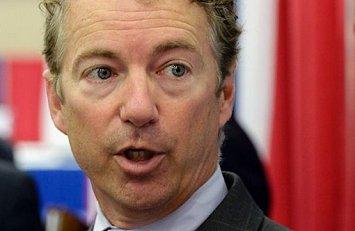
It’s probably safe to say Sen. Rand Paul (R-Ky.) has had better weeks. Just over the last few days he started to lose his cool on NPR when asked about a neo-confederate he co-authored a book with; he was caught making ridiculous boasts about his record on minority rights; and he repeated a bizarre conspiracy theory about George Stephanopoulos that’s already been debunked.
And then, after all of this, the Kentucky Republican sat down for a chat with Businessweek’s Josh Green.
Green: A recent article in the New Republic said your budget would eviscerate the departments of Energy, State, Commerce, EPA, FDA, Education, and many others. Would Americans support that?
Paul: My budget is similar to the Penny Plan, which cuts 1 percent a year for five or six years and balances the budget. Many Americans who have suffered during a recession have had to cut their spending 1 percent, and they didn’t like doing it, but they were able to do it to get their family’s finances back in order. I see no reason why government can’t cut 1 percent of its spending.
Except, whether the senator realizes it or not, his description of his plan is extremely deceptive. As Ezra Klein explained, Paul’s response wasn’t actually an answer: “Paul’s budget eliminates the Department of Commerce. It also eliminates the Department of Education. And the Department for Housing and Urban Development. And the Department of Energy. The State Department gets cut by more than 50 percent. Meanwhile, it increases spending on defense by $126 billion. Perhaps these are good ideas! But Paul doesn’t defend them. He obscures them. He tries to make his cuts sound small even though, in the areas Green asked about, they’re huge.”
In theory, Paul could at least try to explain why he thinks cutting the State Department budget in half would be good for the United States. But he either can’t or won’t do that, so he repeats vague talking points that obscure the facts.
Wait, it gets worse.
Green: Any political consultant who saw that list [of cabinet agencies Paul intends to eliminate] would tear out his hair and say the American people would never accept it. You disagree with that conventional wisdom?
Paul: You know, the thing is, people want to say it’s extreme. But what I would say is extreme is a trillion-dollar deficit every year. I mean, that’s an extremely bad situation.
Except, we’re not running trillion-dollar deficits every year. If the senator takes this issue so seriously, shouldn’t he keep up with the basics of current events?
Green: Who would your ideal Fed chairman be?
Paul: Hayek would be good, but he’s deceased.
Recommended


Green: Nondead Fed chairman.
Paul: Friedman would probably be pretty good, too, and he’s not an Austrian, but he would be better than what we have.
Again, Paul doesn’t seem to know what he’s saying. As Jon Chait explained, the senator’s answer “makes no sense” because, “Paul is a hard-money fanatic who wants to abolish the Federal Reserve’s role in using money policy to stabilize the economy. That’s the joke. Milton Friedman, though, had the complete opposite view of monetary policy. His central academic insight was support for very active monetary policy.”
My principal concern with Rand Paul is not his ideology. On plenty of subjective questions, he and I would recommend very different courses of action, which is what spirited political debate is all about.
Rather, what troubles me about the senator is that he doesn’t seem to have the foggiest idea what he’s talking about. Worse, it’s not like he’s ignorant of obscure policy details on issues he deems irrelevant — Paul is strikingly confused about the issues he claims to care about most.
This Businessweek interview was a mess for the senator on economic matters, but let’s not forget that Paul also doesn’t seem to understand his own views on the use of drones, which is another issue he says he cares deeply about.
If this guy intends to seek national office and ask the American mainstream to consider him credible, he has a lot of homework to do — homework he probably should have done before making the transition from self-accredited ophthalmologist to U.S. senator.
The place for in-depth analysis, commentary and informed perspectives.
