








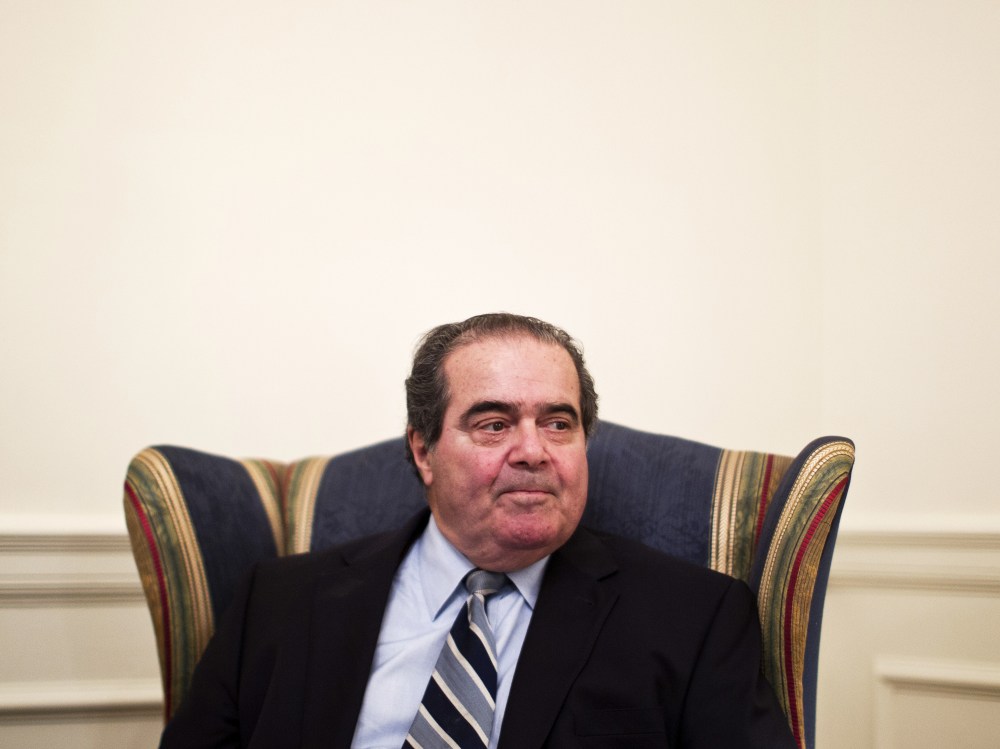
Supreme Court Justice Antonin Scalia, once a highly respected jurist, has seen his reputation as a credible conservative voice falter of late. His Holocaust references; his over-the-top dissent in the DOMA case; his political antics that appear to be an audition for a slot on “Fox & Friends” — it’s all been a bit much. Last year, a constitutional law professor at UCLA said the conservative justice has “finally jumped the shark,” and yet, Scalia somehow still manages to get more offensive.
Consider, for example, this amazing interview between Scalia and New York magazine’s Jennifer Senior. It’s tough to excerpt because the whole thing is just endlessly fascinating, but there were a few tidbits I thought I’d highlight.
Senior asked, for example, about his philosophy of originalism. “I don’t know when I came to that view,” he replied. “I’ve always had it, as far as I know. Words have meaning. And their meaning doesn’t change.”
I see. So Scalia sees himself as a congenital originalist, who believes dictionary entries from the 18th century are — or at least should be — indistinguishable from contemporary definitions.
Soon after, they explored Scalia’s media consumption.
Scalia: I usually skim [the newspapers]. We just get The Wall Street Journal and theWashington Times. We used to get the Washington Post, but it just … went too far for me. I couldn’t handle it anymore.
Senior: What tipped you over the edge?
Scalia: It was the treatment of almost any conservative issue. It was slanted and often nasty. And, you know, why should I get upset every morning? I don’t think I’m the only one. I think they lost subscriptions partly because they became so shrilly, shrillyliberal.
The justice went on to praise Bill Bennett’s conservative talk radio show.
I mention this because there have been instances in which Scalia, repeating factually inaccurate claims during oral arguments, appears to rely exclusively on conservative media, which in turn misleads him. The above exchange suggests that impression is rooted in fact — Scalia embraces the epistemic closure that so often dominates the right.
This exchange also struck me as unintentionally amusing:
Senior: The one thing I did think, as he said those somewhat welcoming things to gay men and women, is, Huh, this really does show how much our world has changed. I was wondering what kind of personal exposure you might have had to this sea change. Scalia: I have friends that I know, or very much suspect, are homosexual. Everybody does. Senior: Have any of them come out to you? Scalia: No. No. Not that I know of. Be forewarned, Antonin Scalia’s friends, he has his eyes on you. The whole interview is just remarkable. Scalia talks about his belief in a literal devil, whom the justice describes as “a real person,” and Scalia complains about American culture, including this gem: “You can’t go to a movie — or watch a television show for that matter — without hearing the constant use of the F-word — including, you know, ladies using it.” Also note, Scalia made a few specific factual claims in the interview, which Ashley Alman noted were incorrect.
Steve Benen is a producer for "The Rachel Maddow Show," the editor of MaddowBlog and an MS NOW political contributor. He's also the bestselling author of "Ministry of Truth: Democracy, Reality, and the Republicans' War on the Recent Past." Recommended


