








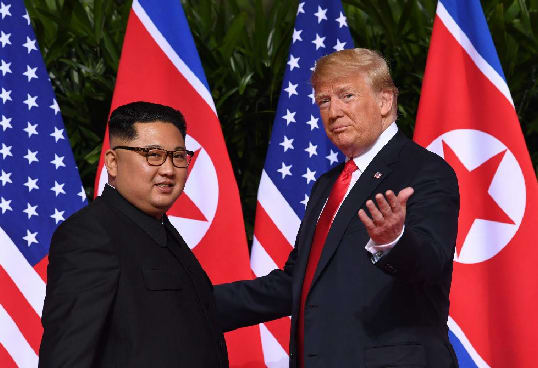
Donald Trump has presented North Korea with the kind of gifts that, not long ago, the rogue dictatorship could only dream of. For example, Kim Jong-un received a long-sought summit with an American president, elevating his country’s legitimacy and stature, in exchange for basically nothing.
Trump then lavished public praise on the brutal dictator in exchange for nothing; he announced a cessation of U.S. and South Korean joint military exercises in exchange for nothing; followed by the Republican raising the prospect of easing economic sanctions against the United States’ longtime adversary.
Trump did all of this because, at least in his mind, these were the steps necessary for him to “solve” a dangerous problem. As the Republican put it after his June 12 summit, “There is no longer a nuclear threat from North Korea.”
That rhetoric appears awfully foolish now.
On Saturday, after Secretary of State Mike Pompeo finished talks with North Korean officials in Pyongyang, Kim Jong Un’s foreign ministry accused the Trump administration of a “unilateral and gangster-like demand for denuclearization.” It was an immediate and sharp contradiction to President Donald Trump’s rosy descriptions of his North Korea diplomacy. […]
This dissonance between fact and fancy was made clear earlier this week. After NBC News first reported that Pyongyang was in fact expanding elements of its weapons program, the president tweeted, “Many good conversations with North Korea — It is going well!”
It’s not going well. Last month’s summit created a theatrical spectacle, but officials are now trying to move forward toward substantive objectives — goals that Trump told Americans he’d already achieved — that appear to be well out of reach, at least at this point in the process.
This is, alas, what practically every knowledgeable observer predicted would happen in the wake of the talks in Singapore. Trump recently suggested he considered skepticism “almost treasonous,” but it’s becoming painfully obvious that he had no idea what he was talking about.
A New York Times report added that the summit meeting’s vaguely worded commitment to “the denuclearization of the Korean Peninsula” meant “something very different in Pyongyang and Washington.”
Distrust on both sides has led the Americans to insist on rapid, deep dismantlement and highly intrusive verification; the North Koreans want an early lifting of sanctions and a formal end to the Korean War, among other steps. On Saturday, Mr. Pompeo and his entourage offered no immediate evidence that they had come away with anything tangible to show that North Korea was willing to surrender its nuclear and missile weapons programs. Mr. Pompeo did not meet with Mr. Kim, as he had in past visits, but held talks with Kim Yong-chol, a senior official who has been the country’s point person in deliberations with the United States, South Korea and China. Bloomberg News’ account made it sound as if North Korea was basically messing with Pompeo, keeping him in the dark about his own schedule, changing his expected accommodations, forcing him to sit through unnecessarily long meals, and denying him direct access to Kim Jong-un. “Amid talk of goodwill and Trump’s repeated tweets of the bond he has developed with Kim, it was also a jarring reminder that North Korea’s approach may not have changed as much as U.S. officials — and Pompeo in particular — had hoped,” the report said. To be sure, the process isn’t over. The secretary of state shrugged off Pyongyang’s rhetoric — as a practical matter, he had limited diplomatic alternatives — and more talks are scheduled. That said, it’s clear that Trump’s assurances have not only unraveled, they’ve also probably left his administration in a more difficult position. Daniel Russel, who was assistant secretary of state for East Asian and Pacific Affairs in the Obama administration, told NBC News yesterday, “Kim can afford to play hardball because it’s clear to him that Trump, who has already told Americans they can sleep soundly because the threat is now over, badly wants a deal. And when you want it bad, you get it bad.”
Steve Benen is a producer for "The Rachel Maddow Show," the editor of MaddowBlog and an MS NOW political contributor. He's also the bestselling author of "Ministry of Truth: Democracy, Reality, and the Republicans' War on the Recent Past." Recommended


