








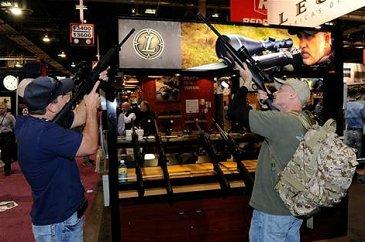
When we see attendance at gun shows and reports of brisk gun sales at gun stores, it’s easy to get the impression that a larger percentage of Americans are choosing to purchase firearms. There is, however, ample evidence to the contrary — even as gun sales go up, the percentage of households with guns goes down.
The share of American households with guns has declined over the past four decades, a national survey shows, with some of the most surprising drops in the South and the Western mountain states, where guns are deeply embedded in the culture.
The gun ownership rate has fallen across a broad cross section of households since the early 1970s, according to data from the General Social Survey, a public opinion survey conducted every two years that asks a sample of American adults if they have guns at home, among other questions.
The rate has dropped in cities large and small, in suburbs and rural areas and in all regions of the country. It has fallen among households with children, and among those without. It has declined for households that say they are very happy, and for those that say they are not. It is down among churchgoers and those who never sit in pews.
Daniel Webster, the director of the Johns Hopkins Center for Gun Policy and Research, told the New York Times, “There are all these claims that gun ownership is going through the roof. But I suspect the increase in gun sales has been limited mostly to current gun owners. The most reputable surveys show a decline over time in the share of households with guns.”
I think the way in which this trend manifests itself politically is worth watching. In fact, it may help explain why so much of the rhetoric that dominates the debate over gun safety seems so unhinged.
Rachel and Chris Hayes had an interesting chat on the show about this a few weeks ago, and something Chris said stuck in my head: “[T]he dirty secret of the gun market right now is there are two lines that go in opposite directions. The percentage of households that own guns is going down, and the number of guns in the country is going up. A smaller group of people are buying more and more guns, which means the manufacturers themselves have the same incentives as Wayne LaPierre, which is to cater to the most extreme gun obsessive acquirers, because that is where their market, and those interest people whose views are the most outside the mainstream. And that makes them politically toxic if they step forward. […] “[I]t’s increasingly kind of a hobby, hobbyist fetishistic audience. It`s not your casual person who may own one shotgun. That`s not where the growth in the industry is. The growth in the industry are people who own 12 guns.” When one considers the paranoia that frequently serves as a foundation for so much of the NRA’s messaging, keep in mind, this isn’t an accident.
The place for in-depth analysis, commentary and informed perspectives. Recommended


