








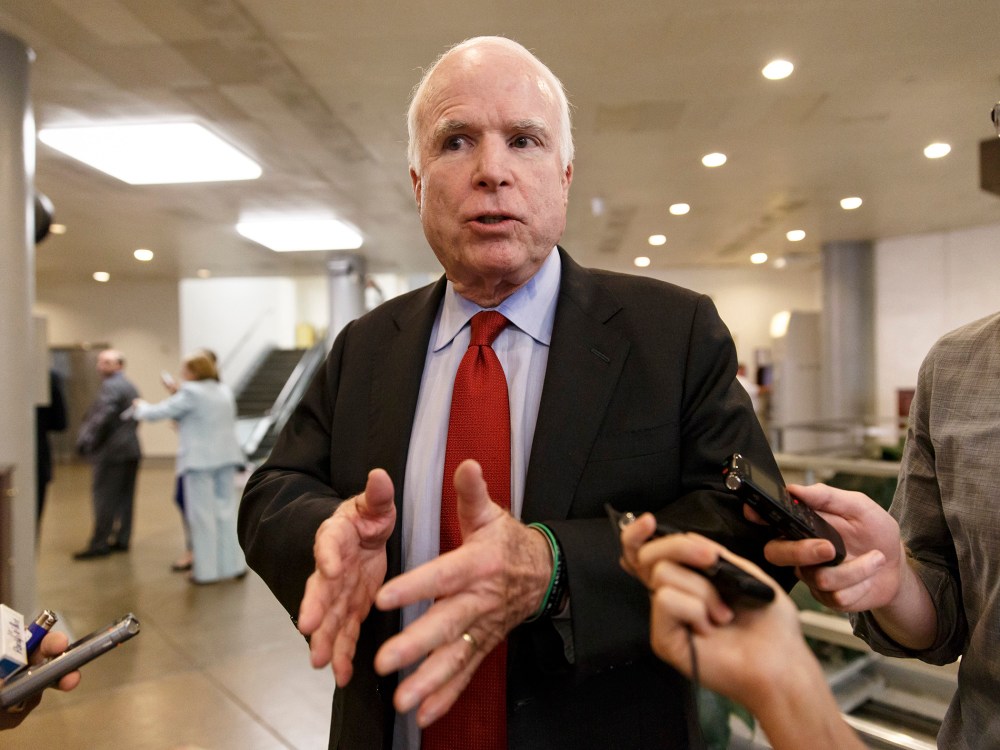
* In a “heated dispute over immigration-law overhaul” [in 2007], McCain screamed at Sen. John Cornyn (R-TX), “F*** you!” He added, “This is chickens*** stuff…. You’ve always been against this bill, and you’re just trying to derail it.” [5/19/07]
* In a discussion over the “fate of Vietnam MIAs,” Sen. Chuck Grassley (R-IA) asked McCain, “Are you calling me stupid?” “No,” replied McCain, “I’m calling you a f***ing jerk!” [Newsweek, 2/21/00]
Recommended


* At a GOP meeting in fall 1999, McCain “erupted” at Sen. Pete Domenici (R-NM) and shouted, “Only an a**hole would put together a budget like this.” When Domenici expressed his outrage, McCain responded, “I wouldn’t call you an a**hole unless you really were an a**hole.” [Newsweek, 2/21/00]
If anyone knows about the fine art of temper tantrums, it’s the senior senator from Arizona.But there’s a larger significance to McCain’s advice, which was echoed soon after by House Majority Leader Kevin McCarthy: congressional Republicans believe disagreements between the Obama administration and Netanyahu’s government should simple evaporate, the sooner the better, and it’s up to the White House to let bygones be bygones.This is horrible advice.The Republican line seems to prioritize fealty to Netanyahu above the basic tenets of any responsible foreign policy. Take the words “Israel” and “Netanyahu” out of the equation and consider this in more structural terms:The head of state of an American ally not only interfered in a domestic political dispute, establishing an unprecedented partnership with one political party, he also exploited domestic divisions to advance his own partisan ambitions abroad. Making matters worse, the same allied head of state broke a longstanding policy commitment, betraying the U.S. administration, and used divisive, racially charged language to rally extremists and win an ugly campaign.The Republican response is, in effect, that the United States should simply not care. In fact, not only should Obama refrain from vague criticisms of the foreign head of state, but as far as GOP lawmakers are concerned, American officials should do literally nothing but embrace the foreign leader.I’m curious: what kind of message do Republicans think this would send to countries around the world? Why would any U.S. administration want to encourage this sort of behavior from American allies, without regard for the consequences?Imagine we were talking about a country Republicans were predisposed not to like. If, say, the French president interfered in America politics, sought to sabotage American foreign policy, broke a commitment to his U.S. allies, and President Obama were furious, would GOP lawmakers reflexively respond, “Get over it”?Or more likely, would they expect American foreign policy to adapt and respond to the betrayal?

Steve Benen is a producer for "The Rachel Maddow Show," the editor of MaddowBlog and an MS NOW political contributor. He's also the bestselling author of "Ministry of Truth: Democracy, Reality, and the Republicans' War on the Recent Past."