









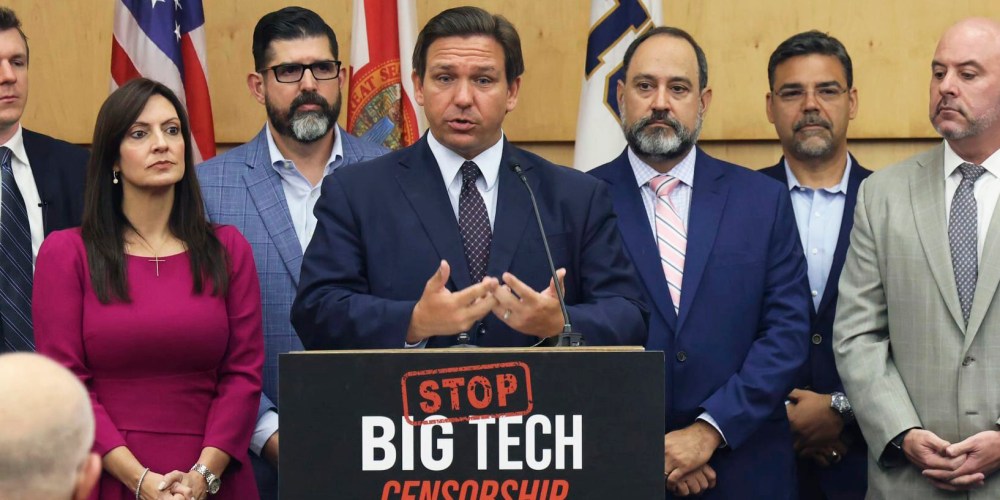

As conservative conspiracy theories against social media companies become more common, Republican legislators have introduced all kinds of measures targeting the platforms’ moderation practices. Yesterday, as NBC News reported, one of them actually became law.
Florida Gov. Ron DeSantis on Monday signed a law that gives the state the power to penalize social media companies when they ban political candidates, escalating a fight between the tech industry and Republicans such as DeSantis and former President Donald Trump. The law to prohibit “deplatforming” is the first of its kind in the nation and may be a model for other states to follow, even though one tech business group said the law runs counter to the First Amendment.
According to Florida’s Republican governor, “Silicon Valley elites” have engaged in a national effort “to silence, intimidate and wipe out dissenting voices.” Measures like the one he signed yesterday are ostensibly designed to help foster more robust political debate by penalizing companies like Facebook and Twitter that impose restrictions on political candidates.
Right off the bat, there’s a serious flaw in DeSantis’ premise: As NBC News’ report explained, “Research on social media has frequently shown … that conservative politicians and websites can be so effective on social media that they often dominate measures such as Facebook’s ranking of top links. Facebook has also relaxed its rules so that conservative pages are not penalized for violations.”
The idea that “Silicon Valley elites” have “silenced” the right is demonstrably ridiculous.
That said, some radical and extremist candidates have been banned for violating the companies’ terms of service — by promoting violent content, for example — and Florida Republicans approved a measure intended to discourage such penalties. In practical terms, the new state law is designed to tell tech giants such as Facebook and Twitter, “If candidates publish content that violate your company’s rules, you’re not allowed to delete their accounts.”
Companies that defy the new state law can be fined up to $250,000 a day. Because Florida is Florida, Republicans carved out an exception for companies that operate “a theme park or entertainment complex” — which is to say, GOP officials shielded Disney.
And while that detail is amusing, the new policy is awfully tough to defend. Consider an analogy.
Imagine you own a restaurant that’s open to the public. Nearly all of your customers are fine, but there are a small number of menaces who cause trouble for you, your staff, and other diners. Your place has certain rules — about attire, about not being disruptive, etc. — which are posted to the wall, but for some reason, these nuisances act like the rules don’t apply to them.
And so, you decide that these pests are no longer welcome at your restaurant. They’re free to go to some other place, but you don’t feel any obligation to seat and serve those who ignore your rules that other customers follow without incident. Then imagine your governor telling you there’s a new state law requiring your private establishment to welcome the troublemakers, whether you like it or not. The analogy to Florida’s new law is imprecise, but the end result is similar: DeSantis is telling private social-media companies they can’t ban candidates that break the companies’ rules. According to the Republican governor and his allies, whether the candidates publish dangerous or repugnant content is irrelevant. If you’re wondering about the constitutionality of such a measure, you’re not alone: A New York Times report added, “Democrats, libertarian groups and tech companies all say the Florida law violates the tech companies’ First Amendment rights to decide how to handle content on their own platforms. It also may prove impossible to bring complaints under the law because of Section 230, the legal protections for web platforms that Mr. Trump has attacked.” With this in mind, lawsuits challenging DeSantis’ new measure are inevitable, and the policy is likely to struggle in the courts. That said, the fact that Florida Republicans invested time, energy, and resources into such an initiative says a great deal about the party’s weird preoccupation with conspiracy theories surrounding Big Tech.
Steve Benen is a producer for "The Rachel Maddow Show," the editor of MaddowBlog and an MS NOW political contributor. He's also the bestselling author of "Ministry of Truth: Democracy, Reality, and the Republicans' War on the Recent Past."
Latest Post
Recommended


