









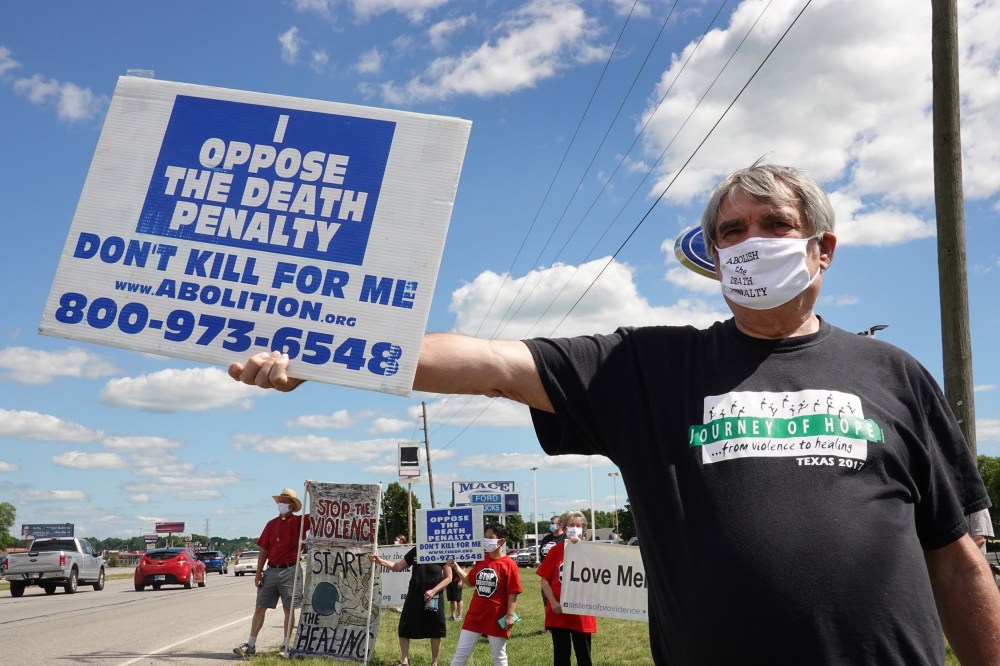
The United States held its first federal execution since 2003 on Tuesday after the Supreme Court, in an unsigned 5-4 overnight opinion, overturned a D.C. district judge’s order to temporarily halt the killing.
Daniel Lewis Lee, 47, was a former white supremacist convicted of participating in the murder of an Arkansas family in 1996. Until today, the victims’ relatives were in an ongoing legal battle to prevent Lee’s capital punishment. According to news reports, Lee professed his innocence before he was executed at a federal prison in Terre Haute, Indiana, noting that his final words were “You’re killing an innocent man.”
There are two other federal executions scheduled for this week.
Of the top 100 largest coronavirus clusters in the country, over 70% are either prisons or jails, according to data published by The New York Times.
San Quentin State Prison, which is second to only Marion Correctional in Ohio, is reporting 2,030 cumulative cases among inmates and 205 among staff. Ten inmates have died.
However, critics have argued that the numbers released by the California Department of Corrections and Rehabilitation are an undercount. Executive Director of Re:Store Justice California and formerly incarcerated lifer Adnan Khan claims that many at San Quentin can initially test negative for coronavirus and then interact with large parts of the population during showers or meals, ultimately contracting and suffering from COVID-19 while being marked as not having it.
The state of California does offer tests for inmates who request them. However, many are worried that result delays can potentially skew numbers and further exhaust already struggling medical staff and resources.
Kentucky state prisons have also been criticized for subpar testing practices. In this case, the sheer number of tests conducted at corrections facilities is what’s in question. According to a local report, 2,632 tests have been administered for roughly 11,200 behind bars.
The actual number of those incarcerated in Kentucky who have been tested is still unclear, and the local ACLU chapter has called on the state Department of Corrections to test “100% of the people that are in their custody.”
WHAS11 reports, “If you assume one test was given to one inmate, it represents about 23% of the prison population tested for coronavirus. But since many inmates … were re-tested to confirm if they could be removed from isolation, the percentage of inmates actually tested for COVID-19 is likely much lower.”
In Texas, thousands of people behind bars are still infected with the coronavirus. Today,The Texas Tribune reports multiple facilities in the state have at least a 25% positive rate among their inmate populations following a round of mass testing. Two of the prisons are seeing the highest resurgence of active infections since the pandemic began.
“You get these windows … but if you don’t follow up to see if it’s grown or decreased, you’re kind of just playing out those cases you had at that time,” Ben King, a clinical assistant professor of public health at the University of Texas at Austin told the Tribune. “It’s kind of like turning on the lights for just a second.” Reports of a “dire situation” involving coronavirus outbreaks and a violent response to protests at an ICE facility paint a dark picture. Court documents obtained by The Daily Beast show that at Farmville, a privately run Immigration and Customs Enforcement (ICE) prison in Virginia, at least 267 of 366 detainees and 22 employees have tested positive for coronavirus. Since late June, people detained at the prison have been protesting the conditions and have received violent backlash from guards, according to The Daily Beast. “They put us in here to let us die,” said one man detained at Farmville who tested positive for coronavirus to the Daily Beast. One third of inmates at Sussex Correctional in Delaware have tested positive for coronavirus. Delaware officials confirmed yesterday that 303 inmates at the prison have COVID-19, making it the largest outbreak of any state-run facility there. The New Orleans jail is once again seeing an uptick in coronavirus cases. NOLA.com reports that five inmates, as well as five deputies and one medical staffer have tested positive. Those who were in known contact with the infected inmates and staff have been tested, according to Darnley Hodge, the jail’s court-appointed administrator. In Alabama, two inmates at different prisons died within days of one another. From AL.com: “Laveris Evans, 31, was serving a 15-year sentence for a robbery that occurred in Jefferson County at Easterling Correctional Facility in Barbour County… Barry Stewart Foy, 57, died Friday at a hospital near Staton Correctional Facility in Elmore County. Foy, who was in the prison infirmary for “multiple advanced and chronic conditions,” was tested for COVID-19 June 11 after he was exposed to the virus by another inmate in the infirmary who tested positive.”
Julia DeAngelo
Latest Post
Recommended


