









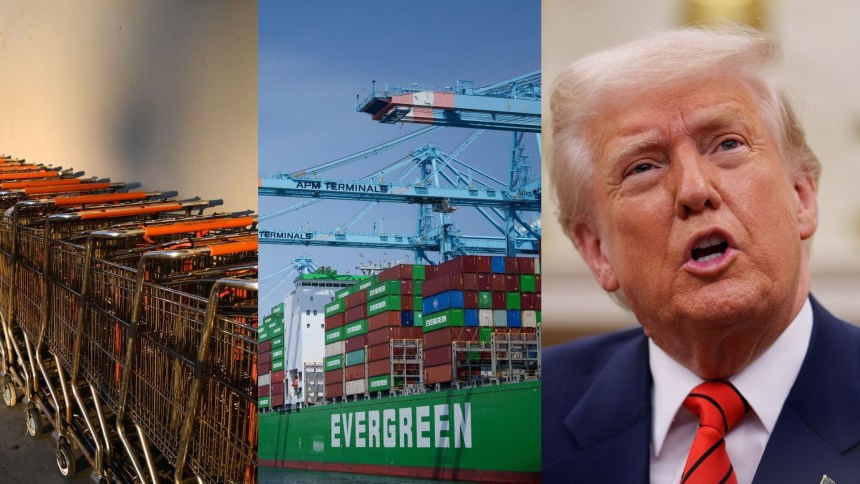

Over the last several weeks, many have asked a foundational question about Donald Trump’s trade tariffs: Why is the president doing this?
Trump tried to answer the question earlier this month, telling reporters that one of his principal goals is eliminating trade deficits. He added that, as far as he’s concerned, a trade deficit is “a loss” that he can’t tolerate. He’d made similar comments many times before.
A few weeks later, as Reuters reported, the latest data on the trade deficit was released.
The U.S. trade deficit in goods widened to a record high in March as businesses ramped up efforts to bring in merchandise ahead of President Donald Trump’s sweeping tariffs, suggesting trade was a large drag on economic growth in the first quarter. While some of the imported goods ended up in warehouses at wholesalers, economists said this would not blunt the anticipated hit on gross domestic product from the deterioration in the trade deficit.
A day later, we learned that the GDP did take a hit for precisely this reason.
At this point, some readers are likely planning to send me annoyed messages via Bluesky, telling me that trade deficits don’t really matter that much. I will gladly concede the point. In fact, I’ve already written about why the importance of trade deficits has been greatly exaggerated.
The relevance of the latest data, however, rests in Trump’s perceptions: The president has put lowering trade deficits at the top of his to-do list, and after failing to shrink the trade deficit in his first term, there’s early evidence that he’s failing again in his second term.
In other words, Trump is the one who said this is a metric that matters, and he’s also the one failing to deliver on his own goal. What’s more, the larger phenomenon isn’t limited to the trade deficit. The president has vowed to cut government spending, but the latest daily financial report from the Treasury Department showed that since Trump returned to the White House, federal spending has gone up, not down. Similarly, the Republican has spoken with great enthusiasm about unleashing the oil industry and increasing drilling. But as CNBC reported this week, the companies involved in the actual drilling and servicing of wells have taken a beating since Trump’s second inaugural. U.S. crude oil prices have fallen below $65 per barrel, down more than 20% since Trump’s second term began, making it unprofitable for many companies to boost production, according to a survey by the Federal Reserve Bank of Dallas. Executives on the frontline of the U.S. shale oil boom were scathing in their criticism of Trump’s policies in anonymous responses to that same survey. They used the word ‘uncertainty’ in their comments more than in any quarter since the start of the Covid-19 pandemic five years ago, according to Mason Hamilton, vice president of economics and research at the American Petroleum Institute.
Trump isn’t failing by his critics’ standards; he’s failing by his own standards.
Steve Benen is a producer for "The Rachel Maddow Show," the editor of MaddowBlog and an MS NOW political contributor. He's also the bestselling author of "Ministry of Truth: Democracy, Reality, and the Republicans' War on the Recent Past."
Latest Post
Recommended


