










In mid-May, House Democrats saw the CARES Act’s expiration on the horizon and took steps to stay ahead of the problem. The chamber approved an ambitious, $3 trillion aid package, which would extend benefits to struggling families, businesses, and communities through the end of the year.
Republicans soon after responded with … very little. The Republican-led Senate never voted on an alternative package, and when GOP leaders unveiled their preferred blueprint, many of their own members balked. There were some bipartisan negotiations, which went nowhere, and at the end of July, CARES Act aid came to a halt.
With the economy still struggling badly, and many Americans desperately in need of a lifeline, Donald Trump announced a series of executive actions in early August, which he said would “take care of, pretty much, this entire situation.”
The presidential measures did not, in fact, take care of the entire situation. The Wall Street Journal reported yesterday:
Treasury Secretary Steven Mnuchin urged Congress to appropriate more money to combat the effects of the coronavirus pandemic, saying at a hearing Tuesday that he was ready to sit down with Democratic leaders to resume negotiations at any time.
There was a bit of a bit of a mixed message from the cabinet secretary. On the one hand, Mnuchin testified that the economy is “recovering very strongly.” On the other hand, he pressed lawmakers to approve new spending to help rescue the struggling economy.
Left unsaid was the obvious fact that the White House’s executive actions have fallen far short. For example, employers aren’t interested in the payroll tax break Trump has touted with misguided enthusiasm, and states have struggled with the president’s directive on unemployment insurance.
It’s against this backdrop that Mnuchin signaled a willingness to negotiate, but as of yesterday, there still isn’t an administration policy, per se.
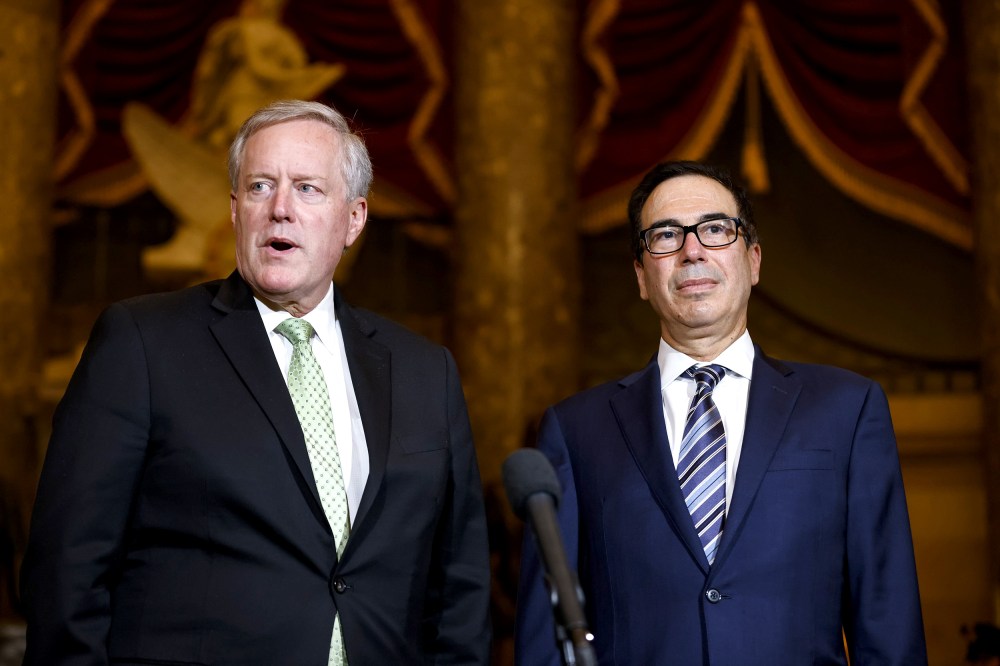
White House Chief of Staff Mark Meadows — by some accounts, the one person most responsible for the stalemate — appeared on CNBC yesterday and said Senate Republicans would return to Capitol Hill next week, at which point they’d take up a bill with $500 billion in additional federal aid.
I’m not sure I see the point. As bipartisan and bicameral talks took shape, Republicans eyed an economic aid bill worth roughly $1 trillion, while Democrats eyed a package worth roughly $3 trillion. Democratic leaders eventually said they’re prepared to split the difference, embracing a $2 trillion bill, if GOP leaders would agree to meet them in the middle. Team Trump balked. And now Republicans are apparently looking at a $500 billion proposal. Or put another way, the party appears to be moving further away from a compromise, instead of moving closer to one. For her part, House Speaker Nancy Pelosi (D-Calif.), who has already offered more than one compromise solution, told reporters late last week that she’d spoken with Mark Meadows, but they remained at a “tragic impasse.” Watch this space.
Steve Benen is a producer for "The Rachel Maddow Show," the editor of MaddowBlog and an MS NOW political contributor. He's also the bestselling author of "Ministry of Truth: Democracy, Reality, and the Republicans' War on the Recent Past."
Latest Post
Recommended


