









Americans do not yet know with certainty who’ll lead the Senate next year. There are still some undecided races, and Georgia will host two runoff elections in early January, which will likely determine which party will have a narrow majority in Capitol Hill’s upper chamber in 2021.
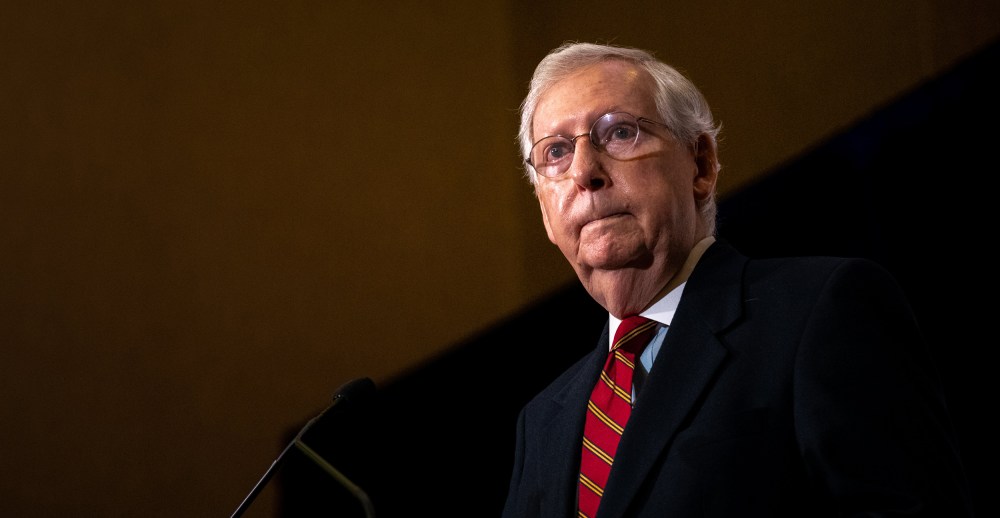
That said, the odds suggest Senate Majority Leader Mitch McConnell (R-Ky.) will remain in his current position, sparking all kinds of interest about what’s possible for incoming President Joe Biden. As the Washington Post‘s Catherine Rampell noted in her new column, some are “already romanticizing ‘divided government.’”
It sounds “inherently moderate,” wax some commentators; it’s “a good moment because in order to get something done, people are going to have to cooperate and compromise,” claim others. In this telling, “divided government” is, paradoxically, just what the country needs to heal our divisions. It’s a nice thought. Unfortunately, a single man stands in the way of this fantasy.
One need not pick up a crystal ball to know what’s likely to happen in the coming months. Indeed, we need only to focus on our recent history — because Mitch McConnell has already told us what to expect.
As I noted in my book (see the first chapter), after Barack Obama was inaugurated in 2009, Republicans were under some pressure to be responsible and constructive, with many pleading with GOP officials to resist the urge to slap away the Democratic president’s outstretched hand.
Then-Senate Minority Leader McConnell executed a different kind of plan, refusing to even consider bipartisan governing, even when Obama agreed with his opponents. “Public opinion can change, but it is affected by what elected officials do,” the Kentuckian told National Journal in March 2010. “Our reaction to what [Democrats] were doing had a lot to do with how the public felt about it. Republican unity in the House and Senate has been the major contributing factor to shifting American public opinion.”
In other words, McConnell felt like he’d cracked a code: Republicans would make popular measures less popular by killing them. McConnell’s plan was predicated on the idea that if he could just turn every debate into a partisan food fight, voters would be repulsed; Obama’s outreach to Republicans would be perceived as a failure; progressive ideas would fail; and GOP candidates would be rewarded for their obstinance. McConnell added soon after, in reference to his party’s approach to policymaking, “The single most important thing we want to achieve is for President Obama to be a one-term president…. Our single biggest political goal is to give our nominee for president [in 2012] the maximum opportunity to be successful.” A decade later, is there any reason to believe McConnell is exploring possible areas of compromise with the incoming Biden administration? Or is it vastly more likely the Senate’s Republican leader is focusing on two specific goals: adding GOP seats in 2022 and taking partisan control of the White House in 2024? Catherine Rampell added, “Maybe McConnell will ultimately be less obstructive. We’re told that he and Biden are ‘old friends,’ after all. But Charlie Brown and the football-wielding Lucy are sometimes said to be pals, too.”
Steve Benen is a producer for "The Rachel Maddow Show," the editor of MaddowBlog and an MS NOW political contributor. He's also the bestselling author of "Ministry of Truth: Democracy, Reality, and the Republicans' War on the Recent Past."
Latest Post
Recommended


