









The Republican Party’s 2016 platform decried what it saw as the president’s over-reliance on executive orders. With the party re-using the same platform in 2020, this provision in particular is … problematic.
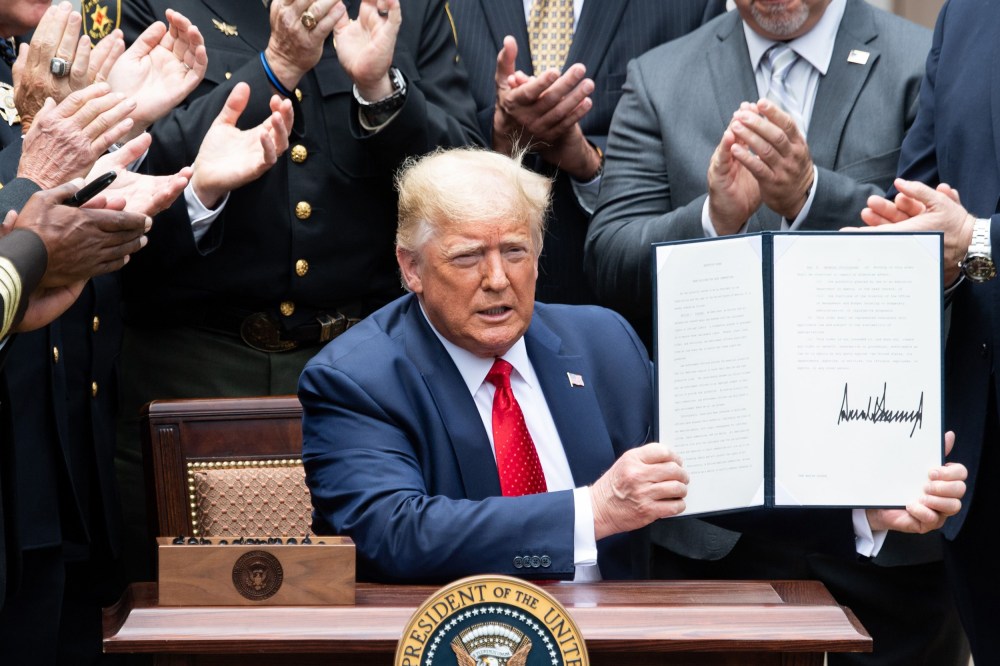
Donald Trump held an event in the White House Rose Garden yesterday, signing a rather modest executive order related to law-enforcement reforms. It came just a few weeks after the president signed an unrelated executive order, which appeared designed to retaliate against Twitter.
That, of course, came about a month after Trump signed an executive order to curtail immigration during the pandemic.
As a political matter, the election-year directives are understandable. The whole idea of a “Rose Garden Strategy” exists for a reason: Trump is eager to use his office to give the appearance of progress. He hasn’t yet literally said, “Look everyone, I’m presidenting!” but it’s the likely subtext we’re supposed to perceive.
What’s more, it’s also worth emphasizing that many of Trump’s executive orders are barely executive order at all. The anti-Twitter measure did little more than ask federal officials to explore a legal avenue — something the president also could’ve achieved with a phone call.
But these details notwithstanding, I seem to recall a 2016 presidential candidate effectively running on an anti-executive-order platform. His name was Donald Trump.
As regular readers may recall, in January 2016, then-candidate Trump told Fox News, “[T]he problem with Washington, they don’t make deals. It’s all gridlock. And then you have a president that signs executive orders because he can’t get anything done. I’ll get everybody together.”
In November 2015, in reference to Barack Obama, Trump added, “He doesn’t work the system. That is why he signs executive orders all the time because he can’t get his own people to go along.” A month earlier, Trump said, “Look at Obama. He doesn’t get anything done…. You’ve got to close the door and get things done without signing your executive orders all the time. That’s the easy way out.”
This posture continued throughout his candidacy. As recently as late September 2016, Trump complained, “Right now, we have an executive-order president. He just keeps signing.” In March 2016, with his hold on the GOP nomination nearly complete, Trump went so far as to declare, “I want to not use too many executive orders, folks. Executive orders sort of came about more recently. Nobody ever heard of an executive order. Then all of a sudden Obama, because he couldn’t get anybody to agree with him, he starts signing them like they’re butter. So I want to do away with executive orders for the most part.” Perhaps the best line of them all was delivered in January 2016, when Trump told CNN his thoughts on the “executive-order concept.” The future president explained at the time, “You know, it’s supposed to be negotiated. You’re supposed to cajole, get people in a room, you have Republicans, Democrats, you’re supposed to get together and pass a law. [Obama] doesn’t want to do that because it’s too much work. So he doesn’t want to work too hard. He wants to go back and play golf.” Evidently, Trump’s understanding of the “executive-order concept” has evolved over time.
Steve Benen is a producer for "The Rachel Maddow Show," the editor of MaddowBlog and an MS NOW political contributor. He's also the bestselling author of "Ministry of Truth: Democracy, Reality, and the Republicans' War on the Recent Past."
Latest Post
Recommended


