








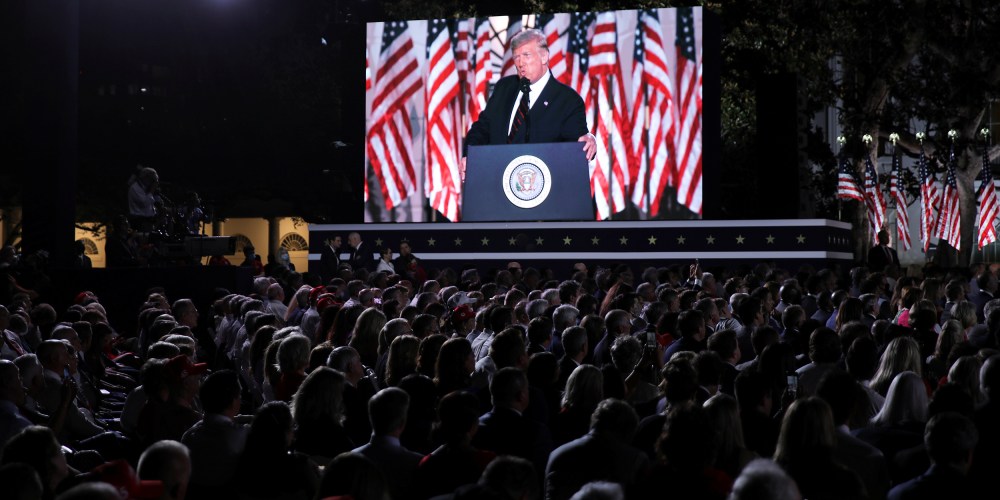

“Our convention occurs at a moment of crisis for our nation,” Donald Trump declared while accepting the Republican Party’s presidential nomination. “The attacks on our police, and the terrorism in our cities, threaten our very way of life. Any politician who does not grasp this danger is not fit to lead our country.”
He added, “Americans watching this address tonight have seen the recent images of violence in our streets and the chaos in our communities…. I have a message for all of you: the crime and violence that today afflicts our nation will soon come to an end…. Safety will be restored.”
Except, this wasn’t Trump’s message last night; it was the text of his speech at the Republican National Convention four years ago. It just sounds like the sort of message peddled at this week’s GOP gathering.
Evidently, the president has come to the conclusion that if the pitch worked once, he might as well try the same pitch again.
And who knows, maybe it’ll propel him to a second term. As we discussed after Trump first rolled out this ugly argument four years ago, fear is a powerful instinct. It’s so potent, and the innate drive to protect one’s self from harm is so overpowering, that it can override almost every other instinct, including those related to intellect and judgment. It’s why the president has focused so intently on trying to terrify the citizenry: fear is at the heart of his candidacy.
But there’s reason for some skepticism about its efficacy this year.
First, it’s no longer 2016. When Trump first told Americans there was “violence in our streets” and “chaos in our communities,” the point was to blame then-President Barack Obama and his Democratic administration for Republican perceptions of social unrest. Four years later, Trump presented a similar vision — he warned last night of “violent anarchists, agitators and criminals” who threaten society with “rioting, looting, arson, and violence” — glossing over the fact that he’s actually the incumbent in the 2020 race, and the crises he decried have unfolded on his watch.
Second, the president doesn’t seem to understand social unrest in any meaningful way, and he has no credible plans to address it. Noting the rhetoric’s “bizarre” qualities, Jon Chait noted overnight, “Trump did not even explain why this outbreak of violence has taken place. It is just a thing that happened, through no fault of Trump’s own.”
Third, the exercise itself was an elaborate attempt to shift the nation’s attention away from the president’s catastrophic failures on addressing the coronavirus pandemic. While polling suggests the defining issues of the 2020 race are the COVID-19 crisis and its effects on the economy, Trump hopes to convince voters that the real issue is urban unrest — not its causes, of course, but its existence.
Much of the U.S. mainstream, however, won’t reshuffle their priorities because the president told them to. As the national death toll inches higher — the virus took more than 1,100 American lives yesterday, and we’re experiencing death tolls on par with the Sept. 11 attacks every three days — and the unemployment rate hovers at levels unseen since the Great Depression, the president faces a daunting challenge: telling the electorate that his failure was a success, and that the entire issue isn’t quite as important as the “rioting, looting, arson, and violence” that he insists has become common in Trump’s America. And finally, when the president wasn’t trying to scare voters into believing he’s the only thing standing between them and imminent societal breakdown, he was simultaneously trying to convince voters that he’d created a utopia that only exists thanks to how awesome his awesomeness is. The trouble, however, is that Trump doesn’t actually have meaningful accomplishments; he has four years of failures, scandals, breakdowns, and missed opportunities. And so, the president lied. A lot. An awful lot. At a seemingly uncontrollable pace, at a volume that suggested there was something deeply wrong with his relationship with reality. Gaslighting has become a sort of political life-preserver for Trump, something he turns to when everything else goes wrong. The Republican signaled last night that he hopes the tactic will keep him afloat for another 67 days.
Steve Benen is a producer for "The Rachel Maddow Show," the editor of MaddowBlog and an MS NOW political contributor. He's also the bestselling author of "Ministry of Truth: Democracy, Reality, and the Republicans' War on the Recent Past."
Latest Post
Recommended


