








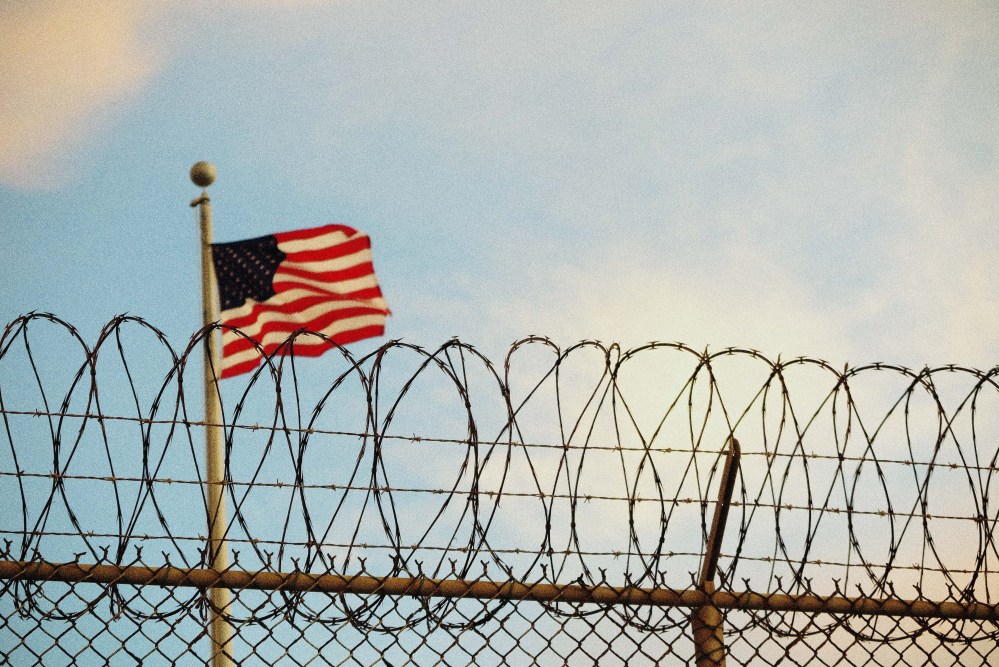

The news didn’t generate a lot of headlines, but the Biden administration announced two weeks ago that it had transferred another prisoner from the Guantanamo Bay prison, shrinking the total number of detainees at the facility to 36.
It was against this backdrop that The Hill reported on renewed Democratic efforts to shutter the prison, which face long odds.
In the past month, House Democrats have advanced legislation seeking to close the facility in Cuba as part of a larger annual defense spending bill leaders are expected to bring to a vote in the full chamber, where the party holds narrow control, in the coming weeks. But in the Senate, where Democrats will need GOP support to pass the defense funding bill, the move faces a wall of opposition from Republicans.
“I’m sure it’s not going to happen,” Sen. James Inhofe, the top Republican on the Senate Armed Services Committee, told The Hill. Rep. Mike Rogers, the top Republican on the House Armed Services Committee, used nearly identical phrasing while making the same prediction.
Rep. Kay Granger, top Republican on the House Appropriations Committee, added, “These detainees are the worst of the worst, and we need assurance that they will never be moved to the United States.”
To the extent that reality has meaning, Granger’s argument badly misses the point: Detainees weren’t sent to Guantanamo because they’re the “worst of the worst”; they were sent there because the Bush/Cheney administration wanted to hold the suspects without trial outside of the American judicial system.
As for moving them to the United States, American prisons on American soil already hold plenty of terrorists. The detainees at the facility often known as “Gitmo” don’t have superpowers. Our prisons have proven more than capable of locking up the “worst of the worst.”
What’s especially discouraging is how little the policy debate has advanced over the last decade.
Updating our earlier coverage, the prison’s population peaked in 2003 with 680 prisoners. The Bush/Cheney administration began moving detainees out in its second term, and by the time Barack Obama took office, the population was down to 242 prisoners.
In 2009 and 2010, Congress made it effectively impossible for the Democrat to close the facility altogether, but Obama successfully lowered the prison population from 242 to 41.
“As president, I have tried to close Guantanamo,” Obama said in a letter to congressional leaders on his last full day in office. “When I inherited this challenge, it was widely recognized that the facility — which many around the world continue to condemn — needed to close. Unfortunately, what had previously been bipartisan support for closure suddenly became a partisan issue. Despite those politics, we have made progress.”
The point of the progress, obviously, was to reduce the overall population, but it was also intended to appeal to Republicans’ sense of fiscal sanity: The smaller the number of detainees, the harder it becomes to justify the massive expense of keeping open a detention facility that houses so few people.
Even if congressional Republicans are inclined to ignore every other consideration, the hope has long been that GOP lawmakers would at least care about wasteful spending: It costs American taxpayers about $13 million per prisoner, per year. For his part, Donald Trump promised voters he’d reverse the progress, telling the public in 2016, in reference to the Guantanamo Bay prison, “We’re gonna load it up with some bad dudes, believe me, we’re gonna load it up.” As was true about so many of the Republican’s promises, none of this reflected reality. On his first day in office, the number of inmates was down to 41. On Trump’s last day in office, the prison had just 40 inmates. And now, that total is down to 36. About a month after Joe Biden’s presidential inauguration, the White House announced plans to shut down the prison once and for all, with the Departments of Defense, State, and Justice planning to work with the White House National Security Council in pursuit of the goal. The latest developments suggest officials have made some progress, but given Republican intransigence, lowering the number from 36 to zero will remain a difficult challenge for the administration.
Steve Benen is a producer for "The Rachel Maddow Show," the editor of MaddowBlog and an MS NOW political contributor. He's also the bestselling author of "Ministry of Truth: Democracy, Reality, and the Republicans' War on the Recent Past."
Latest Post
Recommended


