










The Democrats’ jobs and infrastructure plan is still taking shape. It’s likely to be “enormous” — Sen. Joe Manchin’s (D-W.Va.) word, not mine — but White House officials and congressional leaders are still working on the scope and scale of the legislation.
In this case, the strategy is almost as relevant as the bill. By all accounts, Democrats are prepared to use the budget reconciliation process to pass an infrastructure package, which would make it possible to circumvent a Republican filibuster — as was the case when Democrats passed their COVID relief package.
But there’s a related consequence: if Dems are working on a massive spending bill, members will be eager to add their priorities to the package, especially given the fact that they know this bill is likely to be filibuster-proof. Indeed, as Politico noted, Sen. Bernie Sanders (I-Vt.) has some ideas of his own.
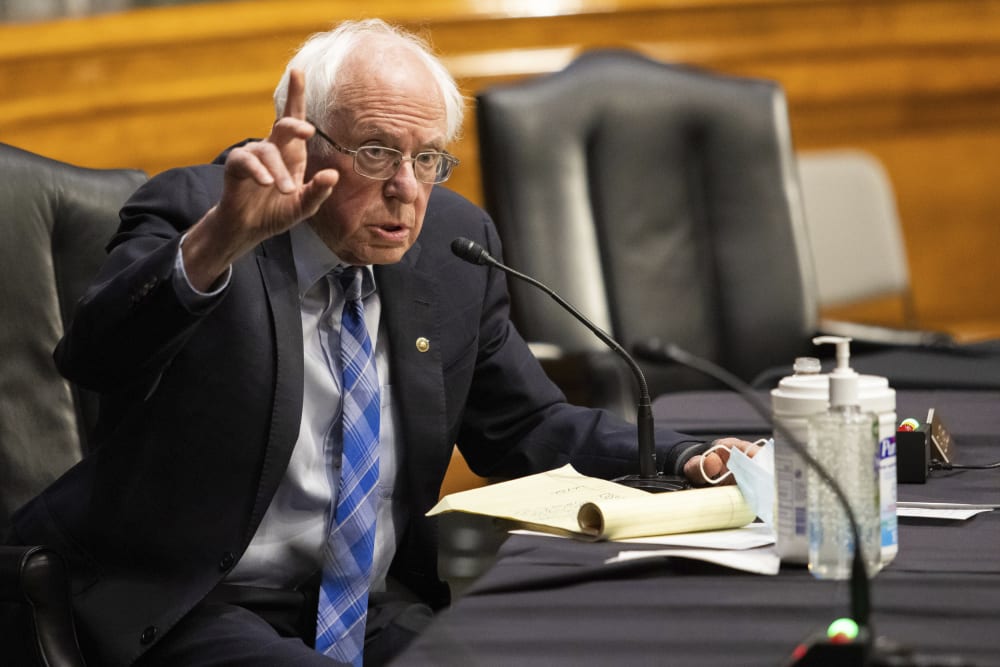
The Vermont Independent is urging Democrats to force Medicare to enter into negotiations with drug companies and use that revenue to pay for a huge expansion of the entitlement program. Sanders, who chairs the Senate Budget Committee, is aiming to lower Medicare’s eligibility age from 65 to 55 or 60 years old and expand the program to cover dental work, glasses and eye surgeries as well as hearing aids.
It’s too early to say with any confidence whether Sanders’ priorities will be included in the package, but the senator’s goal of lowering Medicare’s eligibility age is worth paying particular attention to.
Let’s take a stroll down memory lane. In late 2009, Democrats were close to passing the Affordable Care Act with 60 votes, but there were some provisions that troubled a handful of centrist members. Most notably, some Dems expressed discomfort with the “public option” — the creation of a government-run insurance option that would compete alongside private insurers.
In time, the bill appeared stuck: a handful of Democrats wanted the ACA to pass, but they opposed this one popular provision. A group of five progressive Dems and five not-so- progressive Dems — what was briefly described at the time as the “Team of Ten” — spent several days working out a compromise. The agreement was relatively straightforward: the “public option” would be removed from the legislation, and in its place, the Medicare eligibility age would be lowered from 65 to 55.
It was a major breakthrough, both politically and substantively. As Jonathan Cohn explained at the time, “People between the ages of 55 and 64 have a notoriously hard time buying coverage on their own, since their age and higher incidence of disease makes them the sorts of high medical risks insurers don’t want to cover.” There was just one problem: Joe Lieberman balked. In fact, the Connecticut senator drew a line in the sand: if Democrats didn’t kill the “public option” and the Medicare-at-55 provision, he’d kill the entire reform initiative. Left with little choice, Democratic leaders grudgingly made the changes Lieberman demanded, and the idea quietly faded soon after. Bernie Sanders, however, appears eager to bring it back to the table. I mention this history from 2009 because it’s easy to imagine some describing the Vermont senator’s Medicare idea as excessively liberal. But if, 12 years ago, centrists Democrats such as Arkansas’ Mark Pryor, Nebraska’s Ben Nelson, and Montana’s Max Baucus saw this as an acceptable, mainstream proposal, there’s no reason contemporary officials should feel any differently now.
Steve Benen is a producer for "The Rachel Maddow Show," the editor of MaddowBlog and an MS NOW political contributor. He's also the bestselling author of "Ministry of Truth: Democracy, Reality, and the Republicans' War on the Recent Past."
Latest Post
Recommended


