








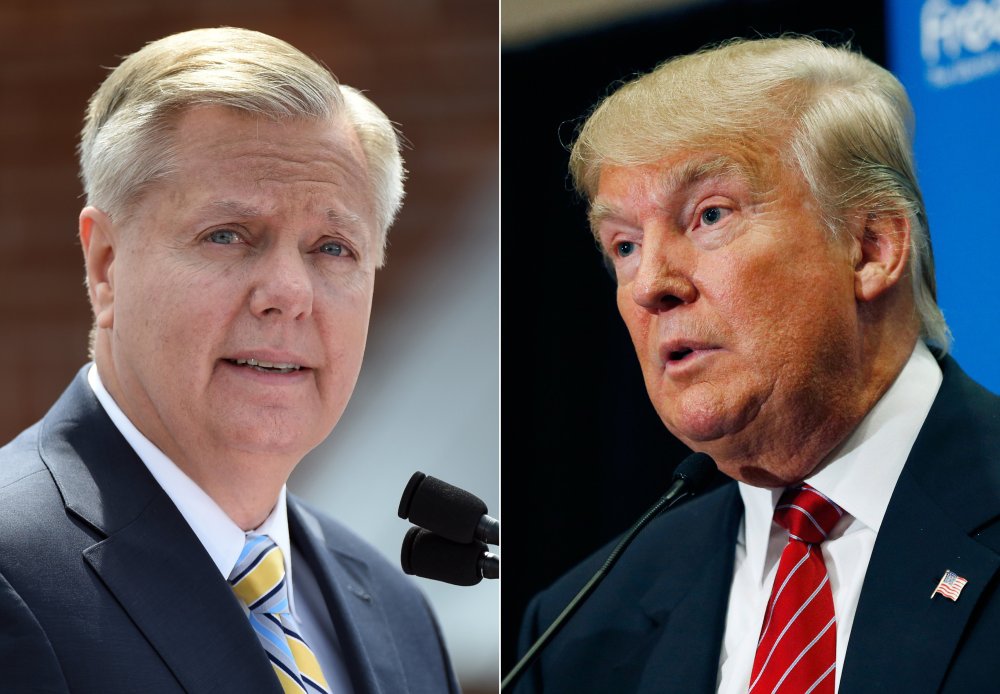
Sen. Lindsey Graham (R-S.C.) has reason to feel frustrated. The Republican senator has gone out of his way to maintain a sycophantic alliance with Donald Trump, hoping that it would offer him an opportunity to help guide the president’s foreign policy. That plan failed: Trump not only ignored Graham’s pleas for U.S. policy toward Syria, the White House didn’t even bother to tell the South Carolinian what was going on.
At the same time, Graham is also apparently frustrated that he can’t stop the impeachment of the president who doesn’t much seem to care about his loyalty.
Sen. Lindsey Graham (R-S.C.) on Wednesday said that he is sending a letter to House Speaker Nancy Pelosi (D-Calif.) warning that Senate Republicans won’t impeach President Trump over his call with Ukraine.
Graham, in an appearance on Fox News’s “Fox & Friends,” said that he was going to ask other Senate Republicans to sign a letter to Pelosi saying that they “do not believe the transcript of the phone call between the president and the Ukraine is an impeachable offense.”
“They’re about to destroy the nation for no good reason,” Graham said. “And I want Nancy Pelosi to know that Republican senators are not going to impeach this president based on this transcript, so she can stop now before she destroys the country.”
It’s a curious approach to the issue. Graham seems to believe, for example, that he and other Senate Republicans will side with Trump no matter the results of the impeachment inquiry, so there’s no point in the U.S. House pursuing the matter. The South Carolinian is the second GOP leader this week, following Mitch McConnell, to effectively rule out the possibility of Republicans holding their president accountable.
The Senate trial isn’t close to beginning, but some in the majority party apparently want to make it clear that the fix is in.
Of course, the House impeachment is not dependent on a specific Senate outcome. In 1998, for example, Graham helped lead the impeachment charge against Bill Clinton, knowing at the time that there was no realistic chance of the Senate removing the Democratic president from office. Graham did it anyway, indifferent to the process’ effects or likelihood of success.
But it was the “destroy the nation” line that struck me as especially important.
As Graham, the chairman of Senate Judiciary Committee, surely realizes, his golfing partner in the Oval Office effectively combined American foreign policy and his re-election campaign. For the first time in history, a sitting president — more than once — urged foreign countries to investigate a domestic rival in order to help strengthen his hold on power.
According to Lindsey Graham, the key to preventing the destruction of the United States is to consider what happened and do literally nothing. To hold Trump accountable would be to put the nation’s future at risk, but to passively look the other way would keep the country intact. First, the nation will do just fine if Trump is impeached. We’ve been through worse than political processes that much of the country already supports. Second, those who’ve lead impeachment crusades probably shouldn’t talk so recklessly about the dangers of impeachment. And third, isn’t allowing presidential abuses of power to go unchecked a much greater danger to the American system? Doesn’t the rule of law demand some semblance of accountability when those in positions of authority go too far? Postscript: To be sure, the Republican senator tends to get a little hyperbolic when he’s excited. Earlier this year, Graham said that if Trump caved in the government-shutdown fight, it would “probably” mark “the end of his presidency.” Nearly a year later, no one seems to even remember Trump’s pathetic retreat.
Steve Benen is a producer for "The Rachel Maddow Show," the editor of MaddowBlog and an MS NOW political contributor. He's also the bestselling author of "Ministry of Truth: Democracy, Reality, and the Republicans' War on the Recent Past." Recommended


