








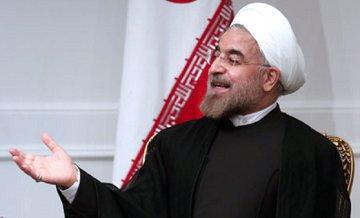
U.S. policy towards Iran has reached a point unseen in a very long time. Indeed, though much of the political world’s attention will be focused this week on whether congressional Republicans shut down the federal government, I hope we don’t lose sight of a new diplomatic opportunity.
As we discussed on Friday, Iranian President Hasan Rouhani is now calling on the United States and the rest of the world to “work together to end the unhealthy rivalries and interferences that fuel violence and drive us apart.” Rouhani went on to endorse a policy of “constructive engagement.”
The New York Times added that Iranian leaders, “seizing on perceived flexibility in a private letter from President Obama, have decided to gamble on forging a swift agreement over their nuclear program with the goal of ending crippling sanctions.” A related report added that “diplomacy is suddenly alive again,” with “surprising progress” that one senior American diplomat described as “head spinning.” Max Fisher made the case that President Obama’s pragmatism “has sent exactly the right signals to Iran, particularly at this very sensitive moment.”
Fisher isn’t the only one thinking this way. Jeffrey Goldberg, a center-right critic of the Obama administration, is thinking along the same lines.
There is one main reason why Iran is making conciliatory noises about its relationship with the U.S. and about the future of its nuclear program, and there is one main reason why Bashar al-Assad, the Syrian dictator, is signaling his intention to give up his stockpiles of chemical weapons.
The reason: President Barack Obama’s toughness.
Note, Fisher argued that it’s Obama’s success with Syria that has bolstered his credibility with Iran, while Goldberg made the case that Tehran has been impressed with Obama’s consistency on sanctions and nuclear proliferation, though both combine to create unexpected conditions: Iranian leaders open to departing from the status quo.
And we may be poised to see the manifestation of these attitudes in the very near future.
Indeed, Fred Kaplan wrote a piece yesterday on what to watch in the coming days, suggesting we “may be on the precipice” of a “possible breakthrough.”
President Obama would be crazy not to dive deep into diplomacy with Iran, right now. Forget the standard throat-clearing bromides and water-testing toe-dips that mark the resumption of relations with suspect characters. When the world’s leaders meet at the U.N. General Assembly next week, Obama should not only shake hands with Iranian President Hassan Rouhani but also meet with him privately, hand him a list of a dozen issues to discuss (uranium enrichment, sanctions, regional stability, etc.), and even be prepared to announce, if possible, a time and place for negotiations to begin and a roster of the delegates to be invited.
Recommended


If Rouhani is who he claims to be — an Iranian moderate who has the authority to strike a bargain on nuclear programs and economic sanctions (at least until hardliners lose patience with him) –then this is an opportunity no Western leader can pass up.
If it’s all a ruse, or if the mullahs overrule whatever deal emerges, there’s no harm in trying. In fact, if things go bad and Western leaders feel compelled to respond with tighter sanctions or military action, they could do so with greater legitimacy after having given the high road a chance.
On Capitol Hill, the prospect of a shift in U.S. policy towards Iran is drawing criticism from Republicans — try to contain your surprise — especially following reports that Obama and Rouhani might even shake hands at the United Nations this week. For the most part, however, Democrats are sending the White House encouraging signals.
Sen. Chris Murphy (D-Conn.), another member of the panel, said it’s “important to send Rouhani a sign that we welcome a new, moderate regime.”
“At some point we need to recognize that there’s probably some good that can come from talking,” he told The Hill. “I have thought for a long time that it’s silly that we believe we’re punishing Iran by ignoring them.”
Rep. Gerry Connolly (D-Va.), a member of the House foreign affairs panel, said Obama was the right candidate for the Iranians to seek a deal since he promised in the 2008 campaign to meet without preconditions.
“The United States should always be open to changing circumstances and changing leadership and be prepared to respond,” he said. “Absolute, closed, ‘we-don’t-care-we’re-not-going-to-talk-to-you’ policies, have rarely worked in our favor.”
The place for in-depth analysis, commentary and informed perspectives.
