








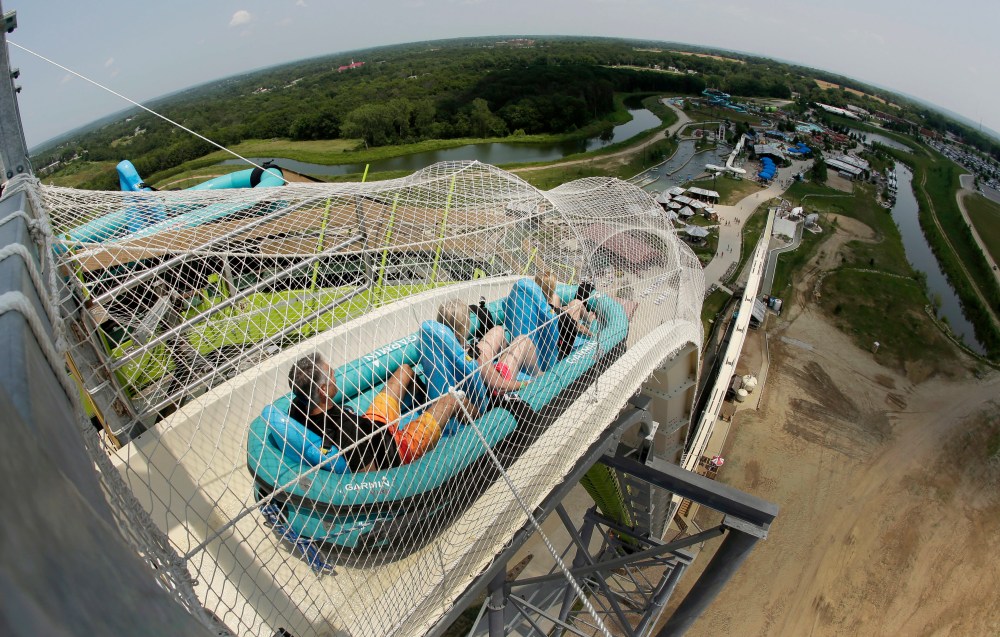
If you’ve ever been to an amusement park, you’ve probably seen some intimidating rides and slides. Sometimes, the scarier an attraction looks, the more popular it becomes: those who enjoy the adrenaline rush look forward to the adventure.
But with that comes an unstated assumption: the rides and slides must be safe, otherwise they wouldn’t be open to the public. People who go to the parks, in the back of their minds, expect government regulations and safeguards to be in place to ensure no one gets hurt by any of these attractions. It’s why we can go on the rides without any real fear for our safety.
Except, in rare cases, those assumptions are wrong. NPR had this stunning report this week.
Roughly 18 months after a child died on what was once the world’s tallest waterslide, authorities have indicted two water park executives in connection with the gruesome death. Their indictments — on charges ranging from second-degree murder to aggravated battery — cap a wide-ranging investigation launched after the 10-year-old rider was decapitated at Schlitterbahn Waterpark in Kansas City, Kan.
Three men have been charged: the ride’s two principal designers, Schlitterbahn co-owner Jeffrey Wayne Henry and John Timothy Schooley, as well as the park’s director of operations, Tyler Austin Miles, who had been indicted earlier. Henry and Schooley, together with Schlitterbahn’s private construction company, face 18 felony counts including second-degree murder — while Miles and the Kansas City park face 20 felony counts.
The ride was called Verruckt — the German word for “insane” — and it was reportedly conceived to impress producers of the Travel Channel’s Xtreme Waterparks series. According to the criminal indictment, the people responsible for creating the slide did not have “any kind of technical or engineering credential relevant to amusement ride design or safety.”
According to the filing, one of the park’s co-owners said, “If we actually knew how to do this, and it could be done that easily, it wouldn’t be that spectacular.”
They relied on “crude trial-and-error methods,” only bringing in engineers once the rushed construction was complete. When those engineers explained that rafts could go airborne on the slide, the warnings were covered up.
The results were horrific. Some riders received concussions, one suffered temporary blindness, and one 10-year-old boy was gruesomely killed.
Reading about this left me wondering how in the world there were no safeguards in place to prevent tragedies like these. The Boston Globe‘s Michael Cohen explained: A big part of the reason is lack of regulation. Amusement park oversight is a hodge-podge of state laws, with no federal involvement. In 1981, Congress passed legislation creating a “roller coaster loophole” that took away the power of the Consumer Product Safety Commission to oversee parks. While half the states have a regular inspections requirement, 10 states leave it up to county governments and private inspectors, and six states don’t regulate amusement parks at all. Amazingly, in Florida, the state’s most popular parks — Disney World, Universal Studios, and Busch Gardens — have been exempted by law from accident investigations. This lack of oversight is occurring even though 1,000 injuries are reported annually at amusement parks — a number that is almost certainly too low, considering that half of all parks simply ignore the requirement to provide such information. Kansas, not surprisingly, is one of the worst state offenders. It required annual exams by private inspections, but they didn’t have to be shared with state officials and there are no spot inspections. Sen. Ed Markey (D-Mass.) has long taken the lead on this issue, trying to get Congress to approve federal safety standards that would apply to rides at amusement parks nationwide. So far, his efforts haven’t gone anywhere. Perhaps now would be a good time for lawmakers to take a fresh look?
Steve Benen is a producer for "The Rachel Maddow Show," the editor of MaddowBlog and an MS NOW political contributor. He's also the bestselling author of "Ministry of Truth: Democracy, Reality, and the Republicans' War on the Recent Past." Recommended


