








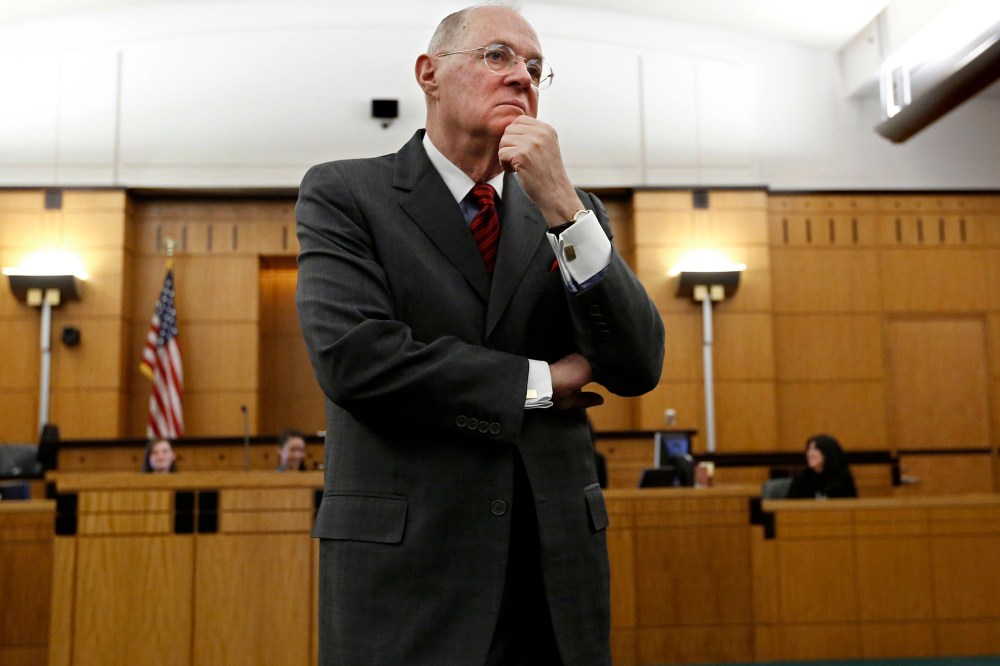
No one expected the Supreme Court to issue any stop-the-presses, landmark rulings on the last day of their term last week, but much of the political world was keeping an eye on the high court anyway for one important reason: there were rumors that Supreme Court Justice Anthony Kennedy might retire.
By any fair measure, such a move would set off a political earthquake, which is why many legal observers breathed a sigh of relief when the 80-year-old Reagan appointee did not announce the end of his tenure. The reprieve, however, was temporary. NPR’s Nina Totenberg reported over the holiday weekend:
[I]t is unlikely that Kennedy will remain on the court for the full four years of the Trump presidency. While he long ago hired his law clerks for the coming term, he has not done so for the following term (beginning Oct. 2018), and has let applicants for those positions know he is considering retirement.
Kennedy’s position on the court is more than consequential. In the most hotly contested and closely divided cases, his vote often decides the outcome.
Given the timing of next fall’s term — the one for which Kennedy has not hired clerks — don’t be too surprised if the justice steps down around the time of next year’s midterm elections.
And if that happens, the events that follow will likely change the direction of the nation for a generation. Indeed, a Washington Post report added that it’s “difficult to overstate the significance of all this.”
Indeed, if nothing else of real substance gets accomplished on Trump’s watch, it all might have been worth it for the GOP merely for his potential appointment to replace Kennedy. Kennedy is the swing vote on a pretty evenly divided nine-vote Supreme Court, and replacing him with a more conservative justice would tilt the court further to the right for years or potentially decades to come.
Replacing Kennedy with a Gorsuch-esque justice would give us five justices that were to Kennedy’s right. And that, according to Andrew D. Martin’s and Kevin M. Quinn’s scores of the ideology of Supreme Court justices, would be basically unprecedented.
Kennedy, for example, was a swing vote who upheld the Roe v. Wade precedent in 1992. If he were replaced with a Donald Trump nominee, there would almost certainly be five justices to roll back the clock on reproductive rights to before 1973.
Of course, this goes well beyond abortion rights. Supreme Court rulings affect every facet of modern American life — civil rights, voting rights, workers’ rights, environmental safeguards, the separation of church and state, and on and on — and will continue to do so well into the future.
The nation was confronted with a unique opportunity last year to create the first center-left majority on the Supreme Court in decades, but Senate Republicans refused to consider Barack Obama’s compromise nominee. That same opportunity was presented to the electorate last November, but just enough voters chose not to take advantage of it. I’ve long believed much of the left has grown complacent about the Supreme Court, which likely contributed to some liberals voting third-party in 2016, contributing to the election of Donald Trump. With Kennedy’s retirement on the horizon, the nation is likely to pay a high price for many years to come. Postscript: If Kennedy steps down next fall, what happens if Democrats win back the Senate in the midterms? Perhaps they would pull a McConnell and keep the seat open until after the 2020 presidential election? I suppose anything’s possible, but I’d caution against such thinking. Democratic odds in the race for the House majority aren’t bad, but the Senate map is daunting and it would take an extraordinary wave for Dems to have a chance.
Steve Benen is a producer for "The Rachel Maddow Show," the editor of MaddowBlog and an MS NOW political contributor. He's also the bestselling author of "Ministry of Truth: Democracy, Reality, and the Republicans' War on the Recent Past." Recommended


