








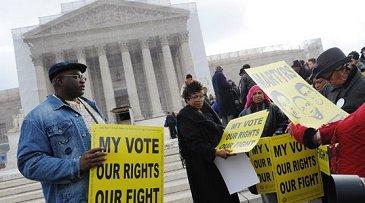
The National Voter Registration Act of 1993, better known as the federal “motor-voter law,” allows people to register to vote while renewing drivers licenses or applying for social services. As part of the documentation process, folks have to say that they’re American citizens.
Arizona, however, approved something called Proposition 200, which gave the federal law a little touch-up — those registering can’t just say they’re American citizens; in this state, folks are expected to prove it.
And this, in turn, has led to an interesting Supreme Court case.
Supreme Court justices expressed some skepticism on Monday about an Arizona law that requires people registering to vote in federal elections to show proof of citizenship.
The legal question before the nine justices is whether the voter registration provision of the 2004 state law is trumped by a federal law, the 1993 National Voter Registration Act, which outlines various ways in which people can register to vote in federal elections.
That law requires no proof of citizenship. Would-be voters simply sign a statement saying they are citizens.
The case comes just two weeks after the Supreme Court heard a challenge to the Voting Rights Act. (Curiously, Justice Scalia appears to have been obnoxious during oral arguments in both cases.)
The legal question today was a little different, and arguably more straightforward: are states able to create new voter-registration restrictions under the motor-voter law? Arizona says yes; the Obama administration says no.
But let’s not brush past the potential significance of the answer. Rick Hasen, an elections-law expert at UC-Irvine, told Sahil Kapur the “implications of this sleeper case could be profound.” If the justices rule in Arizona’s favor, and states can bypass the existing federal voter-registration form, “it could have a major effect on the power of the federal government to impose rules on states for running congressional elections.”
Supporters of the federal law seemed cautiously optimistic after this morning’s arguments. Doug Kendall, president of the Constitutional Accountability Center, said in a statement, “A majority of the Court, including Justice Kennedy, appeared to recognize that the entire point of having a single Federal form was to streamline the voter registration process, and that approving Arizona’s law would pave the way for a patchwork of 50 state forms. We are optimistic that that recognition will lead the Court to strike down Arizona’s law and respect Congress’ power to protect the right to vote in Federal elections.” Whether that optimism is misplaced is unclear. As is often the case, the most ambivalent was Justice Anthony Kennedy, who channeled the views of both sides during different parts of the argument. At one point, Kennedy wrestled with whether Arizona’s proof-of-citizenship requirement crosses a line. He asked the state’s attorney general, who was defending the law, whether states may also require proof of one’s address or date of birth when registering to vote. If so, he posited, then the federal requirement “is not worth very much.” At another point, he launched a defense of Arizona’s actions in principle and took issue with some of the reasoning by the Ninth Circuit Court of Appeals, which ruled against Arizona. A ruling is expected over the summer.
The place for in-depth analysis, commentary and informed perspectives. Recommended


