








Two weeks ago, the Democratic-led House voted 402 to 12 to ensure the 9/11 Victims Compensation Fund doesn’t run out of money. The bill then went to the Republican-led Senate, where it ran into a little trouble, before ultimately passing easily yesterday.
The Senate passed a bill Tuesday to ensure a fund to compensate victims of the Sept. 11, 2001, terror attacks never runs out of money — and that first responders won’t have to return to Congress to plead for more funding.
The vote came after intense lobbying from ailing 9/11 first responders — including one who died shortly after testifying before Congress last month.
The bill, which was passed by a vote of 97-2, would authorize money for the fund through 2092, essentially making it permanent.
The legislation now heads to the White House, where Donald Trump will almost certainly sign it. (If recent history is any guide, the president will also suggest the bill was his idea and he was solely responsible for its passage.)
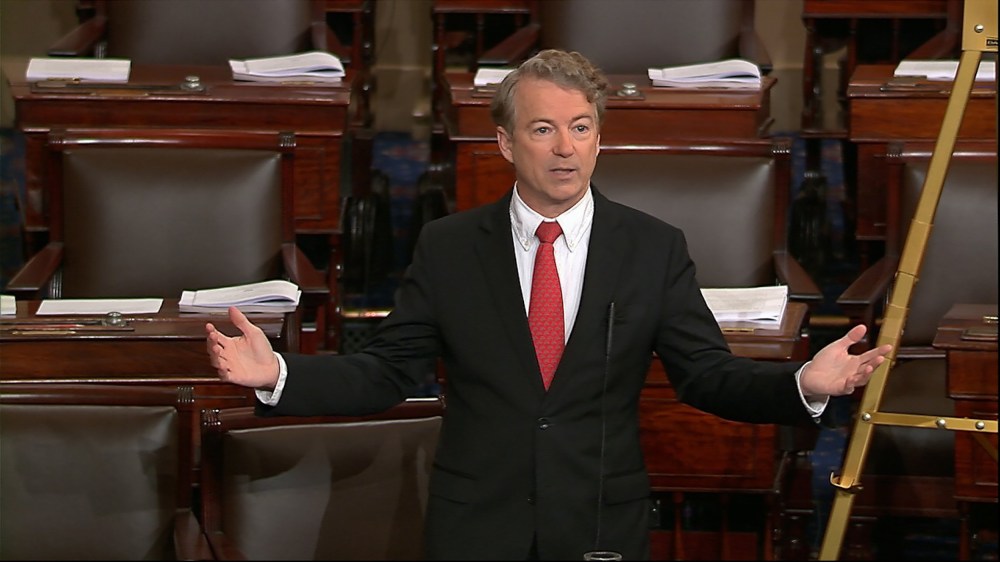
Whenever there’s a lopsided vote with only a handful of opponents, observers are invariably curious about who broke with the overwhelming majority. In this case, the 9/11 Victims Compensation Fund enjoyed strong bipartisan backing, but Sens. Rand Paul (R-Ky.) and Mike Lee (R-Utah) voted “no” — even though they knew it would pass anyway.
This came a week after Paul delayed this vote, objecting to a procedural effort to fast-track the proposal.
On Twitter yesterday, the Kentucky senator wrote, “While I support our heroic first responders, I can’t in good conscience vote for legislation which to my dismay remains unfunded. We have a nearly trillion dollar deficit and $22 trillion in debt. Spending is out of control.”
This is not a good argument.
For one thing, as we recently discussed, the legislation isn’t expensive, at least not by congressional standards. As the Associated Press reported, the Congressional Budget Office estimated that the legislation would cost about $10.2 billion over the next decade, all of which would go toward care for 9/11 first responders.
For another, if anyone deserves this federal aid, it’s the ailing 9/11 first responders who rely on the fund.
But what’s especially jarring about Rand Paul’s argument is the selective application of his principles. If the Kentucky Republican were consistent in his concerns about the nation’s finances, and sincere in his belief that the deficit and debt represented a genuine threat, this could at least be the basis for a conversation. The senator would still be wrong, but it would be worth talking about. We know, however, that the Republican tax plan, designed to disproportionately benefit the very wealthy, cost roughly 100 times more than the 9/11 Victims Compensation Fund bill. When that came up for a vote, Rand Paul was all for it, seemingly indifferent to the bill’s impact on the national debt. But when it’s the 9/11 Victims Compensation Fund on the line, suddenly the Kentucky Republican has concerns about fiscal responsibility. Postscript: Circling back to our earlier coverage, proponents of the 9/11 Victims Compensation Fund have taken care to avoid turning this debate into a partisan dispute, which is wise. But it’s also true that Republicans, who routinely pretend that they’re the sole arbiters of American patriotism, have consistently been the sole hindrance for this bill. In addition to the two GOP senators who balked yesterday, it was also a group of Republicans who opposed the bill in the House last week. What’s more, as Matt Steib recently noted, “Over the years, advocates for funding for first responders and victims of 9/11 have had to face Republicans blocking the effort in the name of fiscal responsibility. In 2010, 42 Republicans motioned to block the vote on the passage of the Zadroga Act, named after the first NYPD officer whose death could be attributed to exposure to toxic chemicals at Ground Zero. In 2015, the bill was held up again by two House Republican committee chairmen concerned about spending.”
Steve Benen is a producer for "The Rachel Maddow Show," the editor of MaddowBlog and an MS NOW political contributor. He's also the bestselling author of "Ministry of Truth: Democracy, Reality, and the Republicans' War on the Recent Past." Recommended


