








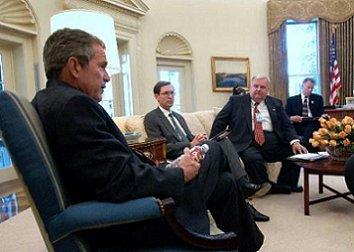
Economist Glenn Hubbard, dean of Columbia Business School, saw his stature and credibility as a scholar take a pretty severe hit during the Bush/Cheney era. Hubbard served as the chairman of the White House Council of Economic Advisors under George W. Bush, and ended up looking pretty foolish — he not only defended ridiculous policies, the Bush gang had him promote policies he’d argued against before joining the president’s team.
In other words, Hubbard became known as an economist who would say things he didn’t believe, simply because political circumstances forced him into it.
Hubbard is now an economic adviser to Mitt Romney — who, incidentally, also is known for saying things he doesn’t believe — and today has a Wall Street Journal op-ed arguing that President Obama’s budget plan includes a secret plan to raise everyone’s taxes by 11%.
Commenting on the piece, Treasury Secretary Tim Geithner said Hubbard’s argument is “completely made up,” and a “remarkably hackish observation for an economist.”
Austan Goolsbee, himself a former chairman of the White House Council of Economic Advisors, has apparently been friends with Hubbard for nearly 20 years, so he responded with a lighter tough, but even he was willing to say, “Glenn seems to have jumped the shark.”
Hubbard’s numbers seem in pretty serious danger of violating the league’s substance abuse policy.
His claim that the President’s budget requires large tax increases on the middle class to stabilize the debt is just factually wrong. Just go look at the Congressional Budget Office’s numbers. They examined the President’s budget and directly refute the central claim of the op-ed.
Goolsbee went on to note that by Hubbard’s logic, a Romney administration would “cut Social Security and Medicare by 26% and then raise taxes on the middle class by $3 trillion.”
Keep in mind, Hubbard isn’t some random Fox News personality or a House Republican freshman; he’s an economist with impeccable credentials. He also happens to be publishing nonsense in the Wall Street Journal.
It’s a reminder of something called the “wonk gap.”
Last year, after National Review ran a piece with obvious factual errors about health care policy, Jon Chait noted, “One of the unusual and frustrating aspects of the health care debate is the sheer imbalance of people who understand the issue at all from a technical standpoint. Even the elite policy wonks of the right make wildly incorrect claims about the issue.”
Most people are not policy wonks. We really on trusted specialists to translate these details for us. This is true as well of elected officials and their advisors. Part of the extraordinary vitriol of the health care debate stems from the fact that, on the Republican side, even the specialists believe things that are simply patently untrue. As with climate change and supply-side economics, there isn’t even a common reality upon which to base the discussion. Paul Krugman added some related thoughts at the time. First of all, I don’t think this is unique to health care, or especially unusual. Monetary policy, fiscal policy, you name it, there’s a gap, although not quite as large as on health. Second, I’m surprised that Chait doesn’t refer to Upton Sinclair’s principle: it’s difficult to get a man to understand something when his salary depends on his not understanding it. In fact, in general right-wing think tanks prefer people who genuinely can’t understand the issues — it makes them more reliable. Doesn’t this apply to both sides? Not equally. There was a time when conservative think tanks employed genuine policy wonks, and when asked to devise a Republican health care plan, they came up with — Obamacare! That is, what passes for leftist policy now is what was considered conservative 15 years ago; to meet the right’s standards of political correctness now, you have to pass into another dimension, a dimension whose boundaries are that of imagination, untrammeled by things like arithmetic or logic. The wonk gap remains a constant source of frustration. The scope of the nation’s challenges are enormous, but the debate remains stunted — any policy discussion has to progress from a shared foundation of reality, and at this point, the right isn’t even prepared to accept the basics. Their experts seem strikingly confused. The issue is not just someone on the left thinking those on the right have the wrong answers. Rather, the issue is the lack of intellectual seriousness on the right, making it impossible to get beyond the questions themselves.
The place for in-depth analysis, commentary and informed perspectives. Recommended


