








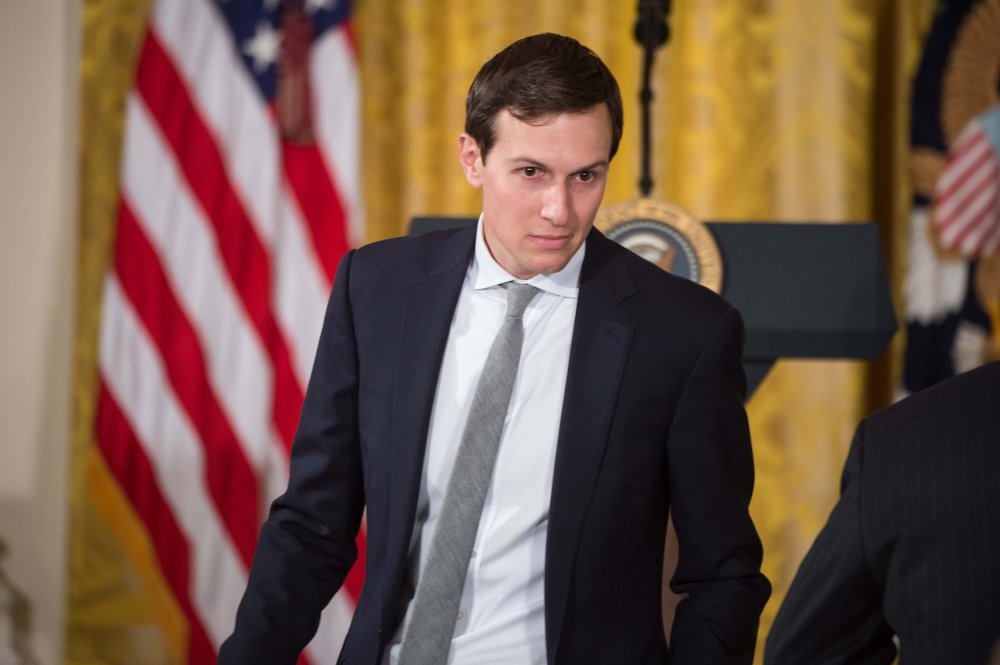

It’s safe to say Jared Kushner, a senior adviser to the president and Donald Trump’s son-in-law, is not having a good week.
We learned yesterday that Kushner, unable to get a permanent security clearance for over a year, has now lost access to classified materials. A few hours later, however, conditions went from bad to worse.
The New Yorker reported about a month ago that U.S. intelligence officials had delivered a stark warning to the White House, alerting the West Wing to the fact that “a member of the president’s family” — assumed to be Trump’s son-in-law — was being targeted by a Chinese influence operation. The same article added that Kushner had effectively blown off protocols while meeting with Chinese officials.
Just as alarmingly, the article added, “According to current and former officials briefed on U.S. intelligence about Chinese communications, Chinese officials said that Cui and Kushner, in meetings to prepare for the summit at Mar-a-Lago, discussed Kushner’s business interests along with policy. Some intelligence officials became concerned that the Chinese government was seeking to use business inducements to influence Kushner’s views.”
And while that obviously suggests a serious national security breach, a Washington Post report took the controversy to an even more alarming level with a report published late yesterday.
Officials in at least four countries have privately discussed ways they can manipulate Jared Kushner, the president’s son-in-law and senior adviser, by taking advantage of his complex business arrangements, financial difficulties and lack of foreign policy experience, according to current and former U.S. officials familiar with intelligence reports on the matter.
Among those nations discussing ways to influence Kushner to their advantage were the United Arab Emirates, China, Israel and Mexico, the current and former officials said.
Early last year, according to the reporting, officials in the UAE concluded that Kushner was “particularly manipulable” thanks to his family’s financial difficulties.
Wait, it gets worse.
The same Post report added that White House National Security Advisor H.R. McMaster discovered that Kushner hadn’t coordinated — or even fully disclosed — some of his foreign contacts.
It led to concerns within the White House that the president’s young and inexperienced son-in-law was “naive and being tricked” by foreign officials. Indeed, it should’ve alarmed practically everyone in the West Wing when some foreign officials “said they wanted to deal only with Kushner directly and not more experienced personnel.”
In other words, they saw Kushner as the weak link whose vulnerabilities could be exploited. This, not surprisingly, has prevented him from getting the permanent security clearance he needs to do his job. So what are we left with? One of the president’s top aides, who oversees a vast policy portfolio, can’t get a security clearance from the FBI, is seen by foreign countries as someone who’s easy to manipulate. This same top aide, facing private financial hardships, has had private meetings with foreign officials, to the alarm of top White House officials. As this mess — unlike anything Americans have ever seen from a White House — continues to unfold, keep a few things in mind. First, as Rachel emphasized last night, rules against nepotism exist for a reason. Second, having a top White House official facing dire financial straits, and then allowing that official to have undisclosed meetings with foreigners who see him as vulnerable, naturally created serious national security concerns. And third, it’s genuinely difficult to imagine how John Kelly, H.R. McMaster, and Jared Kushner will continue to serve within the same West Wing for much longer.
Steve Benen is a producer for "The Rachel Maddow Show," the editor of MaddowBlog and an MS NOW political contributor. He's also the bestselling author of "Ministry of Truth: Democracy, Reality, and the Republicans' War on the Recent Past." Recommended


