








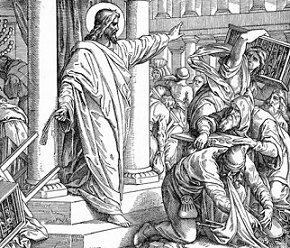
Probably everyone has heard the New Testament story in which Jesus entered the temple and told the money changers, “You know, if you got a massive tax break, the benefits would probably benefit poor families eventually.” Or something like that, right?
That seems to be the message I’ve been hearing from the right this week. Over the weekend, evangelical megachurch pastor Rick Warren said the Bible “says we are to care about the poor,” but he also said he opposes “wealth redistribution,” adding, “When you subsidize people, you create the dependency.”
He’s not the only one adopting this theological approach.
House Budget Committee Chairman Paul Ryan (R-Wis.), whose budget plan recently passed the House in a party-line vote, says his faith contributed in shaping the proposal, which he says is consistent with Catholic teachings.
“A person’s faith is central to how they conduct themselves in public and in private,” Ryan said in an interview released on Tuesday by the Christian Broadcasting Network. “So to me, using my Catholic faith, we call it the social magisterium, which is how do you apply the doctrine of your teaching into your everyday life as a lay person?”
To be sure, Ryan’s spiritual beliefs are his own business, and his religious beliefs are between him and his conscience. I’m not going to pretend to be a theologian or try to interpret Scripture for him.
I can, however, point out the nation’s Roman Catholic bishops — the leaders of Ryan’s faith tradition — have urged Republicans to adopt a budget strategy that “requires shared sacrifice by all,” including additional tax revenues and eliminating unneeded military spending. In a letter last year, the bishops also characterized “massive cuts” to programs that benefit the poor as unacceptable. “The needs of those who are hungry and homeless, without work or in poverty should come first,” the bishops said, articulating a principle that the Ayn Rand acolyte considers ridiculous.
I can also point out that Ryan’s budget plan is simply brutal towards the poor. The House Republican agenda gets “at least 62 percent of its $5.3 trillion in non-defense budget cuts over ten years from programs that serve people of limited means,” while also “giving a massive tax break to the wealthy.” This means redistributing wealth in the wrong direction — taking money from SNAP, Medicaid, and education, and redirecting that money towards those who are already rich. If his read on the New Testament is that Jesus would cut food stamps while giving millionaires a tax break, Paul Ryan has a far more creative mind than I do. I hate to break it to the right-wing Budget Committee chairman, but praying that dubious numbers will somehow add up doesn’t count as a budget shaped by faith.
The place for in-depth analysis, commentary and informed perspectives. Recommended


