








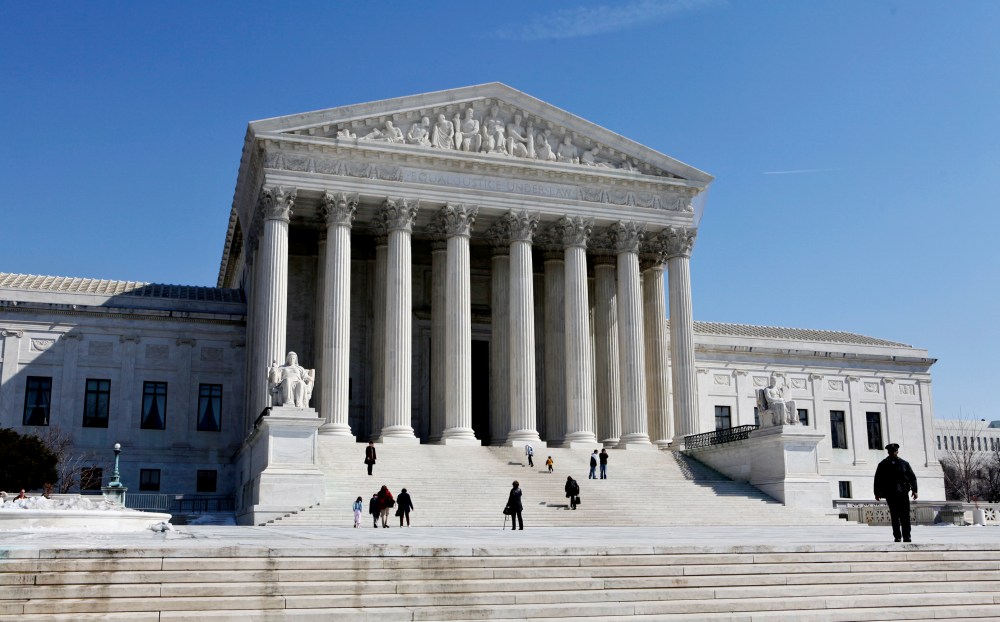

In Saturday’s installment of “This Week in God,” we discussed the Supreme Court allowing Alabama to execute Domineque Ray, a Muslim inmate who was offered a Christian minister to stay at his side when the state killed him. Ray requested a religious leader from his own faith, but the state balked.
Following a 5-4 vote, the U.S. Supreme Court last week rejected the inmate’s request for a stay, ignoring the rather obvious First Amendment problems associated with Alabama favoring one religion over all others. The outcome generated quite a bit of criticism from the left, but civil libertarians weren’t entirely alone.
The Washington Post‘s Eugene Scott noted that some on the right were critical, too.
Conservative columnist Bethany Mandel tweeted: “The state should not play God. But if it does, it shouldn’t deny a (wo)man a way to atone to their God before doing so.”
Seth Mandel, executive editor of the Washington Examiner magazine, tweeted: “As a conservative who opposes both the death penalty and religious discrimination I find this story appalling.”
And Southern Baptist minister Alan Cross tweeted: “Every time we want the state to favor Christianity over other religions, the result is a loss of religious freedom for all.”
Quite right. When public officials, with the U.S. Supreme Court’s approval, elevate one faith tradition over others, it creates the conditions our First Amendment has long sought to prevent. Christians who shrugged with indifference when five conservative justices turned away Domineque Ray’s appeal should consider the long-term effects of such a principle.
Today, it’s Christians who receive special treatment in Alabama. What will conservatives say when it’s a different faith that’s elevated in a different state tomorrow?
For those who missed Rachel’s segment on Friday night, and/or our Saturday coverage, let’s recap. Ray was scheduled to be executed for the robbery, rape, and murder of a 15-year-old girl, Tiffany Harville, in 1995. His guilt was not in doubt. She wasn’t even his first victim. Rather, what mattered in this case was the method in which the state planned to kill him.
Alabama said it would permit a Christian minister — an employee of the state prison system — to be in the execution chamber with Ray at the time of his death, but not an imam.
The 11th Circuit Court of Appeals sided with the inmate, citing the First Amendment, and issued a stay. If Christian inmates can have a Christian minister with them during their executions, a unanimous appellate court panel concluded, then inmates of minority faiths deserve equal treatment.
When the U.S. Supreme Court disagreed, Justice Elena Kagan wrote a striking dissent, explaining why the high court’s majority was “profoundly wrong.”
Whether or not one feels sympathy for a man convicted of heinous crimes; at issue here is the underlying legal principle that in the United States, people of every faith tradition — and those who’ve chosen not to follow a spiritual path at all — will be treated equally under the law. On matters of religious liberty, the government must remain neutral and not play favorites, and yet, Alabama is the nation’s only state with an official policy of having a Christian minister — and only a Christian minister — in the execution chamber. The five conservatives on the U.S. Supreme Court didn’t seem to care. On the contrary, they prioritized Alabama’s interest in killing the inmate quickly. Slate’s Dahlia Lithwick, who talked with Rachel about the case in detail on Friday night, added: This is a court that has staked its moral legitimacy on the proposition that religion, above all, is at the very core of humanity, to be elevated in all instances no matter the competing interests. In so many faiths, there is no more sacred moment than entry and departure from this life. But never mind. For a court that cannot bear the thought of a religious baker forced to frost a cake in violation of his spiritual convictions to be wholly unaffected at the prospect of a man given last rites by a member of another faith borders on staggering. The court that had no problem with a transparently anti-Muslim immigration ban, promised and performed as an anti-religious measure, looks more and more like it has two standards for protecting religious liberty. Domineque Ray’s lawyer told reporters at 10:20 p.m. on Thursday night that Alabama had, in fact, executed his client. There were no religious leaders in the room.
Steve Benen is a producer for "The Rachel Maddow Show," the editor of MaddowBlog and an MS NOW political contributor. He's also the bestselling author of "Ministry of Truth: Democracy, Reality, and the Republicans' War on the Recent Past." Recommended


