








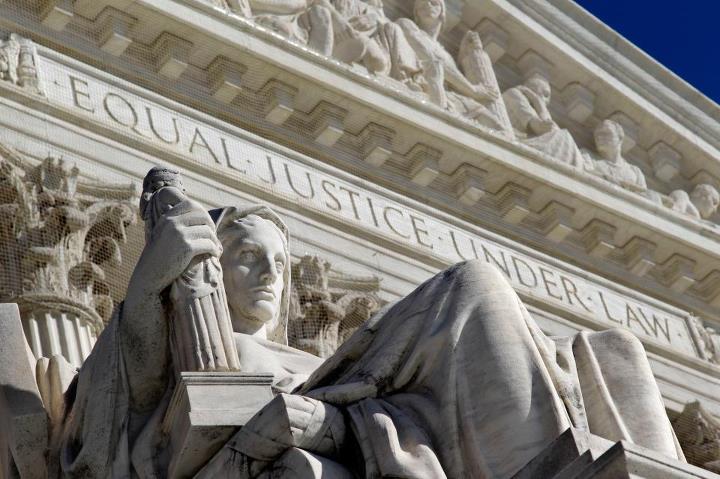

First up from the God Machine this week is a closer look at a step the U.S. Supreme Court took this week that seemed wholly at odds with bedrock principles of religious liberty.
At issue was Alabama’s plan to execute a man, Domineque Ray, for the robbery, rape, and murder of a 15-year-old girl, Tiffany Harville, in 1995. His guilt was not in doubt. She wasn’t even his first victim. Rather, what mattered in this case was the method in which the state planned to kill him.
Alabama said it would permit a Christian minister — an employee of the state prison system — to be in the execution chamber with Ray at the time of his death, but Ray was a Muslim and requested an imam. Officials balked and a court fight ensued.
The 11th Circuit Court of Appeals sided with the plaintiff, citing the First Amendment, and issued a stay. If Christian inmates can have a Christian minister with them during their executions, a unanimous appellate court panel concluded, then inmates of minority faiths deserve equal treatment.
This week, the U.S. Supreme Court, on a 5-4 vote, rejected the appellate court’s reasoning. As the New York Times reported, the court’s majority said little in defense of its decision, though Justice Elena Kagan, writing for the dissenters, made a striking case that the majority was “profoundly wrong.”
Under Alabama’s policy, she wrote, “a Christian prisoner may have a minister of his own faith accompany him into the execution chamber to say his last rites…. But if an inmate practices a different religion — whether Islam, Judaism or any other — he may not die with a minister of his own faith by his side,” Justice Kagan wrote.
“That treatment goes against the Establishment Clause’s core principle of denominational neutrality,” she added, referring to the clause of the First Amendment that bars the government from favoring one religious denomination over another. […]
“Ray has put forward a powerful claim that his religious rights will be violated at the moment the state puts him to death,” she wrote. “The 11th Circuit wanted to hear that claim in full. Instead, this court short-circuits that ordinary process — and itself rejects the claim with little briefing and no argument — just so the state can meet its preferred execution date.”
And that’s ultimately what makes this dispute so notable. It’s not about feeling sympathy for a man convicted of heinous crimes; it’s about the underlying legal principle that in the United States, people of every faith tradition — and those who’ve chosen not to follow a spiritual path at all — will be treated equally under the law.
On matters of religious liberty, the government must remain neutral and not play favorites, and yet, Alabama is the nation’s only state with an official policy of having a Christian minister — and only a Christian minister — in the execution chamber.
The five conservatives on the U.S. Supreme Court didn’t seem to care.
Indeed, I’d love to offer a detailed assessment of the conservative justices’ reasoning, but they offered no real explanation for overturning the 11th Circuit, except to say that the condemned man “waited until January 28, 2019 to seek relief.” The calendar may not seem especially relevant, but apparently, Ray was supposed to speak up a few months ago, when Alabama originally scheduled his execution. He might have done so, but he was only made aware of the Christian-chaplain-only rule a couple of weeks ago. At that point, the Supreme Court had a choice: prioritize Ray’s religious liberty or Alabama’s execution schedule. The five conservatives went with the latter. Slate‘s Dahlia Lithwick added: This is a court that has staked its moral legitimacy on the proposition that religion, above all, is at the very core of humanity, to be elevated in all instances no matter the competing interests. In so many faiths, there is no more sacred moment than entry and departure from this life. But never mind. For a court that cannot bear the thought of a religious baker forced to frost a cake in violation of his spiritual convictions to be wholly unaffected at the prospect of a man given last rites by a member of another faith borders on staggering. The court that had no problem with a transparently anti-Muslim immigration ban, promised and performed as an anti-religious measure, looks more and more like it has two standards for protecting religious liberty. Domineque Ray’s lawyer told reporters at 10:20 p.m. on Thursday night that Alabama had, in fact, executed his client. There were no religious leaders in the room.
Steve Benen is a producer for "The Rachel Maddow Show," the editor of MaddowBlog and an MS NOW political contributor. He's also the bestselling author of "Ministry of Truth: Democracy, Reality, and the Republicans' War on the Recent Past." Recommended


