








Two weeks ago today, Donald Trump traveled to Kentucky for a campaign rally intended to benefit one man: Gov. Matt Bevin (R). The president told the unpopular governor, on the eve of his re-election bid, “[I]f you lose, they’re going to say, ‘Trump suffered the greatest defeat in the history of the world. This was the greatest.’” Trump told local voters, “You can’t let that happen to me.”
The next day, Bevin lost.
A week later, Trump tried again, making his third recent trip to Louisiana, where he seemed desperate to carry Eddie Rispone (R) across the finish line in this year’s gubernatorial election. “You got to give me a big win, please,” the president told voters at a campaign rally near Shreveport last Thursday. “Please. OK? OK?”
As it turned out, no, it wasn’t OK.
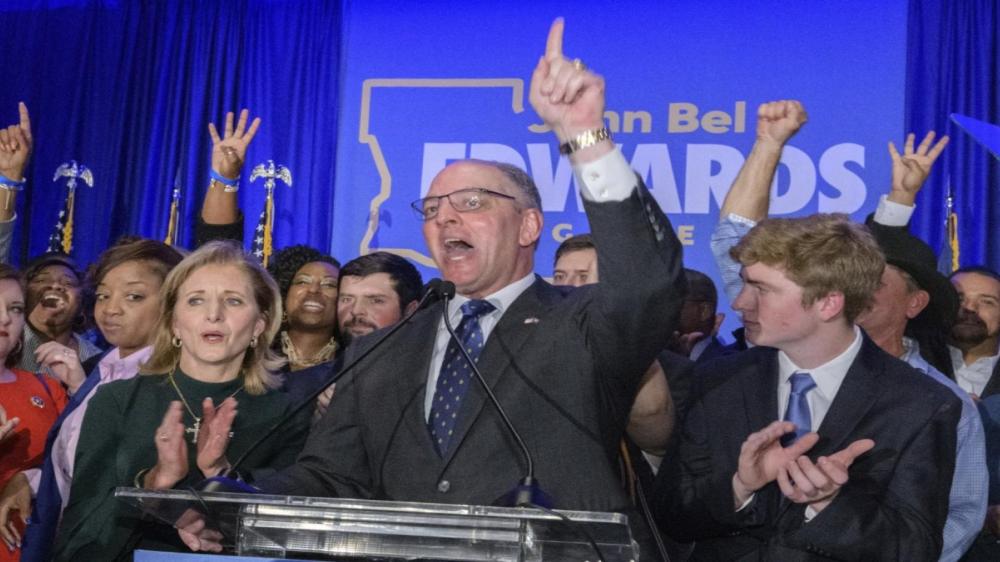
Democratic Gov. John Bel Edwards narrowly won a second term as Louisiana governor, beating Republican challenger Eddie Rispone by 1.4 percentage points and delivering another blow in off-cycle elections to President Donald Trump. […]
Edwards’ victory in a state that Trump carried in 2016 by nearly 20 percentage points highlights the limitations of nationalizing local races. Rispone, a wealthy businessman and longtime Republican donor, tied himself to Trump. He often railed against illegal immigrants on the campaign trail and portrayed Edwards as a “liberal, socialist-leaning governor.”
The similarities between Kentucky and Louisiana are hard to miss. A southern red state where Trump won easily? Check. A competitive gubernatorial race? Check. A Republican nominee who went out of his way to be as Trump-like as possible? Check. A campaign in which the president personally invested considerable amounts of time, effort, and political capital? Check.
A Democratic victory? Check. A humiliating outcome for Trump? Double check.
In fact, by some metrics, Trump invested more into Louisiana’s gubernatorial race than any other, hosting three rallies in five weeks — including two events in the final two weeks ahead of the runoff election — on top of an aggressively high number of tweets, local media appearances, and personally recorded robocalls.
It didn’t matter, even in a state the president carried in 2016 by 20 points.
As bad as the 2018 election cycle was for the White House, the president could at least point to a slightly expanded Republican majority in the U.S. Senate as proof that the year wasn’t a complete electoral disaster. What’s more, he could claim, with varying degrees of plausibility, that he didn’t personally campaign for many of the U.S. House Republicans who lost.
With this in mind, 2019 was arguably worse: Trump’s candidate lost in Kentucky despite the president’s considerable efforts, Trump’s candidate lost in Louisiana despite the president’s considerable efforts, and Democrats took complete control in Virginia, flipping both chambers of the state legislature.
Yes, the GOP candidate won in Mississippi, but even there, the gubernatorial race was the closest the state had seen in two decades. Taken together, the off-year elections couldn’t have gone much worse for Trump’s Republican Party. Trump thought the key to helping his preferred candidates win was to nationalize the races and turn the contests into referenda on his presidency. It’s now clear that was a losing strategy — driven in part by the fact that Trump doesn’t seem to know what he’s talking about. Indeed, the president has been working from the assumption that an electoral backlash to Congress’ impeachment inquiry would inevitably give the GOP an enormous boost. There’s no evidence such a backlash exists — and ample evidence to the contrary. Similarly, Trump has assumed he has the political sway to simply bark orders in ruby-red states, and the local electorates will follow his instructions. Obviously, they won’t. If the White House’s Republican allies aren’t feeling anxiety right about now, they’re not paying close enough attention. Not only is the GOP hemorrhaging support in suburban areas — a trend that propelled John Bel Edwards to victory — but the results leave little doubt that there’s little Trump can do to help candidates in tough races. As for the implications in the Bayou State, Republicans hoped to take back total control of the levers of power in Louisiana, helping set the stage for, among other things, gerrymandered district lines following the 2020 census. That’s no longer a possibility: not only is Edwards remaining in the governor’s office, but we also learned over the weekend that the GOP majorities in the state legislature fell just short of super-majority status. For Trump’s GOP, this loss wasn’t just embarrassing; it was also consequential.
Steve Benen is a producer for "The Rachel Maddow Show," the editor of MaddowBlog and an MS NOW political contributor. He's also the bestselling author of "Ministry of Truth: Democracy, Reality, and the Republicans' War on the Recent Past." Recommended


