








As important and consequential as Russia’s attack on our elections was in 2016, there’s no reason to examine the interference in a solely retrospective way. On the contrary, there’s every reason to believe officials in Moscow, pleased with the success of their previous efforts, will try again in 2020.
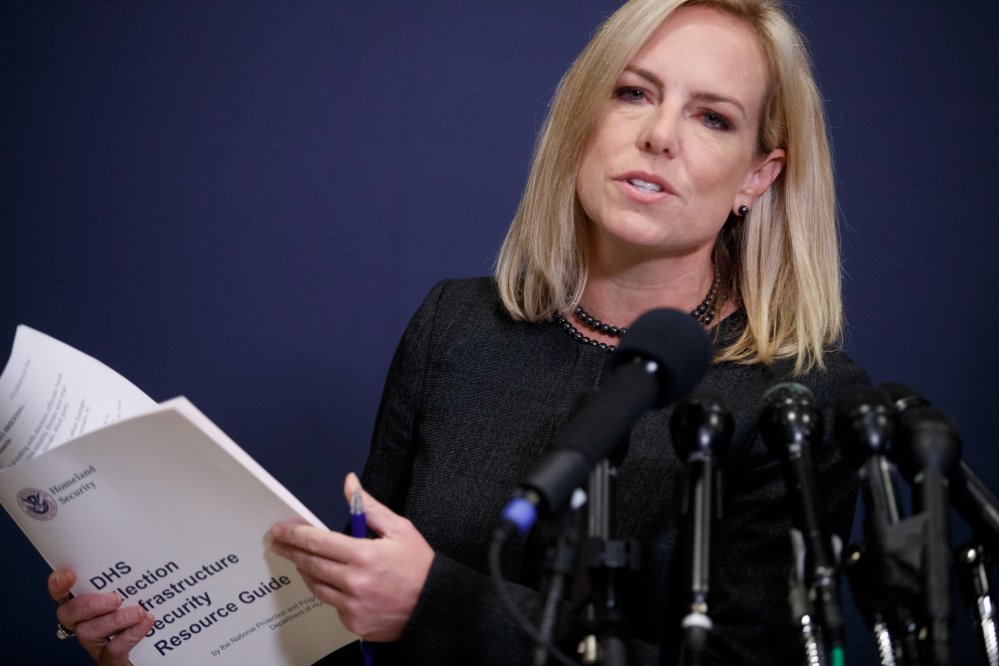
With this in mind, Kirstjen Nielsen, before ending her tenure as Homeland Security secretary, reportedly tried to organize a meeting of relevant cabinet secretaries to prepare a coordinated strategy in preparation for the next election cycle.
Her efforts would’ve benefited from some presidential leadership, which she never received. In fact, according to a New York Times report, acting White House Chief of Staff Mick Mulvaney told Nielsen not to even broach the subject of foreign interference in our elections around Donald Trump, apparently because it makes the president feel bad.
Ms. Nielsen left the Department of Homeland Security early this month after a tumultuous 16-month tenure and tensions with the White House. Officials said she had become increasingly concerned about Russia’s continued activity in the United States during and after the 2018 midterm elections — ranging from its search for new techniques to divide Americans using social media, to experiments by hackers, to rerouting internet traffic and infiltrating power grids.
But in a meeting this year, Mick Mulvaney, the White House chief of staff, made it clear that Mr. Trump still equated any public discussion of malign Russian election activity with questions about the legitimacy of his victory. According to one senior administration official, Mr. Mulvaney said it “wasn’t a great subject and should be kept below his level.”
It’s easy for many observers outside the White House to get the impression that the delicate president has a fragile ego, but this report suggests the problem might be even more severe than we’ve been led to believe.
U.S. intelligence officials believe a foreign adversary may target our elections next year, but no one should bring this up in the president’s presence, because he prefers not to be reminded of the dubious legitimacy of his own election.
The principal goal, in other words, isn’t to protect the American system of elections from a foreign attack, but rather, it’s to protect the American president’s feelings.
Making matters worse, this is not just a story about White House passivity and negligence in the face of a looming threat. On the contrary, regular readers may recall, Trump has taken some steps that might even make the problem worse. It was, after all, just last year when the White House eliminated the job of the nation’s cyber-security czar, as part of John Bolton’s reorganization of the National Security Council. The New York Times reported at the time, “Cyber-security experts and members of Congress said they were mystified by the move…. It was the latest in a series of steps that appeared to run counter to the prevailing view in Washington of cybersecurity’s importance.” A year later, it’s no easier to defend the move.
Steve Benen is a producer for "The Rachel Maddow Show," the editor of MaddowBlog and an MS NOW political contributor. He's also the bestselling author of "Ministry of Truth: Democracy, Reality, and the Republicans' War on the Recent Past." Recommended


