








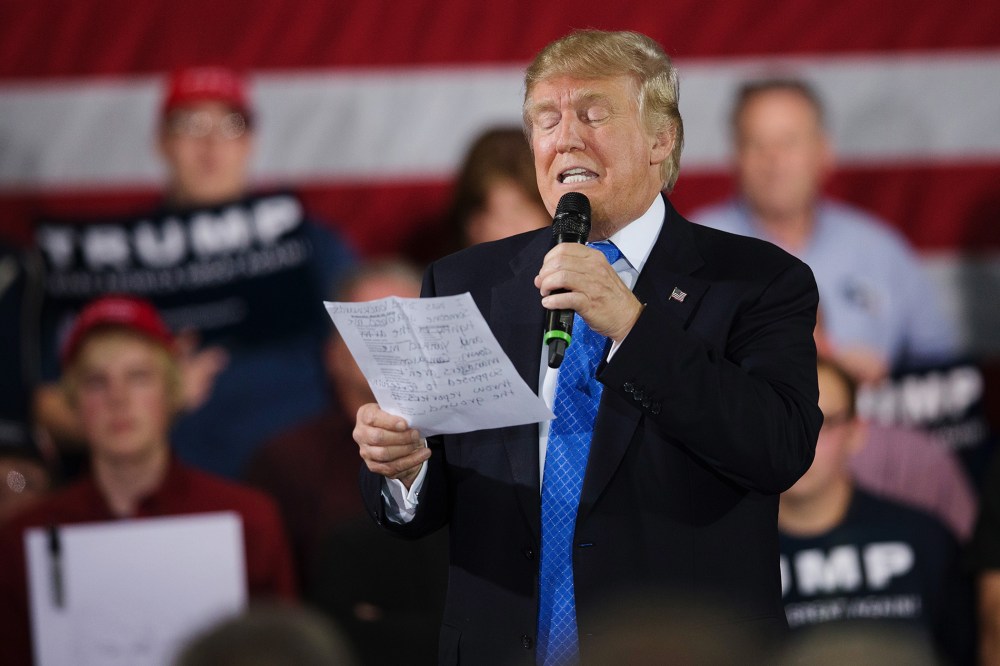
Donald Trump, for reasons that have never been altogether clear, identified the trade deficit as one of the nation’s most important and damaging challenges. The president even promised to soon cut the trade deficit in half.
The Republican’s failure to reach that goal is now obvious: the Trump administration reported yesterday that the trade deficit in goods has reached record heights (or depths, depending on how one looks at it). Catherine Rampell explained in her new column that the president can’t pass the buck on this one — since his policies, intended to shrink the trade gap, made it worse.
He has picked trade wars the world over, with friends and foes alike. He has also threatened even more tariffs, including an additional hike in tariffs on Chinese goods, a new “national security”-driven duty on auto imports, etc. These actions and threats have led to some predictable consequences.
One is that U.S. companies have stocked up on some imported goods to beat the tariffs, which increases imports in the short run. Higher imports = bigger trade deficit.
Another is that other countries have levied their own retaliatory tariffs on our own products — most famously, red-state goods such as soybeans and bourbon. So there has been less demand for U.S. exports. Lower exports also = bigger trade deficit.
Philip Bump added that one of Trump’s most important mistakes was making promises on the issue that he’d never be able to keep.
But stepping back, it’s also worth appreciating the larger pattern — because when it comes to the economy, this isn’t the only area in which the president’s rhetoric is at odds with his reality.
On job creation, for example, Trump considers himself the greatest president in human history. At a White House event yesterday, he boasted, “Unemployment at 3.7, 3.6, probably.” (The unemployment rate is actually 4%, but who’s counting.)
What the president tends to overlook is the fact that job growth in the United States has slowed since he took office. In his first two years in the White House, the economy created 4.78 million jobs. That’s a perfectly good number, reflecting a healthy job market, but in the preceding two years, the economy created 5.08 million jobs.
How does Trump explain the drop off? So far, he hasn’t.
And then there’s the nation’s economic growth. According to the Trump administration, there was annual GDP growth of 2.9% in 2018, which, again, is a good number — it matched the best year of the Obama era — and an improvement on Trump’s first year in office. But the Republican told voters that if he were elected, his economic policies would create annual growth between 4% and 6%. Those were ridiculously ambitious goals, which he’d never be able to reach, and which make decent growth look worse by comparison. So where does that leave us? Trump vowed to cut the trade deficit, but he made it bigger; he promised to accelerate job growth, but the market has cooled; and he predicted GDP growth as high as 6%, but he hasn’t come close. None of this is to say that his presidency has been a failure on the economy. It really hasn’t. But Trump is desperate to take a “promises made, promises kept” message to voters next year, and his record will make that pitch difficult to believe. Postscript: Bloomberg News recently reported, “Measured by 14 gauges of economic activity and financial performance, the U.S. economy is not doing as well under Trump as it did under all but one of the four Republicans and three Democrats who have occupied the White House since 1976.”
Steve Benen is a producer for "The Rachel Maddow Show," the editor of MaddowBlog and an MS NOW political contributor. He's also the bestselling author of "Ministry of Truth: Democracy, Reality, and the Republicans' War on the Recent Past." Recommended


