








As Election Day came to an end last week, the results in U.S. Senate races were the most discouraging aspect for Democrats in an otherwise strong cycle for the party. Three red-state Democratic incumbents had lost, another was trailing in Montana, and the GOP candidate was ahead in Arizona’s open-seat contest.
On Wednesday morning, Donald Trump held a press conference in which he boasted, in reference to the upper chamber, “[W]e picked up a lot…. Fifty-five is the largest number of Republican senators in the last 100 years.”
As a factual matter, that wasn’t even close to being true. There was, for example, a 55-member GOP Senate majority as recently as 2006, which wasn’t exactly a century ago.
But it was also wrong because the Republican majority in the Senate next year won’t have 55 members. Sen. Jon Tester (D) ended up prevailing in Montana, and as we learned last night, the Arizona race worked out in Democrats’ favor, too.
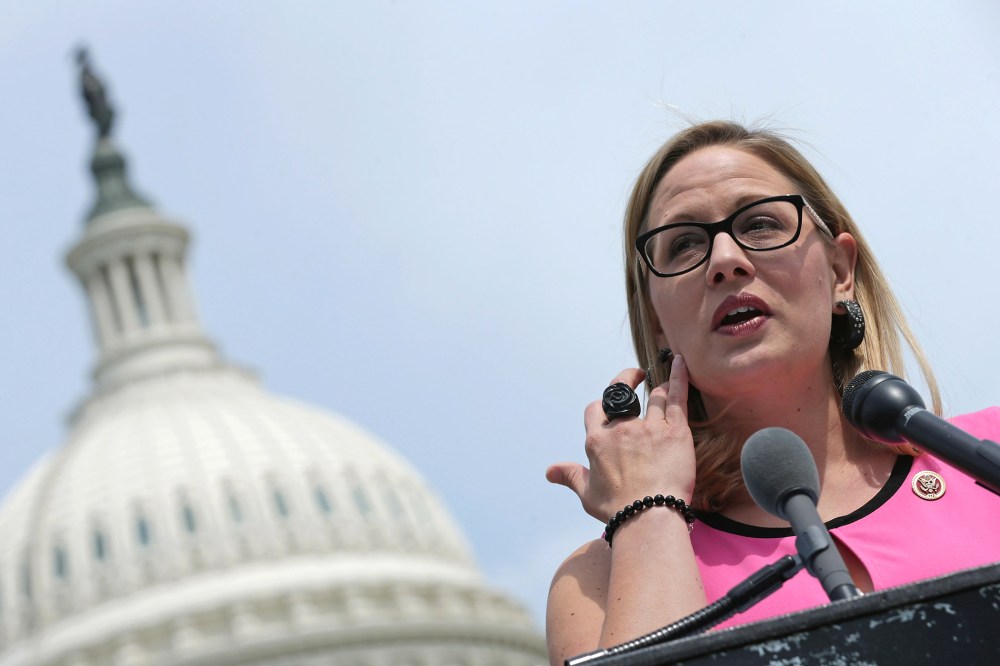
Democratic Rep. Kyrsten Sinema is the apparent winner in the Arizona Senate race, narrowly defeating Republican Rep. Martha McSally, according to NBC News.
As of Monday night, Sinema had 1,097,321 votes, or 49.68 percent, while McSally had 1,059,124 votes, or 47.96 percent.
At 42, Sinema will be the Senate’s youngest woman. She’ll also be the first ever openly bisexual U.S. senator, Arizona’s first woman senator, and the first Democratic senator elected in Arizona since the 1980s.
The national reverberations of the outcome are already significant.
For example, thanks to Sinema’s victory, the Senate will be even more closely divided than expected. With one Senate race unsolved, and one Senate special election still remaining, the Republicans’ net gain in the chamber currently stands at zero — the GOP had 51 seats going into Election Day, and at least for now, it has 51 seats going into the next Congress.
That’s likely to change fairly soon, with Republicans relatively well positioned in Florida and Mississippi, but even if both races end up in the GOP’s favor, that would give Republicans a net gain of two for the cycle and a three-seat majority next year — creating a 53-47 chamber — smaller than the president’s boast last week, and smaller than what the National Republican Senatorial Committee expected as recently as a month ago.
This will matter, of course, when it comes to governing in the next Congress, but it will also make it slightly less daunting for Democrats when looking ahead to the 2020 election cycle. Trump, meanwhile, has another reason to be bothered by the election results. The candidate he endorsed in Arizona lost and the candidate he attacked won — all in a state he won two years ago. What’s more, Trump bragged last week, in reference to a question about congressional retirements, “In Jeff Flake’s case, it’s me. Pure and simple. I retired him. I’m very proud of it. I did the country a great service.” And now Jeff Flake’s seat has flipped from “red” to “blue.” As for McSally — who lost her own U.S. House district during her Senate race — there’s still a chance she’ll end up in the Senate anyway. Appointed Sen. Jon Kyl (R) is serving in the late Sen. John McCain’s (R) seat, but Kyl isn’t expected to stick around, and Arizona Gov. Doug Ducey (R) will need to appoint someone else. McSally is likely to be on a very short list.
Steve Benen is a producer for "The Rachel Maddow Show," the editor of MaddowBlog and an MS NOW political contributor. He's also the bestselling author of "Ministry of Truth: Democracy, Reality, and the Republicans' War on the Recent Past." Recommended


