








The national political landscape isn’t exactly tranquil right now. The White House is facing crisis conditions; the president’s political operation is facing a counter-espionage investigation; the president himself may be facing obstruction-of-justice allegations; U.S. allies are giving up on American leadership in ways without modern precedent; and Congress’ agenda is in peril.
It’s against this backdrop that policymakers have to prepare to raise the debt ceiling.
Technically, the nation reached its limit in March, but at that point, the Treasury Department’s “extraordinary measures” kicked in, giving Congress a little breathing room. Nevertheless, Treasury Secretary Steven Mnuchin urged lawmakers more than three months ago to raise the debt ceiling “at the first opportunity.”
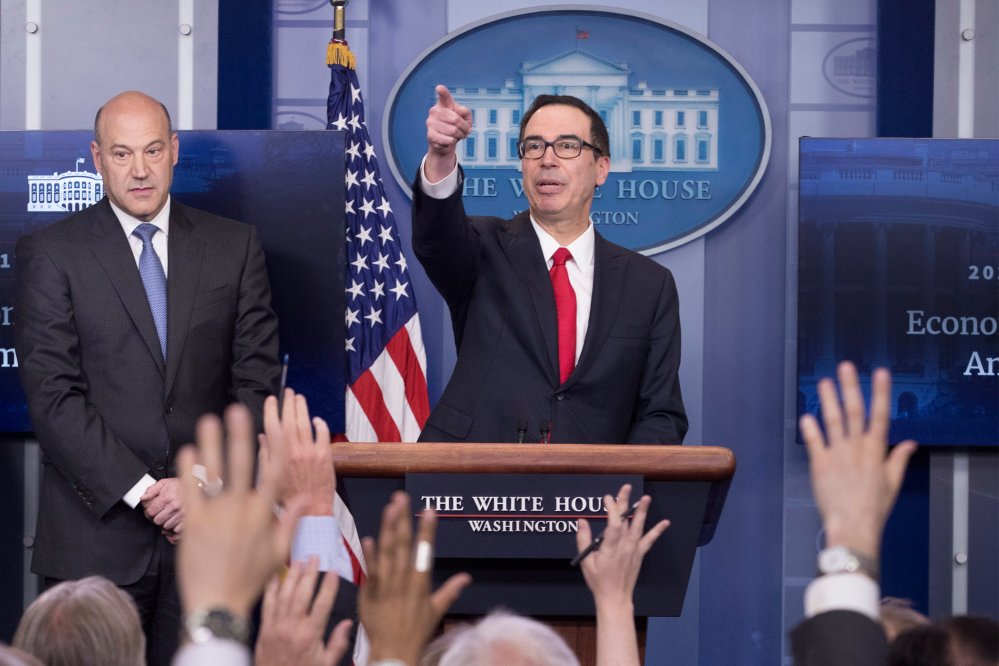
Congress has so far ignored the appeal, prompting Mnuchin to announce on Friday that he has “plans and backup plans for funding the government” into at least September if Congress does not raise the debt ceiling before its August recess. The Washington Post reported:
Asked at the news conference what sort of powers or backup plans he has if the debt ceiling isn’t raised, Mnuchin said with a smile, “Treasury secretary superpowers.” He didn’t respond to questions about whether this included plans to sell off U.S. assets, such as the gold reserve.
“We will be fine, okay, if they don’t do it beforehand,” Mnuchin said, “but I would emphasize that I think the sooner they do it, the less uncertainty there is in the market, and it is important to send a clear signal to the market that, again, this is not an issue.”
Mnuchin’s intended audience was almost certainly investors and global markets. “Don’t worry,” Donald Trump’s Treasury secretary seemed to be saying. “Everything’s fine. The paperwork will be taken care of. There’s certainly no reason for anyone to start ringing any alarms.”
The truth, however, isn’t quite so straightforward.
Federal tax receipts have been quite a bit lower than expected in recent months, which only accelerates the timeline for an inevitable debt-ceiling increase. Complicating matters, the Trump administration can’t seem to get its story straight: while Mnuchin has urged Congress to pass a clean bill, Trump’s far-right budget director, Mick Mulvaney, has said he wants lawmakers to tack on some conservative priorities in the legislation.
For now, the president said he’s taking Mnuchin’s side, but (a) Trump is also on record having argued the exact opposite before the election; (b) Gary Cohn, Trump’s National Economic Council director, has expressed support for Mulvaney’s argument; and (c) White House Press Secretary Sean Spicer recently hedged when asked to back up Mnuchin’s call for a clean bill.
And while Trump World is divided against itself, congressional Republicans — the folks who’ll have to schedule and execute the increase — see raising the debt limit as a difficult and painful vote, largely because they themselves made these votes difficult and painful during the Obama era for reasons that never really made any sense.
House Freedom Caucus members last month “demanded” that any debt-ceiling increase be tied to assorted conservative goals that far-right lawmakers want, which all but guarantees that House GOP leaders will have to reach out to House Democrats to avoid a crisis. House Speaker Paul Ryan (R-Wis.) would prefer not to do this — it’s what John Boehner was forced to do on several occasions, and it contributed to his downfall — but the Republican leader also realizes default isn’t a realistic option. And if the Speaker grudgingly turns to House Dems, hat in hand, their support may end up carrying costs of its own. After all, Democrats will have a fair amount of leverage in that situation, and it’s hard to blame them for exploiting the advantage. All of which is to say, this is a mess that may yet carry real consequences for all of us. It is, after all, the full faith and credit of the United States on the line. Postscript: Democrats haven’t sought advice on what they should seek in exchange for their votes to raise the debt limit, but The New Republic recently recommended they ask for a change to the way the increasingly ridiculous and dangerous debt-ceiling process works, and that struck me as a very good idea.
Steve Benen is a producer for "The Rachel Maddow Show," the editor of MaddowBlog and an MS NOW political contributor. He's also the bestselling author of "Ministry of Truth: Democracy, Reality, and the Republicans' War on the Recent Past." Recommended


