








In the world of Republican campaign politics, this was pretty stunning.
It only took some brief remarks for Sen. Ted Cruz (R-Tex.) to widen the growing divide between himself and his Senate Republican colleagues.
Cruz told reporters here Friday that he plans to stay out of primaries involving GOP senators, a move that means the upper chamber’s top two Republicans will not have the public support of one of the most popular figures on the political right, as they each seek to fend off conservative challenges. It’s a decision that carries risks for Cruz’s long-term standing in the party, observers and Republican strategists say, but is likely to satisfy his most ardent supporters.
“The reason is simple,” Cruz explained after declining to endorse Senate Minority Whip John Cornyn (R-Tex.) or any other incumbent. “I think every elected official, including me, owes it to the people, owes it the grass roots, to go and make the case to the grass roots why he or she is representing their interests.”
Cruz, incidentally, was speaking in New Hampshire at the time.
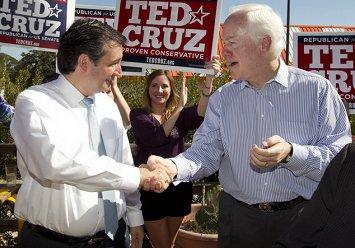
Regardless, this is extremely unusual. Cruz is a Republican senator from Texas. If his fellow Republican senator from Texas, Senate Minority Whip John Cornyn, faces a primary challenger, Cruz won’t so much as offer an endorsement to his colleague.
What’s more, note that Cruz is also the current vice chairman of the National Republican Senatorial Committee, which exists in large part to help Republican Senate incumbents, and yet the junior senator from the Lone Star State doesn’t intend to express support for literally any of his GOP colleagues.
The Atlantic noted back in March that “a remarkable number of both Republicans and Democrats” have already come forward “to say that they think Cruz is kind of a jerk.” The New York Times added that “even some Republican colleagues are growing publicly frustrated” with the right-wing freshman.
The right-wing senator’s new posture against endorsements for incumbents is only going to make matters worse.
Even beyond Texas, Cruz’s silence could embolden conservative activists and groups that boosted him to an unlikely 2012 win to press on against GOP incumbents. In Kentucky, the Club For Growth and the Senate Conservatives Fund, two groups that supported Cruz, are considering whether to back the primary challenger of Senate Minority Leader Mitch McConnell. A handful of other Senate incumbents are also facing some pressure from the political right. “It’s going to alienate many current senators and establishment Republicans,” Rice University political scientist Mark Jones said of Cruz’s posture. “But I think he’s already decided that bridge is burnt and he’s not going to try to reconstruct it.” We’ve seen some instances in which senators try to establish their own spheres of power outside the traditional party framework. Sen. Rand Paul (R-Ky.), for example, has a following independent of the party establishment. But note that even Paul has some interest in remaining part of the team — he endorsed his in-state colleague, Senate Minority Leader Mitch McConnell (R), early on. As of Friday, Cruz won’t even publicly support his own caucus’ leader’s re-election bid. It would cost Cruz almost nothing to say, as Chris Cillizza suggested this morning, “John’s a good man and a strong conservative and I am supporting him.” But Cruz doesn’t want to take even this cursory step. It’s hard not to get the impression that Cruz doesn’t much care about his role in the Senate, and is already planning to run for something else.
Steve Benen is a producer for "The Rachel Maddow Show," the editor of MaddowBlog and an MS NOW political contributor. He's also the bestselling author of "Ministry of Truth: Democracy, Reality, and the Republicans' War on the Recent Past." Recommended


