








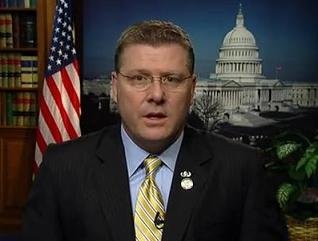
About five months ago, during Senate debate over the proposed American Jobs Act, the White House and nearly all congressional Democrats rallied behind a popular financing option: invest in job creation and create a surtax on millionaires and billionaires to pay for it.
Senate Republicans, not surprisingly, ignored polls showing broad national support for the idea. The Democratic surtax measures died at the hands of a GOP filibuster.
In an unexpected development, however, a conservative House Republican has apparently decided to break ranks on the issue.
Freshman Republican Rep. Rick Crawford will propose a surtax on millionaires Thursday morning, a crack in the steadfast GOP opposition to extracting more money from the nation’s top earners.
The Arkansas Republican will unveil the plan during a local television interview Thursday morning, and plans to introduce legislation when the House returns next week, according to sources familiar with his thinking.
Crawford will propose the additional tax — expected to be north of 2.5 percent — on individual income over $1 million as part of a broader fiscal responsibility package.
To say this is unusual is an understatement. Thanks in part to Grover Norquist’s pledge, Republican anti-tax rigidity has been unyielding for many years. GOP officials are occasionally comfortable recommending federal tax increases on low-income families who are not currently eligible to pay a federal income tax; and will sometimes consider new “revenue” so long as taxes remain unchanged; but for a Republican to ask the wealthy to pay a little more is unheard of in recent decades.
It makes Crawford’s proposal a breakthrough moment — or at least, a possible breakthrough moment. There are a couple of catches to keep an eye on.
The first is that the Arkansas congressman is willing to support a millionaires’ surtax, not to create jobs, but to lower the deficit. In the context of a fiscal debate, Crawford’s measure would, in fact, be a sensible part of a debt-reduction package, but most Democrats — as well as most economists — believe economic growth and job creation are far more important than bringing the budget closer to balance.
In this sense, the freshman’s idea may have merit, but he intends to apply the new revenues to the wrong problem. Second, before we can evaluate Crawford’s idea, it’s important to know what he expects in return for the surtax. The article said this would “part of a broader fiscal responsibility package,” but the devil’s always in the details. Could Democrats go along with a plan that includes a 2.5% surtax on millionaires and billionaires? Sure. Would they trade the surtax for Medicare privatization? Of course not. This is a worthwhile concession, but if it comes with too great a cost, any hopes for a deal will fall apart quickly. And finally, other congressional Republicans haven’t exactly thrown their support behind Crawford’s measure. The Arkansan hasn’t faced GOP excommunication just yet, but if his fellow Republicans stick to the usual script — no tax increases on anyone at any time by any amount for any reason — then his offer will have symbolic significance, but no practical effect. Crawford appears to have taken a step towards a larger compromise. But there are an awful lot of additional steps between this and his destination.
The place for in-depth analysis, commentary and informed perspectives. Recommended


