









The latest NBC News/Wall Street Journal poll included plenty of horse-race data to chew on, but it also included questions about the kinds of qualities voters want (or don’t want) to see in a presidential candidate. Only a handful of qualities were seen as problematic for most voters:
[T]he most unpopular candidate qualities in a general election are being a socialist, being older than 75 years of age and having a heart attack in the past year.
Specifically, 53% of Americans are uncomfortable voting for a candidate over the age of 75, 57% are uncomfortable with candidates who had a heart attack in the past year, and 67% balked at socialist presidential candidates.
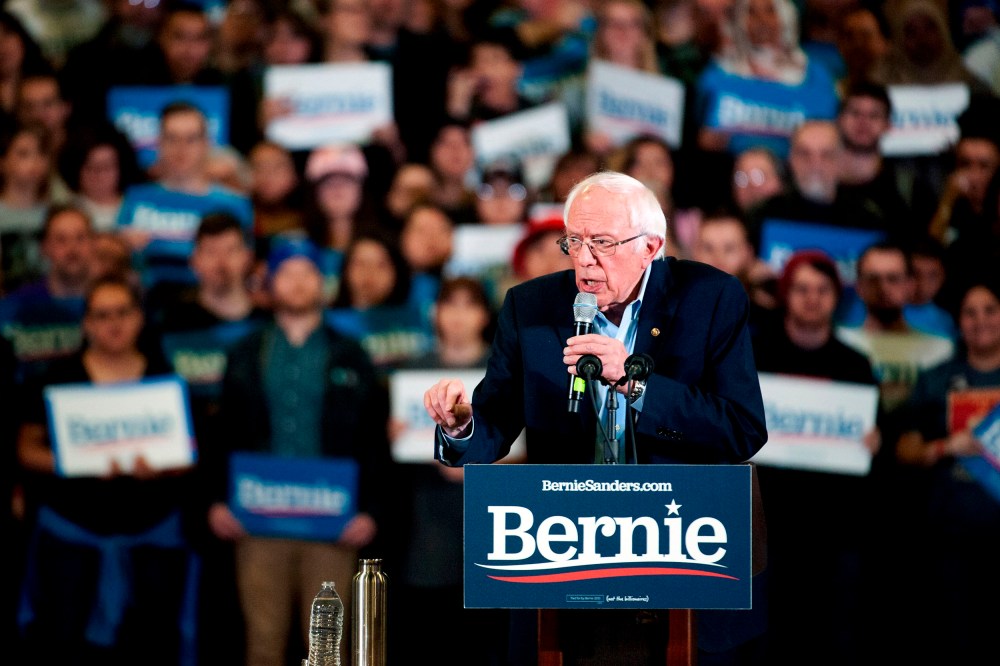
Taken at face value, results like these appear pretty brutal for Sen. Bernie Sanders (I-Vt.). After all, he’ll celebrate his 79th birthday ahead of Election Day; he was hospitalized in October after suffering a heart attack; and the Vermont senator has, for many years, embraced the “socialist” label.
And yet, in the exact same NBC News/Wall Street Journal poll, when voters were asked to consider a hypothetical general-election match-up pitting Bernie Sanders against Donald Trump, Sanders had a modest lead, 50% to 46%. Most voters said they don’t want a candidate like Sanders, but when given a choice between Sanders and the incumbent president, half the country still sides with the independent senator.
The apparent contradiction comes up all the time. Last week, Gallup released a report that found 53% of Americans would not vote for a presidential candidate who considers himself or herself to be a “socialist,” even if the candidate were otherwise well-qualified. Less than 24 hours earlier, a Quinnipiac poll showed Sanders with a healthy lead over Trump in a hypothetical match-up, 51% to 43%.
Something seems amiss, right? National polling keeps featuring two competing messages: more than half the country keeps saying, “We don’t want a candidate like Bernie,” while simultaneously saying, “We’re prepared to vote for Bernie.”
What explains the contradiction? I think there are a few possible explanations.
Sanders may, for example, be a good enough candidate to transcend the reservations. Much of the public may be reflexively uncomfortable with the idea of voting for a 79-year-old socialist who recently had a heart attack, but it’s possible that many of these same voters are nevertheless gravitating to Sanders, his message, and his platform. Americans, in other words, may care far more about the candidate than the candidate’s qualities.
It’s also possible that the public’s reservations about Sanders are genuine, but a whole lot of voters won’t let those concerns outweigh their desire to vote against the incumbent president. Former Rep. Joe Walsh (R-Ill.), for example, after ending his long-shot GOP presidential bid, was asked on CNN recently whether he’d vote for Sanders over Donald Trump. “I would rather have a socialist in the White House than a dictator,” he replied. I suspect Walsh isn’t alone. The possible explanation that may prove problematic, however, is the one that’s harder to test: what if a lot of voters are prepared to back Sanders now, despite his age, ideology, and recent health troubles, because they don’t yet know about his age, ideology, and recent health troubles? For well-informed and politically engaged voters — including, I’m assuming, you — Sanders’ qualities are hardly a secret. Indeed, they seem like common knowledge. But there’s a significant chunk of the electorate with a more passing familiarity with politics and candidates. Asked by a pollster about their 2020 preferences, these voters may balk at the idea of a 79-year-old socialist who recently had a heart attack, and then turn around and express support for the Vermont senator, because they’re simply unaware of these details about Sanders. I don’t know which of these explanations is the most accurate one, but it’s the third one that poses the greatest challenges.
Steve Benen is a producer for "The Rachel Maddow Show," the editor of MaddowBlog and an MS NOW political contributor. He's also the bestselling author of "Ministry of Truth: Democracy, Reality, and the Republicans' War on the Recent Past."
Latest Post
Recommended


