








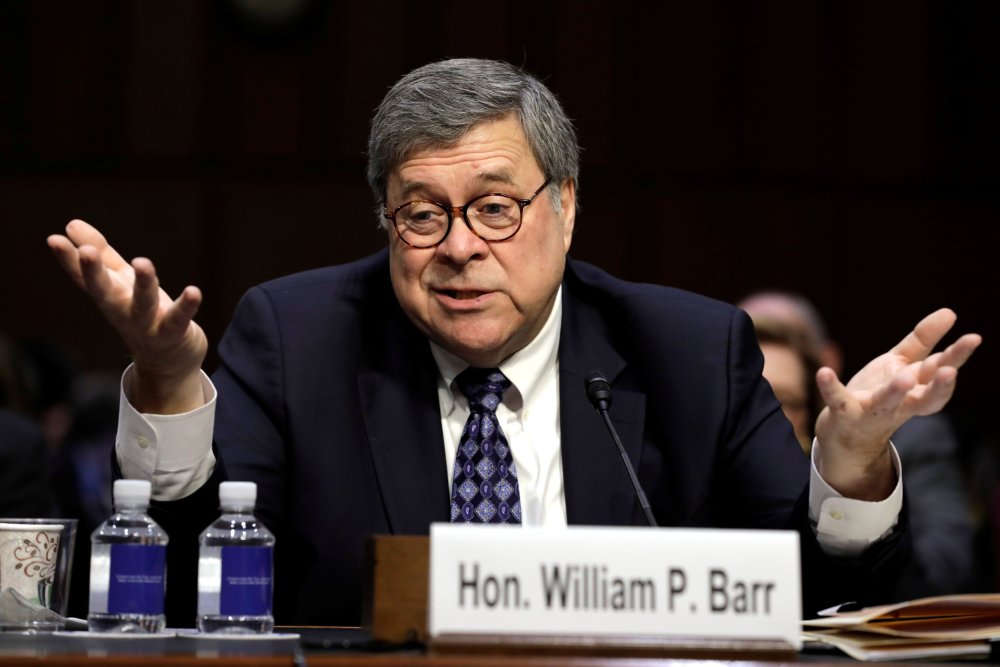
For nearly a month, much of the political world acted as if they knew all they needed to know about Special Counsel Robert Mueller’s report — not because they’d seen the document, but because they were willing to accept Attorney General Bill Barr’s claims at face value.
At one point, Senate Judiciary Committee Chairman Lindsey Graham (R-S.C.) suggested he wasn’t eager to read the actual Mueller report, in part because his trust in Barr was so complete, and in part because he didn’t share Democrats’ “paranoia” surrounding the controversy.
This was not an uncommon perspective. After the attorney general’s original non-summary summary, the White House, Republicans, and even many in media acted as if the entire Russia scandal had instantly evaporated. Barr had exonerated Donald Trump, and it was incumbent upon all of us to simply accept that as fact.
Those who did made a mistake. As the Washington Post reported:
Before the special counsel’s report on Russia and President Trump was released to the public, Attorney General William P. Barr made several statements about what was in its 448 pages.
Barr received special counsel Robert S. Mueller III’s report last month and outlined its principal conclusions in a letter dated March 24. Barr then held a news conference on Thursday, shortly before releasing a redacted version of Mueller’s report.
As it turns out, in some cases, Barr’s characterizations were incomplete or misleading.
Since yesterday afternoon, several outlets have published very compelling pieces, offering extensive details contrasting what the attorney general claimed and what turned out to be true. Each of these pieces paint a damning picture, and they’re worth your time.
But stepping back, I’m also interested in what happens now.
Democratic leaders have accused the attorney general of “deliberately distorting significant portions” of the Mueller report. Some Democrats have suggested Barr should resign. Jon Chait made the case that impeaching the Republican lawyer is a credible idea. It’s unlikely, of course, that congressional Republicans will raise any similar concerns, especially with the White House cheering Barr on. But it’s still a question that deserves an answer. The attorney general appears to have lied and acted as an extension of the White House, almost certainly knowing he’d get caught. Will there be any accountability? * Postscript: Deputy Attorney General Rod Rosenstein wrote a piece for Time magazine this week, celebrating Barr as a “brilliant and principled conservative lawyer,” who has “earned widespread respect for his integrity and professionalism.” Rosenstein added, “With Bill Barr at the helm, the rule of law is secure.” Is it too late for a retraction?
Steve Benen is a producer for "The Rachel Maddow Show," the editor of MaddowBlog and an MS NOW political contributor. He's also the bestselling author of "Ministry of Truth: Democracy, Reality, and the Republicans' War on the Recent Past." Recommended


