








Whenever some guy like me rudely points out that House Republicans haven’t passed any meaningful jobs legislation in this Congress, GOP leaders’ offices are quick to respond. “Oh yeah?” the typical message begins, “You’re ignoring the more than 30 jobs bills we passed but those rascally Senate Democrats refuse to consider.”
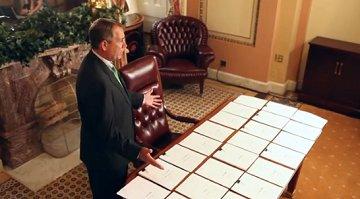
Republicans are quite serious about this. In fact, about a month ago, as President Obama was set to deliver a big speech on the economy, House Speaker John Boehner (R-Ohio) appeared in a video alongside a table with piles of GOP jobs bills — as if to prove how much he and his caucus take the issue seriously.
There is, however, a problem. As Erin Mershon reported yesterday, the Republican job bills don’t actually create jobs.
The GOP jobs package, which currently includes 32 bills, represents Republicans’ hallmark legislative accomplishment over the past two years. In the months ahead of the election, they will lean on it as proof of two things: that they are not the do-nothing obstructionists that Democrats paint them as, and that they are working hard to address the 8.2 percent unemployment rate.
But there’s a problem with their jobs bills: They don’t create jobs. At least, they won’t any time soon.
In interviews conducted by The Huffington Post with five economists, most said the GOP jobs package would have no meaningful impact on job creation in the near term. Some said it was not likely to do much in the long term, either.
Gary Burtless, a senior economist at Brookings, went so far as to call many of the bills touted by Boehner as “laughable.”
Jesse Rothstein, an economics professor at UC Berkeley added, “It’s game playing to try to pretend like they’re doing something. It’s silly season, and so they know they have to put up something that has the label ‘job creation’ on it, whether or not it would work.”
The larger significance to this is the realization that comes when we compare the House GOP’s “jobs bills” to the American Jobs Act proposed by President Obama.
A few weeks ago, I offered a suggestion I jokingly called “radical”: both sides of the political divide should present detailed jobs plans. Then, those plans should be subjected to independent scrutiny to help determine which would be more effective.
The truth is, however, we’ve already seen this kind of analysis. Remember, immediately after Obama presented his plan in September, independent analysis concluded the Americans Jobs Act would have a significant and positive effect. From an AP report published at the time: A tentative thumbs-up. That was the assessment Thursday night from economists who offered mainly positive reviews of President Barack Obama’s $450 billion plan to stimulate job creation. […] Mark Zandi, chief economist at Moody’s Analytics, estimated that the president’s plan would boost economic growth by 2 percentage points, add 2 million jobs and reduce unemployment by a full percentage point next year compared with existing law. Macroeconomic Advisers wasn’t quite as optimistic, but its analysis projected that the White House plan “would give a significant boost to GDP and employment over the near-term.” The firm would expect to see the proposal create at least 1.3 million jobs. On the other hand, we have the 32 bills passed by House Republicans — the GOP did not subject their measures to independent economists for some reason — which we now see wouldn’t make much of a difference at all. GOP lawmakers still claim credibility on job creation — and are convinced the president isn’t to be taken seriously — but they’re apparently not paying close enough attention.
The place for in-depth analysis, commentary and informed perspectives. Recommended


