








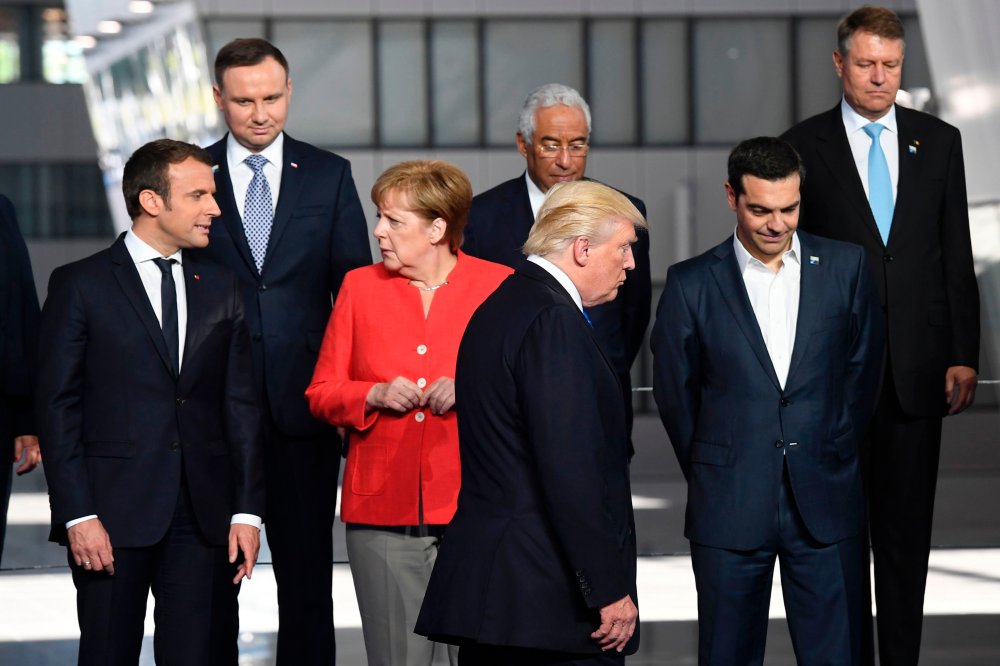
Donald Trump will attend a NATO gathering in a couple of weeks, and the New York Times reported the other day that allied leaders aren’t sure what to expect from the American president.
“Even senior American officials said they had no clarity on Mr. Trump’s intentions for this meeting,” the article said. “They have told senior European officials that a lot will depend on Mr. Trump’s mood as he arrives and what is being highlighted on his favorite American news media outlets such as Fox News.”
This is our lives now.
Of ongoing concern ahead of the meeting isn’t just the president’s unfortunate temperament, it’s also his longstanding antipathy toward the alliance itself. A Washington Post piece noted this week that Swedish Prime Minister Stefan Lofven “explained to Trump that Sweden, although not a member of NATO, partners with the alliance on a case-by-case basis. Trump responded that the United States should consider that approach.”
A senior administration official later said Trump was joking. Reading this Axios piece yesterday, I’m skeptical of the explanation.
In one extraordinary riff during his meeting with the G7 heads of state earlier this month in Quebec, Trump told the other leaders: “NATO is as bad as NAFTA.” An official read this quote to me from notes transcribed from the private meeting.
Noting the degree to which Trump hates NAFTA, a Vox piece added yesterday, “It was painfully clear before Trump entered the White House that he had a penchant for attacking his friends and cozying up to America’s adversaries. But now it seems Trump is hellbent on undermining the country’s strongest military alliance — possibly weakening America’s power in the world in the process.”
Wait, it gets worse.
Trump has also argued in several recent public appearances that the European Union only exists to empower Europeans “to take advantage of the United States.” This isn’t even close to being true.
Carl Bildt, the former conservative prime minister of Sweden, responded yesterday that the American president “has a completely distorted view of the history of European integration — so distorted that it’s dangerous.”
It’s against this backdrop that the Washington Post‘s Josh Rogin published a rather alarming piece overnight on Trump’s “personal attacks on the European Union and other pillars of the Western order.” During a private meeting at the White House in late April, Trump was discussing trade with French President Emmanuel Macron. At one point, he asked Macron, “Why don’t you leave the E.U.?” and said that if France exited the union, Trump would offer it a bilateral trade deal with better terms than the E.U. as a whole gets from the United States, according to two European officials. The White House did not dispute the officials’ account, but declined to comment. Let’s set aside for a moment the point that Trump’s proposal reveals a basic lack of understanding of Macron’s views and those of the people who elected him. This is an instance of the president of the United States offering an incentive to dismantle an organization of America’s allies, against stated U.S. government policy. Trump has been publicly trashing the E.U. and NATO since his campaign, but the pace and viciousness of his attacks have increased. The White House hasn’t yet offered any kind of public explanation for Trump’s animosity for institutional pillars of the Western world — pillars that the United States helped build, and which have enjoyed bipartisan support for decades — though I’m eager to hear the justification. Might it have something to do with the fact that Russian President Vladimir Putin would love nothing more than to see the United States help weaken alliances such as NATO and the European Union?
Steve Benen is a producer for "The Rachel Maddow Show," the editor of MaddowBlog and an MS NOW political contributor. He's also the bestselling author of "Ministry of Truth: Democracy, Reality, and the Republicans' War on the Recent Past." Recommended


