








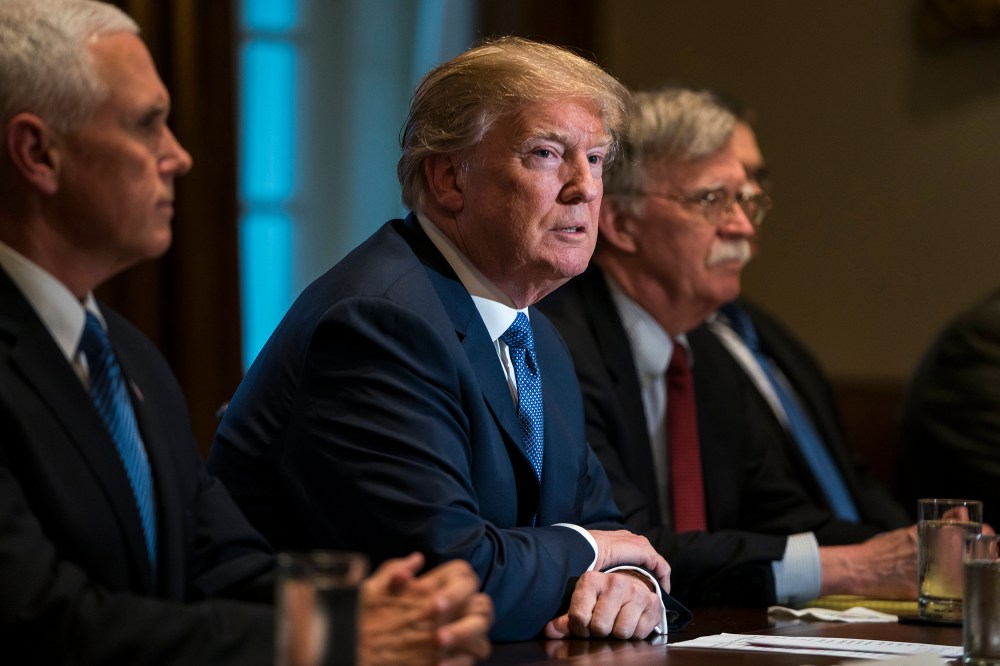

Yesterday afternoon in the Oval Office, reporters asked Donald Trump about a possible response to Iran shooting down a U.S. drone. “They made a very bad mistake,” the president said, echoing an earlier tweet.
Asked how he intended to proceed, Trump added, “You’ll find out… You’ll find out. You’ll find out…. You’re going to find out. They made a very big mistake.”
According to multiple accounts, the Republican soon after approved a military strike, before backing away soon after.
President Donald Trump approved military strikes on Iranian targets in retaliation for a strike on a U.S. drone but later backed away, The New York Times and The Washington Post reported Thursday night, citing multiple administration officials.
The Times quoted a senior administration official as saying the operation was under way in its early stages — with planes in the air and ships in position — when it was called off.
The fact that these details leaked doesn’t come as too big of a surprise. The number of people involved in planning and executing this kind of mission is considerable, so it stands to reason that we’d hear about what transpired.
That said, there are still plenty of questions as to what, exactly, prompted the president to back off. It’s possible, for example, that Trump decided restraint was the smarter move. It’s also possible there were some kind of logistical challenges that forced a change in plans.
The latter is of particular concern, since it leaves open the possibility that the president might yet approve military strikes on Iranian targets again.
What’s far clearer is the fact that Trump and his team don’t appear to have a coherent policy, per se, and their recklessness has contributed to a highly dangerous and unstable dynamic.
It may seem like ancient history, but the Republican president inherited a sound and effective U.S. policy toward Iran. Tehran had not only reached an international agreement with world powers over its nuclear program, but Iran was also honoring its commitments.
Trump, who’s never demonstrated any familiarity with the substance of the JCPOA policy, derailed it — by some measures, knocking over the first domino that set a series of actions in motion. The White House soon after hired one of the nation’s most notorious hawks, John Bolton, to serve as the White House national security adviser, despite (or perhaps because of?) his demands for “regime change” in Iran.
Trump proceeded to designate the Iranian Revolutionary Guard as a terrorist organization — against the advice of leading officials throughout the administration — further escalating matters. More recently, the Republican has sent a series of contradictory signals, drawing red lines one day, downplaying provocative Iranian actions the next. Iran now appears eager to test Trump’s limits, but even the American president himself — the nation’s first amateur chief executive — doesn’t seem to know what he wants to do. Trump has surrounded himself with hawks, but he appears reflexively opposed to the very idea of a new and avoidable war in the Middle East. Oh, and have I mentioned that the United States doesn’t have a Defense secretary because the White House hasn’t been able to get its act together for the last six months? Looking ahead, it’s hard to know what to think. Bolton and Secretary of State Mike Pompeo will surely continue to push the president closer to a military confrontation, and those who see this prospect as madness — a group I am a part of — will continue to hope Trump chooses caution over war. It is, of course, unsettling to think an erratic president, with a tenuous relationship with reality, has to play the role of restrained adult in the West Wing.
Steve Benen is a producer for "The Rachel Maddow Show," the editor of MaddowBlog and an MS NOW political contributor. He's also the bestselling author of "Ministry of Truth: Democracy, Reality, and the Republicans' War on the Recent Past." Recommended


