









In an effort to defend her state’s controversial new voter ID law last year, Texas State Rep. Debbie Riddle offered a memory.
She’d once seen a Latino woman at a polling place who needed assistance because she couldn’t speak English and seemed unfamiliar with the process, Riddle recalled during a legal deposition.
The law was being challenged by the federal government, and Riddle was asked to offer specific incidents of voter fraud that justified the new rules.
Riddle, a Republican who has been a leader of Texas’s efforts to make voting harder, said she had no idea whether the woman she saw that day was a citizen or not, or even whether she had ultimately voted.
“She was not only limited in English, she really didn’t know any English,” Riddle recalled. Riddle said the incident left her “perplexed [as to] how anyone could come in and attempt to vote and have just a complete disconnect of the entire process.”
Riddle’s suspicions at the ballot box put her at the cutting edge of her party’s strategy on voting rights. While the national GOP has said it will focus on reaching out to Latinos, Republicans on the ground have taken a very different tack: In recent years, a host of voter suppression measures across the country—from purges of voter rolls, to citizenship requirements to ID laws like the one Riddle backed in Texas—have appeared to target Latinos.
“Voter suppression laws and policies threaten to relegate Latino voters to second-class citizenship and impede their ability to participate fully in American democracy,” warned a 2012 report on Latino voter disenfranchisement by the Advancement Project, a civil-rights group.
Rep. Raul Grijalva, an Arizona Democrat, was more succinct. “It’s pretty obvious to me who the target is,” he told msnbc.
Since the civil-rights movement, the public face of voter disenfranchisement has generally been black. African-Americans have been more systematically victimized by efforts to restrict voting than any other group. But while blacks last year appeared to recognize that they were the targets of restrictions on voting, and responded by turning out at a rate few pollsters expected, advocates for Latinos say many don’t yet understand that their rights are at risk.
“There is a lot more work to do in the Hispanic community to get them to connect the dots between the voter suppression movement and their emerging political power,” Juan Cartagena, the president of Latino Justice, told msnbc.
It’s no coincidence that these threats to Latino voter participation come at a time when the group’s political power is growing rapidly. Latinos now make up 10% of all eligible voters in the U.S., and with 60% of all new citizens in the coming years projected to be Latino, it’ll soon be much more. And because Latinos still punch far below their numerical weight—in 2010, just 31% of eligible Latinos voted, compared to 49% of non-Latino whites and 44% of African-Americans (see chart below)—they’ve got plenty of room to grow.
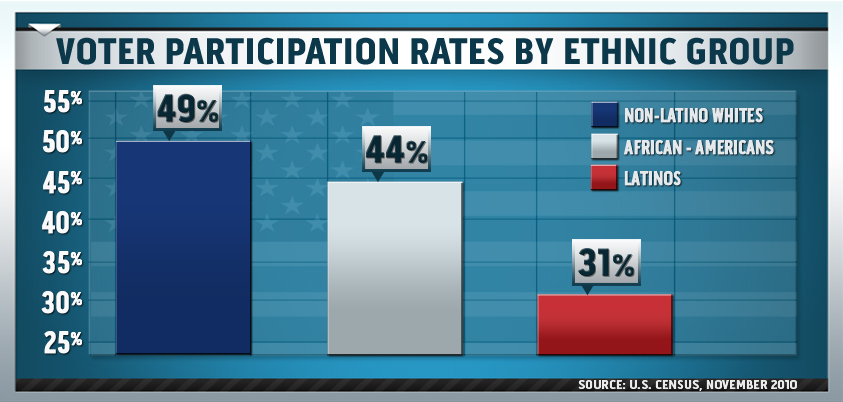
“We are seeing more intense efforts to block the growth of the electorate in states with greater Latino numbers,” Nina Perales, the top lawyer for the Mexican American Legal Defense Fund, told msnbc. “With greater Latino participation in the electorate, we are also seeing push-back from states.”
Nor is it likely a fluke that the Republican-led effort is intensifying at a time when Latinos may be poised to become a reliable part of the Democratic coalition, after being seen for decades as a legitimate swing vote. Last fall, more than 70% of Latinos supported President Obama, furthering a move toward the Democratic party that has been underway for several years.
As the targets of these voting crackdowns have expanded to include Latinos, so too has the rationale used to justify them, which now often focuses on the need to prevent non-citizens from voting. But, as with other forms of alleged voter fraud, there’s little evidence to suggest that’s happening. A lengthy investigative report by the Carnegie-Knight initiative found just 56 accusations of non-citizens voting since 2000. Of those, just one ended in a conviction.
Still, broad efforts targeting non-citizens are the next big thing in the “election integrity” movement. Hans Von Spakovsky, a Republican lawyer who has done perhaps more than anyone else to push the case for photo ID and similar measures, told PBS last year that laws requiring that people registering to vote first prove their citizenship are “the very next stage after photo ID.”
In fact, that stage is already well underway. Earlier this month, the Supreme Court heard a challenge to Arizona’s Proposition 200, passed in 2004, to prevent non-citizens—most of whom are Latino—from voting, by requiring that people provide documentation proving their citizenship when they register. The federal voter registration form already requires users to attest, on penalty of perjury that they’re a citizen. But thanks to Prop 200, Arizona has rejected more than 30,000 federal forms that don’t provide the additional citizenship documentation, according to opponents of the measure.
Arizona was ahead of the curve. Since 2011, Georgia, Alabama, and Kansas have passed similar measures. And in Michigan’s primary last year, Republican Secretary of State Ruth Johnson added a citizenship confirmation checkbox to ballot applications, creating confusion and keeping some legitimate voters from the polls, according to reports.
A recent Rasmussen poll found that 71% of respondents support requiring people to prove their citizenship when registering. In a statement to msnbc, Catherine Engelbrecht, the president of True the Vote, a Tea Party offshoot that stokes fear over voter fraud, noted that Mexico and Canada require proof of citizenship or naturalization, and called such laws “far from radical.”
But the push for these measures is being led by some of the same people behind recent efforts to target illegal immigrants more broadly. The Alabama measure was part of a larger law cracking down on illegal immigrants—it prevents them from receiving benefits, and encourages law enforcement to probe people’s citizenship status. Both the Alabama voting measure and the Kansas law, on which Alabama’s was closely based, were written by Kansas Secretary of State Kris Kobach, who also wrote Arizona’s controversial “Papers Please” law, parts of which were rejected by the Supreme Court last year.
“Their attitude is us versus them,” Grijalva said. ” ‘Us’ being, we’re the good Americans, they’re the new, bad Americans. And what can we do to minimize their influence in the political sphere?”
There’s little doubt that Latinos have been hit particularly hard by the citizenship laws. A federal court found that naturalized citizens—the vast majority of whom are Latino—face difficulty using their driver’s license to register. And Latinos are less likely than non-Latino whites to have a driver’s license in the first place, meaning they’d need a copy of their birth certificate or passport when registering. Those aren’t documents that most people carry around with them at the mall or other locations where voter registration drives tend to take place. It’s not just citizenship laws. Last year, 16 states sought to purge their voter rolls of non-citizens, despite lacking a system to ensure that naturalized citizens—who are disproportionately Latino—aren’t wrongly targeted.. Consider what happened in Florida, where Latinos make up more than half of all naturalized citizens. After Gov. Rick Scott, a Republican, was elected in 2010, the state sought access to the federal Department of Homeland Security’s Systematic Alien Verification for Entitlements (SAVE) database, but was denied because of privacy concerns. So instead, it used a state DMV database that lists non-citizens. But some people became citizens after getting their driver’s license, causing them to be wrongly flagged as non-citizens, and others were simply listed in error. The system produced so many false positives that Florida’s Republican Secretary of State, Kurt Browning, abandoned the effort. But last year, after Browning had been replaced by Ken Detzner, the purge gained new life. Detzner sent a list of 2,700 “sure-fire” non-citizens—narrowed from an earlier list of 180,000—to county election officials, directing them to purge anyone who didn’t verify their citizenship within 30 days. According to a Miami Herald analysis, 58% of voters targeted were Hispanic, and 87% were racial minorities. Again, there were so many errors that most county election officials refused to carry out the purge, and the federal government ultimately stepped in to stop it. But last August, Florida was granted access to SAVE, and with just six weeks to go before the election, it again re-started the purge, this time with just its 198 most rock-solid names. And again errors soon surfaced: One legitimate voter falsely flagged was Yeral Arroliga, an immigrant from Nicaragua, who told the Herald he’d already sent his proof of citizenship after being targeted in the earlier purge. “It just doesn’t help us whatsoever,” one Republican county election official told ThinkProgress. “It’s awful.” It was a similar story in Colorado last year. After an extensive effort by Republican Secretary of State Scott Gessler to purge the rolls—he also gained access to SAVE—a total of fourteen voters were ultimately found to be non-citizens. None had ever voted before. Meanwhile, a glitch in the state’s online registration system led to 779 registrations being invalidated—a problem that Gessler appeared far less focused on. Even voter ID laws hit Latinos particularly hard. A 2006 study by the Brennan Center found that 16% of Latinos don’t have an acceptable ID, compared to just six percent of non-Hispanic whites. In Texas, where a 2011 voter ID law was blocked by the federal government, more than 400,000 Latinos—nearly 10% of the state’s massive Latino population—live in counties without an office that issues IDs, the Justice Department found. This week, Virginia became the sixth state to pass a voter ID law, and Arkansas looks set to become the seventh. The courts have blocked such laws in Texas and South Carolina, under Section 5 of the Voting Rights Act. But a conservative push to have Section 5 declared unconstitutional reached the Supreme Court last month. A ruling is expected in June. Nowhere has the fight over Latino political power been as intense as in Texas, where even the redistricting process has been used as a weapon. A federal court found last year that Texas intentionally discriminated against Latinos in its 2011 plan, deliberately carving up districts held by minorities, while protecting those held by Anglos. Lawyers fighting the plan “have provided more evidence of discriminatory intent than we have space, or need, to address here,” a three-judge panel wrote. Indeed, Lone Star State Democrats say that Republicans have made a decision to give up on Latinos and instead work to keep them from the polls, just as they have with African-Americans. “They’ve come to the conclusion that they’re not going to win the Latino vote,” Texas Democratic party chair Gilberto Hinojosa told msnbc. “That for them to develop policies that attract the Latino vote, they automatically alienate the biggest part of their base. So the only way they can avoid the inevitable is to delay Latino voter participation.” Juan Cartagena sees more than partisan politics behind the trend. At issue, he argues, is nothing less than the status of Latinos in American civil society. “Voting is all about membership,” said Cartagena. “And people fight about membership in this country.”
Zachary Roth Recommended


