








Angela and Jamar sat down for a quick breakfast in Ollie’s Trolley, a small diner decorated with iconic ornaments reminiscent of the 1950s. They had come from Patterson, New Jersey to participate in reverend Al Sharpton’s “Justice for All” march in Washington, D.C.
“We had to come here and make a statement,” Angela said.
Demonstrators marched by the thousands on December 13th in major cities including Oakland, Boston, New York and St. Louis to protest police misconduct and the recent grand jury decision not to indict police officers in New York City and Ferguson, MO.
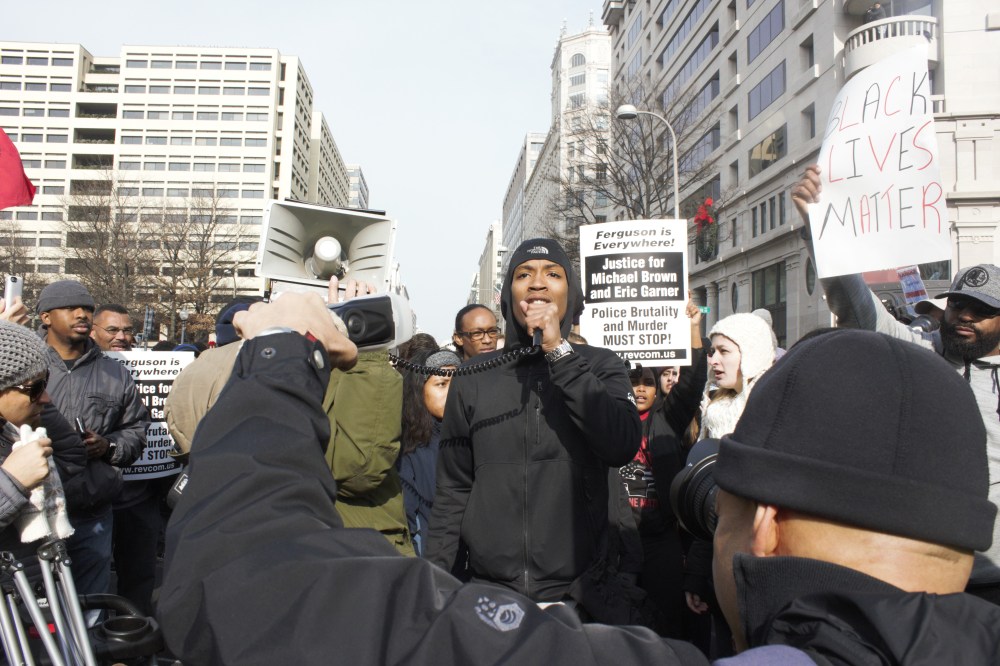
It was an unseasonably mild day in Washington, D.C., and protesters gathered on the corner of Pennsylvania Ave. and 13th street at 10:30 a.m., carrying a variety of signs including the ACLU “Black Lives Matter” poster and shouting chants that have come to be associated with the national protest against aggressive policing.
“Hands up, don’t shoot,” shouted Joseph Kent, college student at Morgan State University in Baltimore, Maryland, as crowds continued to arrive. Chanting into a microphone, Kent led his peers in a bold call and response of the protest slogan. At approximately 11:30 am, the march took off, with more than 10,000 participants marching down Pennsylvania Avenue toward the capitol building.
Although it’s been more than two weeks since the New York grand jury announcement that officer Pantaleo would not face criminal charges for placing Eric Garner in an apparent chokehold after police officers approached him for selling loose cigarettes, social response to the decision has lost little momentum.
Garner’s death was ruled a homicide by the New York City Medical Examiner’s Office caused in part by the chokehold; a move prohibited by the New York Police Department since 1993. Two cell phone videos capturing the event depict a passive Garner, who tried to discourage the police from interrogating him.
“I’m minding my business, officer, I’m minding my business,” Garner can be heard saying. “Please just leave me alone. Please.”
The decision not to indict officer Panteleo also comes on the heels of the Missouri grand jury decline to indict Ferguson police officer Darren Wilson in the killing of the unarmed black teen, Michael Brown. The decision not to indict two separate police officers, both occurring in different regions of the country and coupled with the recent death of Tamir Rice in Cleveland, Ohio and Akai Gurley in New York City, has ignited nationwide protests as well as renewed a conversation about the relationship between local law enforcement and minorities.
But is the country really sitting on the cusp of change and reform in how policing is exercised in America?
National social movements have historically had potential to incentivize political reform. The civil rights movement that took place in the 1960’s ultimately led to the passage of the Civil Rights Act of 1964, signed into law by President Lyndon B. Johnson and the Voting Rights Act, also signed by President Johnson. The impact that a renewed civil rights movement could have on policing was remarked on by Reverend Al Sharpton, host of MSNBC’s “PoliticsNation.”
“This is not a black march or a white march—this is an American march for the rights of the American people,” Sharpton said to a crowd of over 10,000 on a podium shared with the families of Michael Brown, Eric Garner and others who lost a loved one due to an altercation with police. “We are not anti-cop. But we are anti-police brutality.”
Brooklyn resident and Cablevision operator Jessica Vick, who came to the rally with her cousin Joyce to march and trace the steps that Dr. Martin Luther King Jr. led in the historic march of 1963, said the mix of ethnicities and ages made the march a unique and empowering experience.
“I felt a whole aura— a whole positive feeling over me,” Vick said. “It’s so powerful being there and marching for a cause and seeing everybody come together.”
D.C. police were visible, although they kept a low profile at the peaceful march. The rally drew close to 25,000 participants.
On a recent segment on his MSNBC show, Sharpton stressed the historical significance of the response to these cases.
“There’s no doubt in my mind that policing is the biggest civil rights issue of our time,” Sharpton said during a segment on “PoliticsNation.” “And the issue goes back decades. But now, we may finally be seeing some real change in America.”
Scrutiny from the United States Justice Department is serving as an impetus for local governments and law enforcement across the country to address and reexamine the use of excessive force within the police departments, including an announcement from the beleaguered New York City mayor Bill de Blasio to pursue reform and policy changes within the New York police department.
“Fundamental questions are being asked and rightfully so,” de Blasio said. “The way we go about policing has to change.”
On Thursday December 18th, President Obama signed into law the Death in Custody Reporting Act (which passed in both chambers of congress), that will require states receiving federal funds to submit a quarterly report on the deaths that occurred from altercations from law enforcement as well as those who die in prison. A St. Louis Post-Dispatch report found that out of the 18,000 U.S. police departments in the country, only 1,100 reported a single fatal police shooting that was considered justifiable.
Two other prominent cases have contributed to recent anger over policing: the death of John Crawford III, who was shot in a Walmart in Beavercreek, Ohio when police mistook the Walmart BB gun Crawford was holding for a high capacity assault rifle, and the death of 12-year-old Tamir Rice, who was shot and killed by a rookie police officer. Rice was playing with an “airsoft” pellet gun, when a 911 caller reported him. The 911 caller said that the gun was most likely a toy, although the orange cap that distinguishes the gun as fake was not on the gun, according to Cleveland police. An autopsy report released last Friday states that Tamir Rice died from a gunshot wound to the torso with “injuries of major vessel, intestine and pelvis.” Rice’s family has filed a wrongful death suit against the Cleveland police officer who shot Rice, Timothy Loehmann, his partner and the city of Cleveland. Crawford’s family filed a federal civil suit on Tuesday. “These incidents aren’t new, Rev.,” said judge, New York City prosecutor and legal analyst Faith Jenkins on “PoliticsNation.” “It’s just the proliferation of video tapes to show how certain police officers are policing in certain communities.” But the video tapes alone do not guarantee an indictment. Not only is the presence of evidence needed for an indictment to be returned, but “the will of the prosecutor,” as referred to by Faith Jenkins, is crucial in having criminal charges pressed on a defendant. In the Garner case, the only charges considered were manslaughter and criminally negligent homicide, a move on the part of Staten Island District Attorney Daniel Donovan, which prosecutor and commentator Seema Iyer also questioned on “PoliticsNation.” Other minor charges, which may have resulted in an indictment, including strangulation in the 1st and 2nd degree, should have been considered as well, Iyer said. Experts agree that while training reforms are important, that will not solely serve to foster better relationships between communities and police. A change in the mindset of sergeants, prosecutors and the way the society at large perceives minorities is also imperative in easing tension between police and minority communities. “They need to embrace the thought of negotiating with people more on minor offenses,” retired ATF agent Jim Cavanaugh said of local law enforcement agencies on “PoliticsNation.” “The criminal justice system is skewed against minorities. Let’s fix it. We need the officers to be free to be in the street to deal with violent crime; not men like Garner.” “Even with new training, they also have to show that there will be penalties or there will be some kind of retribution if they don’t follow the training,” Sharpton said on the same segment. “If people don’t feel it’s going to be enforced, it won’t help.” Benjamin Crump, attorney for the Brown family, echoed these sentiments and questioned the actions of prosecutor Bob McCullough in the grand jury proceedings in St. Louis, when Crump and Lesley McSpadden, mother of Michael Brown, appeared on “PoliticsNation” to discuss the grand jury verdict. “Reverend Al, when you look at this process, they allowed him to just come and talk for four hours and they never asked him a tough question. They never cross-examined him,” Crump said in the Monday interview. “They were both big…you are looking and saying where are the Hulk Hogan punches at when you look at his face punches? He just had blush on his cheeks.” President Obama’s request for $263 million for body cameras and an overhaul of the nation’s law enforcement, in the wake of the widespread criticism of police, may be a significant step toward reforming police misconduct. “This is the first time I’ve seen actual steps that have been put down with funding behind it—and some concrete steps gives me hope. We need specific, real steps, because this is a real problem,” Sharpton said. At the D.C. march, Sharpton called for a reexamination in the threshold used for indicting police officers, the use of open juries in these proceedings and the use of special prosecutors in cases that involved police officers. He also spoke of his inspirations. “I stood in this city and was inspired when I saw a black man put his hand on the bible and become president. And I’ve also been inspired today when I see young white kids holding up signs, saying black lives matter.”
Yvonne Juris Recommended


