








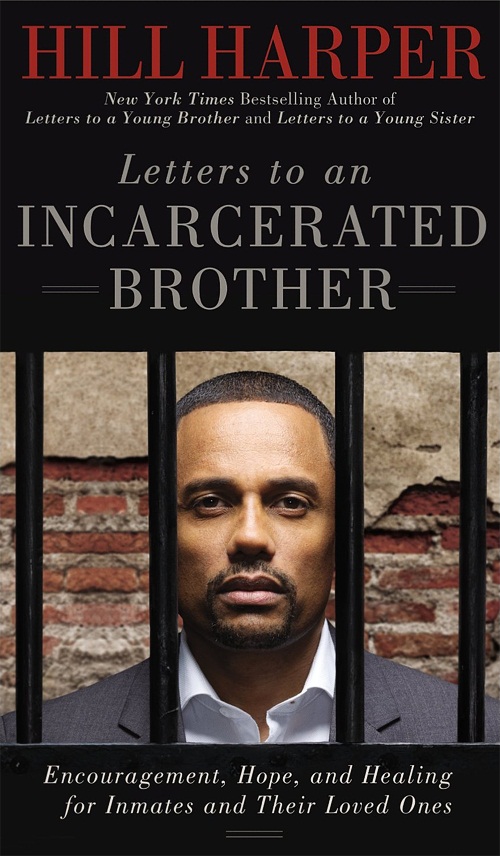

The following is an excerpt from Hill Harper’s new book, Letters to an Incarcerated Brother: Encouragement, Hope, and Healing for Inmates and Their Loved Ones:
This was a book I had to write. After the publication of my first book, Letters to a Young Brother, I began receiving an increasing number of moving letters from inmates who had read it. With each letter I thought more about our broken systems of incarceration and our collective lack of political will to change something that is deeply flawed. It seems political debate has become more and more preoccupied with power maintenance, with few real solutions ever contemplated,let alone offered. The great issues of poverty, race, civil rights, exploitedworkers, or access to quality public education seem abandoned.
Meanwhile, millions of young men and women graduate from the streets and matriculate to prison rather than to college. About 2.24 million people in this country are now being held in federal and state prisons or local jails—more than one-quarter of the world’s total of eight million prisoners. Another 4.8 million are under parole supervision or probation. In thirty years, our prison population has quintupled. We aren’t experiencing a mass incarceration crisis, this is a hyper incarceration crisis.
No mind, because we rarely see these people, do we? Wrong. We distract ourselves from thinking about it by discussing the high price of fighting crime, or we bitterly debate the efficacy of helping others by means of expensive social programs. We try not to think too much about “the immigrant problem.” When you can’t do anything about it, it’s better to lock away pain and poverty behind walls or push them to the outskirts of our boutique cities. Or like Chicago, tolerate young Black men killing one another at twice the rate of deaths of the war in Iraq. Or Washington, D C, where a mind-boggling three out of every four young Black men end up escalating through its penal system.
In “The Caging of America,” Adam Gopnik writes, “Mass incarceration on a scale almost unexampled in human history is a fundamental fact of our country today—perhaps the fundamental fact, as slavery was the fundamental fact of 1850. In truth, there are more black men in the grip of the criminal-justice system—in prison, on probation, or on parole—than were in slavery then.”
Apparently, all the proposed solutions for our social problems have become “business models.” Which would cost taxpayers less: government-funded incarceration like that of the past or the increasing privatization of the present? How can we lower the “debt margin” of having to feed these “unpleasant” people whom we’ve sent to prison? Perhaps they can make up for it by working at jobs below minimum wage. There’s an “elephant in the room” that is becoming more and more obtrusive—our system of incarceration. I, for one, am incapable of ignoring it.
So are others. In Michelle Alexander’s awe-inspiring study, The New Jim Crow, she provides a chilling thesis: When you’re locked up, you’re locked out of the American mainstream and trapped within America’s latest caste system. If this were equally a threat to all citizens, it would be terrifying enough (and something would have already been done about it). But that’s far from the case. The target populations of our prison system are highly skewed toward three groups of citizens: Black males, low-income people in urban environments, and immigrants. African-Americans are at the top of the list, with an astonishing prison rate that is seven times higher than the imprisonment rate for white, non-Hispanic Americans. In fact, at this point, this country has locked up a larger percentage of its Black population than South Africa did during the worst years of apartheid. How did it happen? Alexander makes the case that the burgeoning incarceration of Blacks and other minorities is actually a reemergence of old Jim Crow.
The Jim Crow laws were state and local laws in the United States enacted in the South about a year after the Civil War ended and endured until 1965. Their purpose was to establish de jure (law-based) segregation of the races in every public institution or facility of the former Confederacy. The establishment of the so-called separate-but-equal rule separated African-Americans from the white population starting in 1890, formalizing inferior economic, social, and educational conditions for Blacks. Northern segregation differed in that it was de facto (by common practice), perpetuated by housing, bank lending, and job discrimination. In the 1950s, school segregation was declared unconstitutional. The remaining Jim Crow laws were struck down by the Civil Rights Act of 1964 and the Voting Rights Act of 1965. Jim Crow, however, has endured in the form of the prison industrial complex.
The term prison industrial complex is an attempt to sum up the various strategies used by our system of incarceration to enslave and eliminate various populations in our country—and, as a side benefit, to create pools of cheap labor. As scholar and sixties activist Angela Davis bluntly put it: “Jails and prisons are designed to break human beings, to convert the population into specimens in a zoo—obedient to our keepers, but dangerous to each other.” Such virulent criticisms of the current prison system have revealed that dirty living conditions, unpalatable food, and unchecked violence in prison have a manipulative purpose. They are there to break the will of incarcerated men and women and to ensure that a large percentage (more than half) will return again as a source of labor, often within months of being released.
The profit-making strategies of incarceration go virtually unchecked when private companies such as the Corrections Corporation of America or the GEO Group run them. Companies such as these are controlled by few government regulations. About 16 percent of federal prisoners (33,830) and nearly 7 percent of state prisoners (94,365) are housed in private facilities, even though their existence has never been statistically justified. In 2001, a study by the Bureau of Justice Assistance concluded that the supposed savings involved in privatizing prisons had “simply not materialized.” When money was saved, it was done by reducing staff, strangling education programs, or cutting medical services.
Meanwhile, in less than thirty years, our prison population has mushroomed—six to ten times higher than the prison populations of any other industrialized nation in the entire world. At the same time, our crime rates have dropped below the international average. Yet as far back as 1973, the National Advisory Commission on Criminal Justice Standards and Goals clearly disproved the myth that decreasing crime rates have anything to do with increasing incarceration and announced that prisons unmistakably create crime rather than prevent it. In our cities, out-of-control incarceration has infected poorer neighborhoods like a plague. There are more than 1.7 million children in the United States with one parent—usually their father—locked up. Single-parent households put severe economic strain on the remaining parent, who must support her children financially and be their homemaker at the same time. They also make it more likely that children will drift into defiant, disobedient frames of mind. Many know that, statistically, they as well are slated for incarceration.
However, swollen prison populations are not just the result of drug arrests or longer sentencing. They’re also caused by the way such inmates are “rehabilitated.” Quite often, a prisoner is released with no resources and little planning and placed in a halfway house from which he is given a certain time period to find a job or be sent back to jail. Federal and state governments across the country have spent billions of dollars on halfway houses, despite statistics that prove they sometimes make it more likely that offenders will return. As dire as these problems are, there is hope and there are solutions. I, along with countless others, watched, filled with inspiration, as newly elected Pope Francis washed and kissed the feet of inmates, expressing to one prisoner, “Washing your feet means I am at your service. … And I do it with my heart.” Others serving and providing solutions include Catherine Rohr, an ex–venture capitalist who founded a nonprofit group called Defy Ventures with bankers and other financial managers. Using $800,000 in donations and $60,000 of Rohr’s own money, they created an internship program that helps ex-cons succeed as entrepreneurs, income earners, fathers, and even role models for their communities. Why is this so successful? In my opinion, it’s because Defy educates and brings together two disparate social groups. The covert segregation of the new Jim Crow alienates the incarcerated from society. Rohr and others like her are grafting them back in. Other old and new strategies are proving just as effective. Founded in 1972, the Safer Foundation of Illinois has offered job-finding services that have reduced recidivism rates to 13 percent for their participants in a state whose recidivism rate overall is 52 percent. Mayor Cory Booker of Newark, New Jersey, sees his Office of Reentry and job-placement programs for the recently incarcerated as a way of helping Newark’s economic renewal. In a state with a 50 percent recidivism rate, he’s managed to lower the rate of re-arrest after nine months to 29 percent. Such statistics have inspired me to get more involved with the problem of incarceration in this country, but I suppose my reason for writing this book also has a deeper emotional component. In part, my own identity as a Black man compelled me to create it for my brothers and sisters. Letters to an Incarcerated Brother is an attempt to reach out to those who make up our mostly concealed incarcerated population, to speak to as many as possible against the apathy of contemporary American ideas and attitudes about the subject. This book seeks systemic change by providing advice and inspiration in the face of debilitating challenges along with encouraging words for restoring a sense of self- worth. I want to demonstrate the transformative value of education and pathways to bring it to our prisons. I want to show how every one of us can create a detailed plan of reform and self-improvement and follow it to the letter. I want us all to blueprint the steps leading from whatever burdens we may be living with to a successful life as equal Americans. I want to offer books, manuals, and organizations that will agree to educate our prison population about the legal aspects of their incarceration and stand behind them with information as they face the parole board or teach them how to file a grievance with full knowledge of the consequences and risks. I want to offer examples of those who rose from the mire in which they were trapped but also reveal the manipulations of the prison industrial complex to produce and hold on to cheap laborers. I want all of us to feel the suffering of families torn apart and plunged deeper into poverty by the absence of a locked-up parent. I want us to understand how their child’s incarceration curtails the basic rights of mothers, forcing them to travel hundreds of miles and to pay thousands of dollars for expensive and required prepay collect-call services just to stay in contact with an incarcerated loved one. I want everyone to know that longer prison terms make it more likely that the next generation will end up suffering the same or a greater form of oppression. I want to reveal the housing, employment, counseling, training, recovery, and medical services available after parole and highlight methods to beat the odds and avoid returning. I want us to understand that, until the current prison system is reformed, we are all Incarcerated Brothers. Finally, this book isn’t just for the incarcerated. There are many people living in prisons not made of iron bars whom I hope this book will help free. Reprinted by arrangement with GOTHAM BOOKS, a member of Penguin Group (USA) LLC, A Penguin Random House Company. Copyright © UNCLE FRANK, INC., 2013.
PoliticsNation Recommended


