








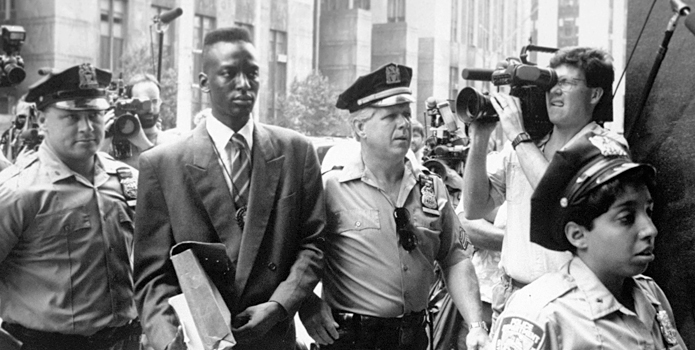
Raymond Santana emerged from an eight-year stint in prison as a man in pieces.
Part of him remained the scrawny 14-year-old he was when he went in, convicted of a particularly brutal rape that he didn’t commit.
The rest of him was something he barely recognized. His social skills and youth had been wasted in the lockstep of prison life: years of violence behind bars had frayed his nerves; some family and friends had long since abandoned him; he’d never attended a school dance, worked an afterschool job or filled out a college application.
“You try to live a normal life,” Santana, now 38, told msnbc.com last week. “But some of the things you’ve gone through never go away. But I had to stop caring about the labels people put on me. “
The labels stuck on him by so many—including Donald Trump, a ravenous New York City media, and millions of New Yorkers—included animal, monster, and rapist. Santana is one-fifth of The Central Park Five, a group of Harlem youths wrongly accused and convicted of the 1989 rape and beating of a white jogger in Central Park. The youngest of the group were 14, the oldest 16. The victim,Trisha Meili, was 28 and an investment banker at Salomon Brothers.
Their story came to exemplify so much of what was wrong with crack-era justice in New York City during the 1980s, with apparently uncrossable lines between races and classes, with shoddy police work and with politicians and a media quick to use racial stereotypes to stoke fear in a polarized public.
Thirteen years after the teens’ convictions and long after each had served lengthy prison sentences, their convictions were vacated after a serial rapist and murderer confessed to the crime. The exoneration offered little solace for many of the teens, who say they lost so much more than they can ever regain.
A new documentary, “The Central Park Five,” by award-winning documentarian Ken Burns and his daughter Sarah Burns, reveals just how botched—and relentless—the investigation against the five teens was, and how overwhelmingly most segments of New York turned against the young men.
But it also offers a chance for the boys, now men, to finally shed the past.
“For so long we didn’t have a voice,” Santana said. “But this documentary is giving us our voice back.”
WOLFPACK
The Central Park Jogger case became one of the most high-profile and racially charged cases in modern city history. Tabloid newspapers screamed “Nightmare in Central Park” and “Wolfpacks Prey”; many of the sensational headlines likened the minority youth to beasts.
Donald Trump took out full-page ads in four New York newspapers, including The New York Times, appealing for the reinstatement of the death penalty. ”I want to hate these muggers and murderers,” Mr. Trump wrote in the 600-word ad. ”They should be forced to suffer and, when they kill, they should be executed for their crimes.”
Mayor Ed Koch called them animals who had committed “the crime of the century.”
If ever there was a public lynching in Manhattan, these five—Santana, Kevin Richardson, Antron McCray, Yusef Salaam and Kharey Wise—were certainly strange fruit.
“The system put a mark on us,” said Salaam, a father of five daughters and a step-son. He now works in information tech. “You’re not the same as everyone else. And nobody ever asked who we were. As black and brown people, it’s as if we were born guilty.”
“Their exoneration came 10 years ago this month. And now an important new documentary is bringing new light to this ugly chapter in New York’s history,” the Rev. Al Sharpton said during a special segment on the case airing Thursday night on PoliticsNation at 6pm.
All but McCray, who after leaving prison moved out of state and changed his name, joined Sharpton for Thursday’s program. Sharpton was an early supporter of the group and helped to raise thousands of dollars in bail money for them.
“It was such an important story on so many levels. For the first part, nobody knows what happened to these guys. I mean, we still talk to people every day who say, oh yes, that wilding case. They don’t know that the convictions were vacated, they don’t know that they really did not do it, that it wasn’t just some kind of technicality,” Sarah Burns said on the show.
“But I think even more importantly, there are a lot of lessons we can learn from this case about false confessions and how they happen, what makes kids vulnerable to false confessions. And then also, I think it’s important to have a conversation about why it was so easy for people to believe that these kids had committed this horrible crime, even in the face of no evidence. And that has everything to do with the suspicions and assumptions that people made about young minority teenagers,” she said.
The case against them was thin and riddled with holes from the start. There was no physical evidence connecting them to the scene. The group offered contradictory accounts of what happened that cool October night. And none of the boys say they knew each other before they’d been hauled in by police and accused of gang-raping the victim.
But each eventually offered a convoluted confession implicating one another. The confessions, they’d later say, were coerced. There were no family or lawyers present and the boys, still in their early teens, say they had little understanding of the legal process or their rights.
In 2002, another man, Matias Reyes, a serial rapist and murderer who was serving a life sentence for unrelated crimes, confessed to the crime. DNA evidence recovered from the scene matched that of Reyes. His semen was recovered from the victim’s sock. Matias said he’d acted alone.
Their convictions were vacated but long after each had served their full sentences of five to 10 years. “It doesn’t leave us,” Richardson, 38, told msnbc.com. “We’ve been home over 10 years. But we lost our youth. We’re just trying to move on as men. Bu we can never get back what we lost.” Santana and Richardson are both employed with the New York City pension and benefits fund. In 2003, each of them filed a $50 million civil lawsuit against the city of New York. The city has yet to settle the matter, continues to defend the handling of the case by the police officers and prosecutors involved, and recently subpoenaed the Burnses for outtakes from the documentary. Critics say the media is as culpable in feeding the frenzy around the case as zealous police investigators and prosecutors. “A lot of people didn’t do their jobs. Reporters, police, prosecutors, defense lawyers—this was a proxy war being fought and these young men were the proxies for all kinds of other agendas,” Jim Dwyer, a columnist for The New York Times, who covered the case, said in the documentary. “And the truth and the reality and justice were not part of it.” Still, in New York City, and across the country for that matter, there remains a system ripe for wrongful convictions. The sheer volume of arrests has enabled a “prosecutor-driven pleading system” that can motivate people—guilty or innocent—to take deals rather than take their chances in court. Eric Deggans, a TV and media critic for the Tampa Bay Times newspaper and author of the new book Race-Baiter: How the Media Wields Dangerous Words to Divide a Nation, said the media’s handling of recent incidents like the Trayvon Martin and Jordan Davis cases may indicate the media’s increased mindfulness in high-profile cases involving race. “It’s hard to know how far we’ve come, because I can’t remember a recent case with similar circumstances,” Deggans said of the Central Park Jogger case. “It does seem that, in the Trayvon Martin case and the more recent case of an unarmed black teen shot dead in a car after arguing with a white man about turning down music, that the media is more sympathetic about publicizing cases where black males are killed under obviously unfair circumstances.” But, he added, in both of those cases, the person killed was unarmed and not breaking any laws when killed. “In situations where those involved are less obviously innocent, it’s hard to know if the outcome would be different,” he said. THEY TOOK IT ALL FROM US On a recent evening Santana and Richardson huddled together, talking about the bad old days, their lost youth and overcoming the damage and pain caused by the case and prison. Shortly they’d be joining most of the other guys for yet another interview about their lives since that day in ’89 when they were rounded up, and the fallout after. When asked if there’s been a measure of closure with the exoneration, the documentary and the shift in the public’s perception of the case, both men paused a long time, then answered. “That moment still hasn’t come,” Santana said. “We were just kids. People don’t realize really how young we were,” Richardson said. “We were just 14-years-old. They took it all from us.” But the release of the documentary has been “therapeutic,” Richardson said. Since the release of the documentary more people than they can count have come up, some with tears in their eyes, and said, “I’m sorry.” Or, “We didn’t know.” “It’s surprising just to see how emotional people are,” Santana said. “People come up to you crying or they want a hug. They apologize because they believed what the police and everyone was saying. But now, they’re finally hearing our voices.”
Trymaine Lee
Trymaine Lee is an NBC News correspondent. Recommended


