








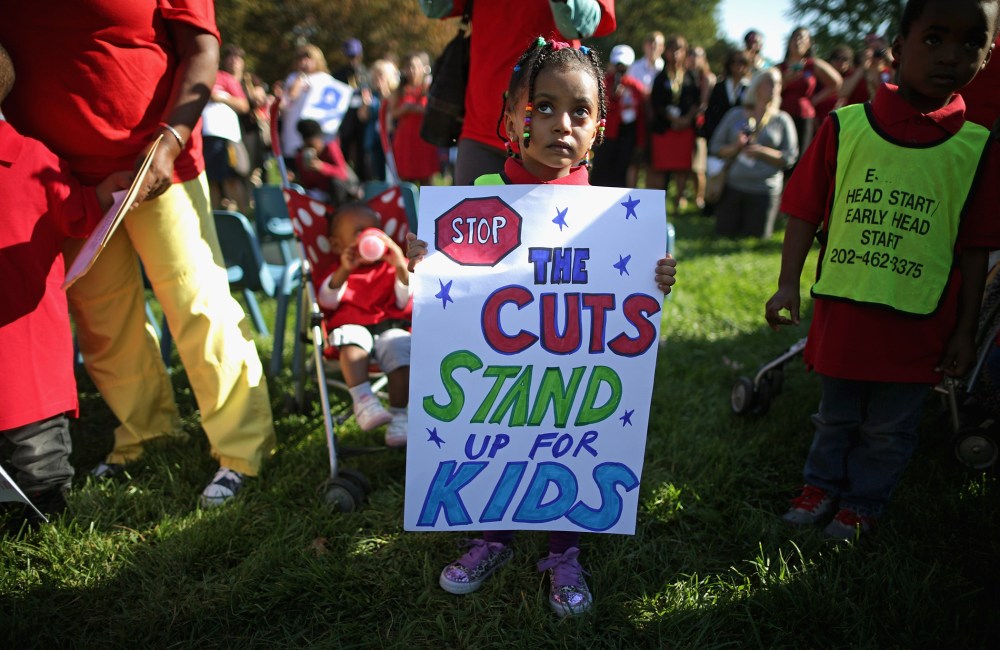
A vast majority of people polled in a new survey believe that affordable access to quality child care could help lift millions of Americans out of poverty.
Some 86% of Americans support it, including 77% of Republicans, according to a recent report from the Center for American Progress. The progressive think tank’s survey, which focuses on anti-poverty proposals targeting millenials, African-Americans, Latinos, and even Republicans, marks 50 years since President Lyndon Johnson’s declaration of a “war on poverty.”
More than four in five of those surveyed support programs the White House has advocated, including expanding nutrition assistance (85%), expanding publicly funding scholarships (84%) and making pre-kindergarten programs universally available (84%) — a program President Obama championed in his 2013 State of the Union address. About three quarters of all Republicans support those proposals too.
Another 80% of all those polled, and two thirds of Republicans, backed a minimum wage hike. Roughly 75% of all those surveyed throw their support behind ideas like helping struggling homeowners refinances mortgages, providing high quality health care coverage for all Americans, and creating subsidized jobs for low-income and long-term unemployed workers.
Although they have been short on details so far, some of the more conservative-friendly proposals won approval, too, including expanding tax credits for low-income families with children, which Republican Sen. Mike Lee has spoken in favor of. Expanding tax credits to families with low-wage jobs wins significant support too, something anti-tax Republicans might be willing to get behind.
More than two thirds of Americans and a majority of Republicans support unemployment benefits during an economic downturn, even though only a handful of Republicans were willing to vote in favor of such an extension Tuesday as the bill squeaked through the Senate.
Most Americans point to structural problems in the economy as the primary cause of poverty, rather than a lack of personal responsibility or laziness. Nearly two thirds of those polled agree that “most people who live in poverty are poor because their jobs don’t pay enough, they lack good health care and education, and things cost too much for them to save and get ahead.” Only one in four agree that “most people who live in poverty are poor because they make bad decisions or act irresponsibly in their own lives.”
That overall feeling tracks closely with how Obama framed the conversation Tuesday as he advocated for unemployment benefits to be extended.
“I’ve heard the argument that says extending unemployment insurance will somehow hurt the unemployed because it saps their motivation to get a new job,” he said, adding, “I can’t name a time where I met an American who would rather have an unemployment check than the pride of having a job.” “The long-term unemployed are not lazy. They’re not lacking in motivation. They’re coping with the aftermath of the worst economic crisis in generations. In some cases, they may have a skills mismatch, right? They may have been doing a certain job for 20 years. Suddenly they lose that job.” The survey reveals that despite some positive economic indicators, many Americans feel the impact of the “world economic crisis in generations” more strongly today than they did when Obama took office. In a similar 2008 survey, respondents estimated that about 30% of their fellow Americans were living below the federal poverty line, while today that estimate has jumped to 40%; economic reality is far better, with just 15% of Americans living below the poverty level. Obama has long championed these issues, which he’s expected to press in his own upcoming State of the Union address, but Republicans are beginning to test the waters, with Sen. Marco Rubio planning a poverty-focused speech this week, and Rep. Paul Ryan planning to address the poor in an interview with NBC’s Brian Williams.
Morgan Whitaker Recommended


