








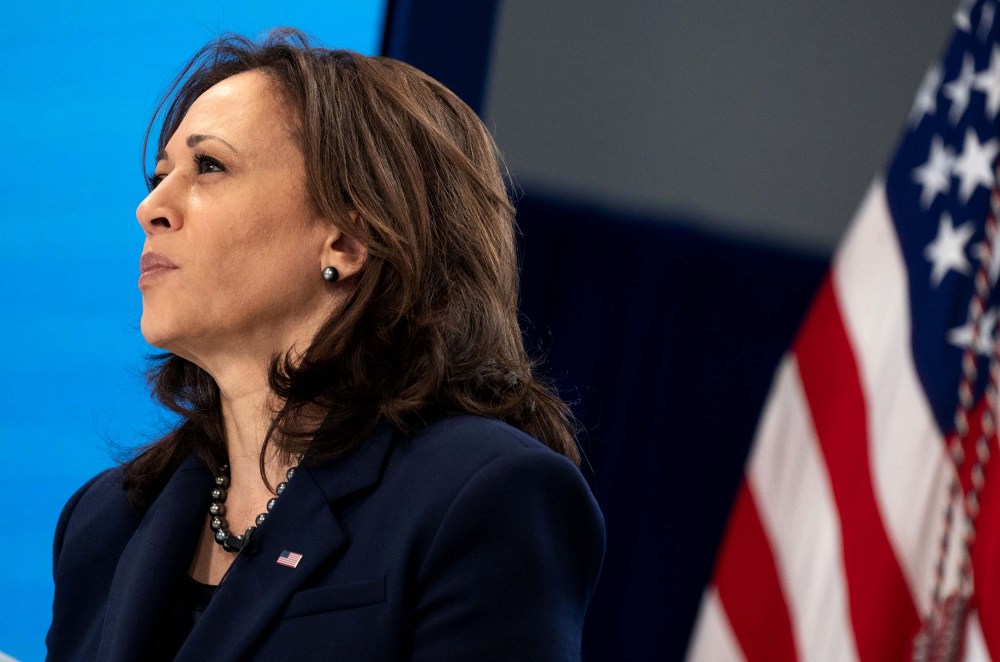
Vice President Kamala Harris is increasingly leaning on big corporations to come up with ideas and enact policy. It’s a practice that has allowed her to take action on issues such as migration into the U.S. and expediting business loans without relying on a constantly-gridlocked Congress, but it’s also a disquieting development — it means partnering with powerful and ruthlessly self-interested organizations that can sabotage broader policy goals and shape the Biden administration’s thinking to their liking.
According to a new report from Bloomberg News, Harris has “increasingly turned to corporate executives from Wall Street and Silicon Valley to serve as informal advisers, policy allies and political boosters,” and has sought out CEOs from companies such as Microsoft, Cisco and Citigroup for phone conversations and strategy meetings. Bloomberg also reports that corporate leaders have used these intimate settings “to push Harris on their own priorities, lobbying against changes to the tax code or for legislation that could prove a boon to their companies.”
Harris’ corporate-influenced migration policy investment plan is a prime example of why her friendliness with corporate behemoths should worry us.
Harris has a sprawling policy portfolio with priorities like voting rights that are difficult to make progress on without congressional involvement, and it’s evident that hobnobbing with the private sector has allowed her to achieve some tangible results. For example, she successfully lobbied Wall Street executives to provide more loans to small businesses, in part by helping streamline their coordination with federal government agencies in identifying lending risk.
But achieving results isn’t the only thing that matters. One must also pay attention to what kind of results are achieved and the process by which they’re conceived and implemented. And Harris’ corporate-influenced migration policy investment plan is a prime example of why her friendliness with corporate behemoths should worry us.
Let’s zoom in on the formation of Harris’ migration policy, per Bloomberg:
In a series of phone calls in the spring, Harris quizzed executives — including Microsoft’s Smith, Chobani Inc. CEO Hamdi Ulukaya, and Mastercard Inc. Chairman Ajay Banga — about what she could do to address poverty, climate change and corruption wreaking havoc on Guatemala, Honduras and El Salvador. The corporate executives told Harris what they saw as some of the core issues driving the migration surge. But they also talked about unorthodox ways the federal government had been able to influence foreign policy crises in the past, from the Cold War through the Arab Spring, through the funding of nongovernmental organizations like the National Endowment for Democracy. … The talks resulted in more than $1.2 billion in pledges to open new facilities, establish job training programs and expand Internet access across Central America. Already, more than 100,000 central Americans received technical and digital skills training from Microsoft, while Nespresso is for the first time sourcing coffee from farms in Honduras and El Salvador.
The idea is that these corporations, working alongside some charities, can use economic development as a way to discourage migration to the United States by improving the economic situation in Central America. I asked a couple of experts what they thought of the plan, and they raised a number of questions and concerns.
Michael Paarlberg, a political scientist at Virginia Commonwealth University who studies Central America, told me that the very premise of this policy might be misguided — that literature on migration suggests that higher incomes in the impoverished region could initially cause an uptick in migration to the U.S.; people who always wanted to journey to the U.S. but didn’t have the money to do things like pay coyotes to help them migrate could be empowered to do so with extra cash from better-paying jobs. He expressed concern that the administration could learn the wrong lesson by viewing improved economic outcomes in the region as a failure if they increased migration flows.
Paarlberg also noted that there are recent “bad precedents” in the region when it comes to agreements meant to attract foreign investment. Honduras’ economic development and employment zones, which were authorized by a law passed there in 2013, have created spaces that are exempt from taxes and local laws, including labor and environmental regulations, and their admission rules allow them to discriminate based on political beliefs, criminal background and socioeconomic status. They’re controversial in the country. That exact kind of arrangement won’t necessarily be repeated with Harris’ plan, but the concern is that U.S. corporations — whose sole goal is to maximize their profits — will extract major concessions from governments in return for their investment in an unstable region. Those concessions can undermine local sovereignty and legal protection from exploitation. And if they’re unpopular or fail to help the most vulnerable people in the region like deportees or people who have gone through the criminal justice system, they undermine the very premise of Harris’ policy.
Alejandro Velasco, a historian of Latin America at New York University, told me he was struck by the report that CEOs were mentioning the Cold War as a guiding light — it was an era during which the U.S. partnered with murderous dictatorships across Latin America which pursued free market fundamentalist policies, like in Chile. Given that big business favors stability for investment and is unconcerned with politics per se, Velasco wondered whether CEOs spitballing with Harris might find the idea of working under El Salvador’s authoritarian and Bitcoin-obsessed president particularly attractive — undermining the Biden administration’s purported commitments to democracy promotion. He also noted that there are questions of whether proprietary restrictions surrounding tech investment in the region will will hamper the spread of knowledge and usable technology for the local population. And there are also questions about who isn’t in the room when Harris is creating corporate brain trusts: “The Central American community in the U.S. is the most important player when it comes to economic development in Central America,” Paarlberg told me, pointing out that the diaspora, which sends a tremendous amount in remittances, has a better understanding of local conditions and needs than corporations that have no local constituency or connections. Unlike grassroots groups or civil society organizations, corporations are not thinking about how their actions shape human welfare or society’s trajectory. None of this it to suggest that a surge in foreign investment isn’t a bright prospect for an economically struggling region. But there is reason to ask questions about how it will be executed give the history of foreign involvement in the region, and reason to be skeptical given how reportage suggests that the plan was born of a corporate meeting of the minds who looked at Cold War influence as a precedent. Reflecting on all the potential pitfalls of Harris’ migration policy should raise bigger questions about what it means for the vice president to depend on and allow her thinking to be shaped by corporations. Unlike grassroots groups or civil society organizations, corporations are not thinking about how their actions shape human welfare or society’s trajectory — they’re structurally designed to care as little as possible about those matters. But what they will do is help create a world that’s more conducive to their own operation. There are long-term concerns as well here. Harris is a major 2024 contender should President Joe Biden decline to run for re-election. These kinds of practices signal a certain kind of worldview to corporate donors and party elites, and, if she runs, they could shape a policy platform that’s more corporate friendly through positions on issues like corporate taxes or regulation of Wall Street. The issue isn’t just being friendly with them now, but the costs of maintaining that friendship in the future.
Zeeshan Aleem is a writer for MS NOW. Sign up for his newsletter. 


