








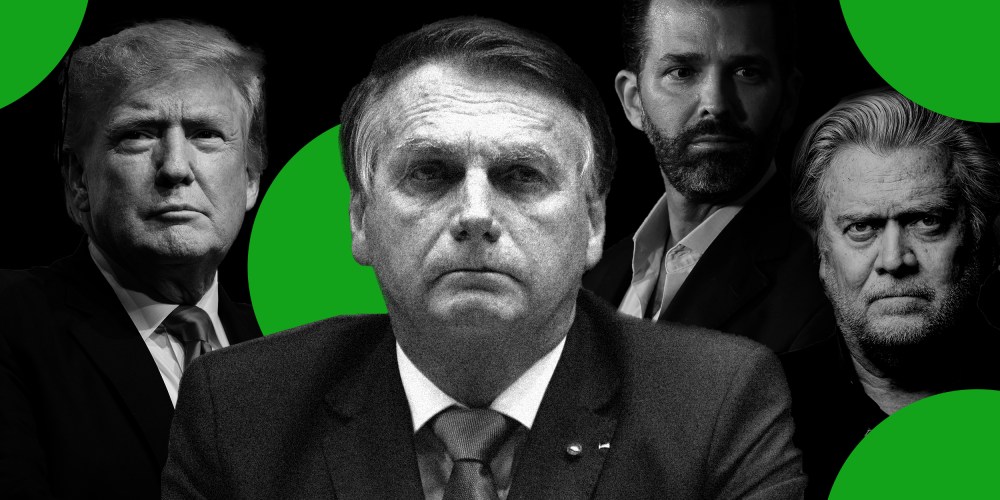
Trumpworld is making substantial inroads into Brazil’s political life — and helping pave the way for Brazilian President Jair Bolsonaro to carry out his own version of “Stop the Steal” in the run-up to his re-election bid next year.
Brazilian democracy is in a precarious state.
The increasing evidence of links between former president Donald Trump’s and Bolsonaro’s circles should be a source of concern for anyone trying to spot trends in right-wing populism — and the threat it poses to the stability of democracy — across the world.
A recent New York Times report has documented several lines of connection between Trump’s and Bolsonaro’s camps, all of which seem primed to encourage Bolsonaro to take aim at Brazil’s electoral process:
- At a Conservative Political Action Conference in Brazil this fall, Donald Trump Jr. told the audience that if they believed that the Chinese weren’t going to try to meddle in Brazil’s 2022 election, “you haven’t been watching.”
- Bolsonaro’s son, Eduardo, recently presented unsubstantiated conspiracy theories about the unreliability of Brazil’s voting system a conference in South Dakota hosted by Trump ally and MyPillow executive Mike Lindell.
- Steve Bannon, Trump’s former campaign manager and chief strategist, said at that South Dakota conference that “Bolsonaro will win,” unless the elections are “stolen by, guess what, the machines.”
- Bolsonaro supporters have been circulating trailers for Tucker Carlson’s conspiracy theory documentary series falsely claiming that Jan. 6 was an inside job by the deep state on WhatsApp.
- Bolsonaro is the only world leader posting on Gettr and Parler, far right-wing social media apps with ties to Trumpworld that market themselves as immune to Silicon Valley “censorship.”
I’d say this is a disconcerting development, for a few reasons.
Brazilian democracy is in a precarious state. The country has a long history of military coups, and had a period of military rule as recently as 1985. Bolsonaro is making explicit references to that history. He organized anti-democracy protests in September, and held a military parade in Brazil’s capital as a show of force in August. “Brazil’s military now runs much of Bolsonaro’s government; more active duty officers serve in this civilian government than during the height of Brazil’s military dictatorship,” Benjamin Glyn Fogel, a Ph.D. candidate at New York University who studies corruption in Brazilian politics, told me.
With Trump’s inner circle helping provide communications strategy, social media platforms, and endorsements, Bolsonaro is collecting ideas and energy from people at the forefront of the American right’s successful campaign to cast doubt on the U.S. electoral process. While it’s unclear if Trumpworld’s influence will move the dial in Brazilian political life, it could potentially provide Bolsonaro with a bit more clout; certain sectors of the Brazilian right worship Trump, Fogel told me. Brazil is another example of how the MAGA movement is continuing to build ties with right-wing populists internationally. While Trump was in office, he showed open affection and admiration for authoritarian leaders. Now right-wing populists in the U.S. and across the West are helping transform Hungary into an international hub for authoritarian activism and thinking. It’s increasingly clear that Brazil is another major focal point for right-wing populists, and can serve as a kind of testing ground for the MAGA movement. Should Bolsonaro succeed in doing serious damage to or subverting the electoral process next year, that would not only be a tragedy for Brazil. It could also serve as inspiration for right-wing populists across the globe — including in the U.S.
Zeeshan Aleem is a writer for MS NOW. Sign up for his newsletter. 


